
Article Summary
Lowering a rubber compound’s specific gravity can reduce part weight and increase the volume produced from a fixed batch mass. Formulators can adjust the polymer blend, filler type or loading, plasticizer level, or cellular structure. Each change can affect performance and processing, so estimate the effect, run a controlled trial, and test the cured compound before production.
What Specific Gravity Measures in a Rubber Compound
Specific gravity (SG) is the ratio of a material’s density to the density of water at a stated temperature, so SG has no units. At 1.000 SG, equal volumes of the material and water have the same mass. The SG of a rubber compound depends on its polymer, fillers, oils, curatives, and any voids; use the finished compound’s specification rather than assuming every solid rubber stock has the same range.
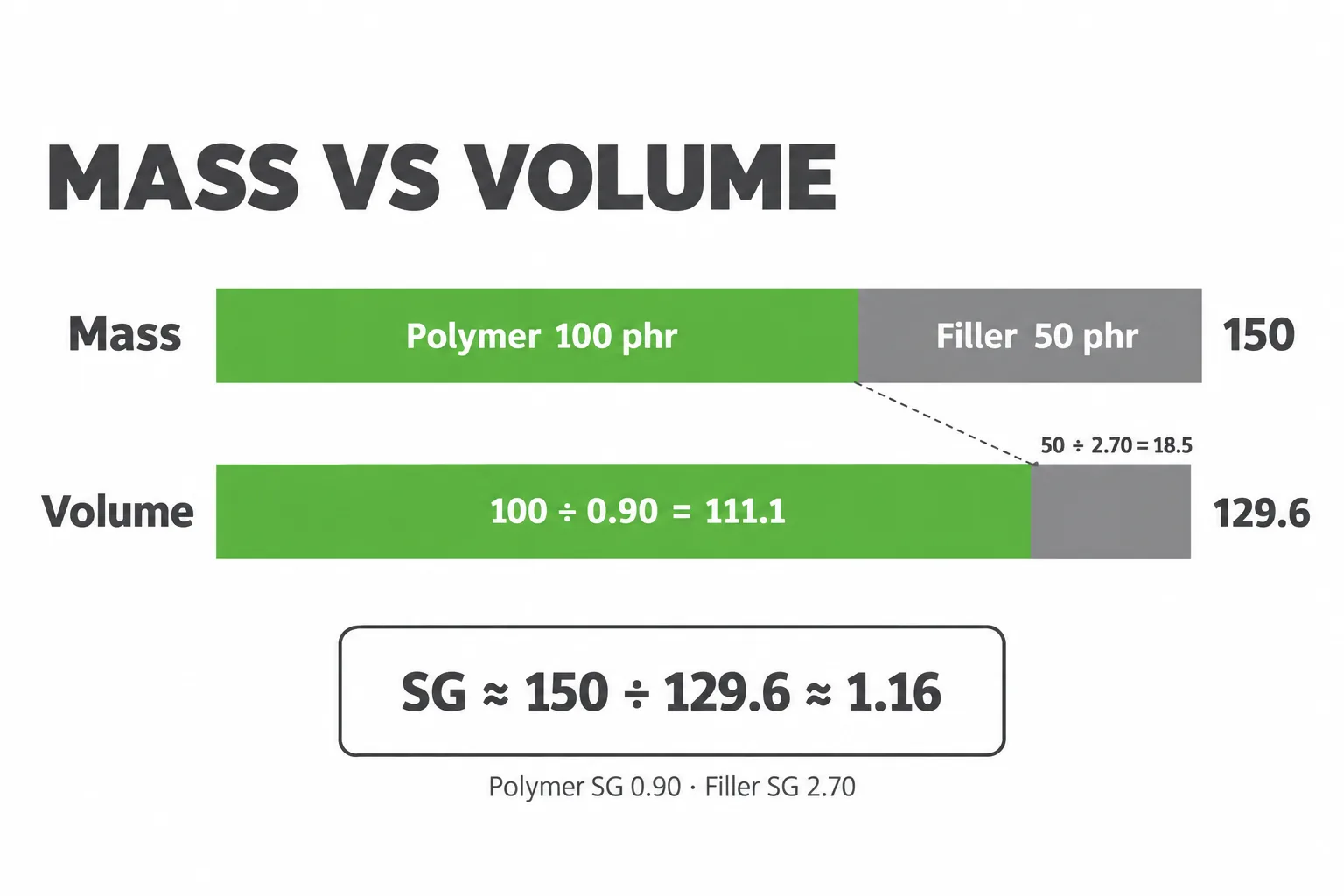
To estimate a blend from ingredient SG values, divide total ingredient mass by the estimated total ingredient volume: SG ≈ Σmᵢ ÷ Σ(mᵢ/SGᵢ). This first-pass calculation assumes ingredient volumes are additive; cure effects, interactions, and porosity can change the measured result. SG is dimensionless, while density is reported in units such as g/cm³ or lb/ft³. When converting, use water density at the same stated reference temperature.
For a simplified example, 100 phr of polymer at SG 0.90 plus 50 phr of filler at SG 2.70 gives an estimated blend SG of 150 ÷ (100/0.90 + 50/2.70), or about 1.16. This excludes oils, curatives, and other ingredients, so a real estimate must use the full recipe and still be verified by testing.
Reference SG Values: Raw Polymers and Compounded Rubber
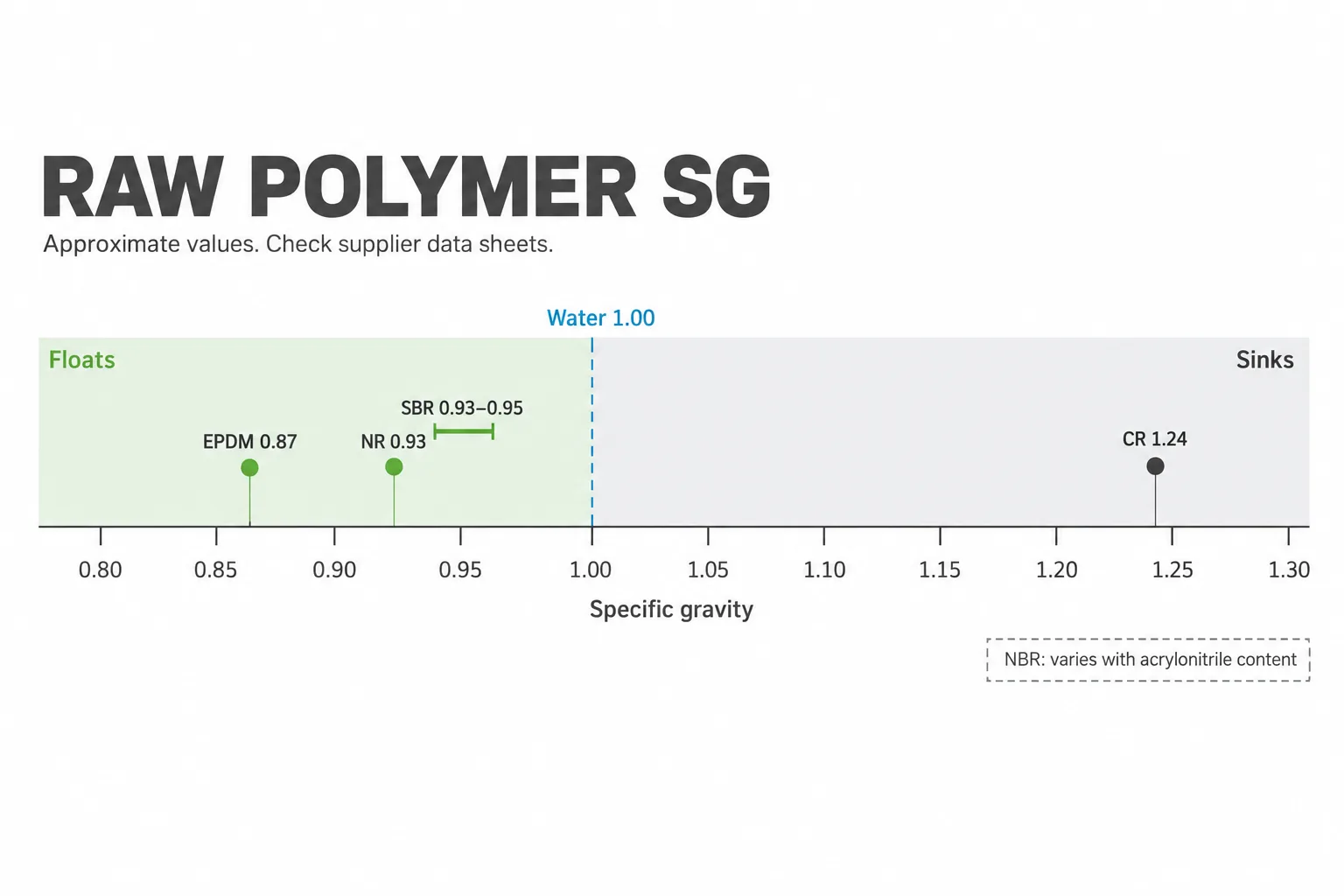
The figures below are approximate reference values, not compound targets. Polymer grade and supplier data can change the value; a filled compound’s SG depends on the complete recipe and loading. See this reference chart of typical rubber and ingredient SG values, then confirm each material against its current technical data sheet.
| Material | Approximate SG | How to use the value |
|---|---|---|
| EPDM polymer (raw) | About 0.87 | Grade-specific; check supplier data |
| Natural rubber (raw) | About 0.93 | Grade-specific; check supplier data |
| SBR polymer (raw) | About 0.93–0.95 | Grade-specific; check supplier data |
| Nitrile rubber (raw) | Varies by grade | Acrylonitrile content affects SG |
| Polychloroprene (raw) | About 1.24 | Grade-specific; check supplier data |
| Filled rubber compound | No universal range | Calculate from the full formula, then measure |
| Cellular rubber | Use apparent density for the finished part | Do not compare directly with a solid compound |
For a non-cellular blend, the estimated SG reflects all ingredients and their proportions. Required reinforcement and other performance limits set the practical target. Foaming creates a cellular structure and should be evaluated separately.
Four Levers That Lower Compound Specific Gravity
| Lever | Potential to lower SG | Possible property effect | Cost effect | Process checks |
|---|---|---|---|---|
| Polymer substitution | Depends on selected grades and blend | May change oil, ozone, heat, or adhesion performance | Depends on polymer price and loading | Recheck compatibility and approvals |
| Low-density filler swap | Depends on filler SG and loading | May change reinforcement, hardness, or cure | Formula- and yield-dependent | Check dispersion, cure, and physicals |
| Added oil or plasticizer | Often a modest adjustment; grade-dependent | May soften the stock or reduce strength | Grade- and formula-dependent | Check cure, bloom, and migration |
| Cellular structure | Can be substantial, but creates a cellular part | May affect strength and compression set | Depends on blowing system and yield | Control cell formation and cure balance |
Lever 1: Shift the Polymer Base
Where the application allows it, selecting a lower-SG polymer grade or changing the polymer blend can reduce the estimated compound SG. Recalculate using ingredient volumes rather than assuming a linear change by weight.
Service requirements may limit this option. Before changing the polymer, check oil resistance, ozone exposure, temperature range, adhesion, and the customer’s approved-material requirements.
Lever 2: Swap Heavy Fillers for Low-Density Fillers
A filler change may be practical in an existing formula, but the feasible loading depends on the recipe and required reinforcement. Compare each filler’s grade-specific SG and test the full compound.
| Filler | Approximate SG | Reinforcement contribution | Weight effect at equal loading |
|---|---|---|---|
| Hollow or expandable microspheres | Grade-specific; check supplier data | Limited or formulation-specific | May lower part weight if spheres survive processing |
| Austin Black 325 | About 1.30, per CFI industry information | Evaluate in the specific formula | Lower SG than conventional carbon black, per CFI |
| Carbon black | About 1.8 | Reinforcing | Reference point |
| Precipitated silica | About 2.0 | Reinforcing | Can raise SG relative to lower-SG ingredients |
| Kaolin clay | About 2.6 | Often used as an extender | Can raise SG relative to lower-SG ingredients |
| Calcium carbonate | About 2.7 | Often used as an extender | Can raise SG relative to lower-SG ingredients |
| Barytes | About 4.0–4.9 | Dense mineral extender | Can substantially raise SG |
CFI describes Austin Black 325 as a finely divided powder made from low-volatile bituminous coal. CFI lists its specific gravity at about 1.30, below the approximately 1.80 value it gives for conventional carbon black. CFI also reports application-specific benefits such as improved air retention and processability; those outcomes should not be promised for every formula. See CFI’s rubber-industry application information and verify product specifications in the current data sheet.
A practical trial may test partial substitution while retaining enough reinforcing filler to meet the part specification. The right loading is formula-specific. For a broader comparison of material families, see CFI’s guide to low-density fillers for rubber.
Lever 3: Raise Oil and Plasticizer Volume
Some process oils and plasticizers have a lower density than the finished compound and may reduce its SG when added. Check the selected grade’s data sheet; oil and plasticizer changes can also affect hardness, tensile and tear strength, cure, and migration.
Treat this as a small, controlled adjustment rather than a default solution. Confirm that the change fits the part’s performance and processing requirements.
Lever 4: Add Controlled Voids
Chemical blowing agents create a cellular structure and can reduce a part’s apparent density beyond what a solid-ingredient change can achieve. This route suits applications whose design permits cells, such as some sponge products, gaskets, seals, and insulation parts. Match gas generation to the cure profile and validate compression set, surface finish, and cell quality.
Expandable microspheres can overlap with the lightweight-filler category above: their effect depends on the grade and whether the spheres remain intact during mixing and processing.
Cost and Yield Effect of Lower Specific Gravity
Price per pound alone does not show material cost per part. When part volume is fixed, lower compound density can reduce the material mass per part; actual savings still depend on formula price, process yield, scrap, and whether the part meets specification. For CFI’s related cost-per-volume discussion, see its profitability page.
Illustrative comparison only. The table uses SG 1.25 as the 100-point baseline and assumes equal formula cost per pound and fixed part volume; it is not a customer result or savings guarantee.
Related readingHow Recycled Material for Rubber Is Shaping Sustainable ManufacturingRead the guide →| Compound SG | Relative volume per 100 lb | Indexed cost per part |
|---|---|---|
| 1.35 | 93 | 108 |
| 1.25 | 100 | 100 |
| 1.15 | 109 | 92 |
| 1.05 | 119 | 84 |
Under those assumptions, moving from 1.25 to 1.15 SG gives about 9% more part volume from the same batch mass. That does not guarantee 9% more saleable parts or lower total cost: compare formula cost, physical properties, process yield, and scrap in the trial.
How to Measure Rubber Density and Verify Specific Gravity
A hydrostatic weighing method compares a specimen’s mass in air with its apparent mass while immersed. For a nonporous specimen, SG is calculated from mass in air divided by the loss in apparent mass when submerged, with any required temperature or sinker correction applied. Remove surface contamination and bubbles, and follow the selected standard’s specimen-preparation instructions. ACE Laboratories summarizes rubber specific-gravity testing and its use in compound quality checks.
Name the test method and specimen condition in the part specification so the supplier and customer compare like with like. ASTM D297 includes density determination among its test methods for rubber products. ISO 2781:2018 specifies methods for measuring the density of solid vulcanized and thermoplastic rubber. ASTM D792 is scoped to plastics by displacement, so do not present it as the general rubber standard.
Track results against the approved compound specification. A change may indicate a weighing error, a different raw material, or a formula or process variation; investigate the batch record and confirm with the required physical tests before drawing a cause.
Trade-Offs to Clear Before a Lighter Compound Ships
| Property | Why it moves | Check before release |
|---|---|---|
| Tensile and tear | Reinforcing black removed or oil added | Full physicals against the control |
| Compression set | Voids and high oil hurt recovery | Set testing at service temperature |
| Abrasion resistance | Sensitive to filler type and loading | Required on wear parts |
| Hardness | Shifts with oil and filler volume | Durometer on cured slabs |
| Cure state | Filler surface chemistry alters scorch and cure rate | Rheometer curve comparison |
| Flow behavior | Filler structure changes extrusion and calender output | Trial on production equipment |
Density and reinforcement are separate properties.
A staged trial, control, partial substitution, and a higher-substitution level where technically appropriate, can show how SG and required physicals change together. Measure each batch and compare it with the control before approving a production formula.
Key Takeaways
| Question a compounder asks | Lever that answers it | Expected SG movement |
|---|---|---|
| Formula is locked; what can change? | Trial a partial filler substitution | Depends on formula and spec |
| New part, no approvals yet | Evaluate polymer grades and blends | Depends on grade and design |
| Small trim to hit a target | Review oil or plasticizer grade | Usually limited; verify by test |
| Weight target is aggressive | Evaluate a cellular design if suitable | Application- and process-dependent |
| How do I verify the change? | Use the specified test method | Follow the approved sampling plan |