
This article presents how specialty carbon additives deliver measurable advantages in manufacturing for sectors such as rubber, plastics, silicone, and coatings. It examines what qualifies a filler as “specialty”, the market dynamics driving demand (for example, the global specialty carbon black market was around USD 3 billion in 2024 and is projected to reach approximately USD 6.3 billion by 2034 at a CAGR of about 7.8 %).
It outlines key technical attributes, such as specific gravity, particle size, and emission profile, that separate high-quality powdered carbons from standard fillers. It shows industry-by-industry applications with data (for example, the polymer filler market was valued at about USD 60.32 billion in 2024 and is forecast to reach USD 98.64 billion by 2034).
Using the overview of CFI Carbon Products and its flagship product, Austin Black 325, the article illustrates how a specialist filler supplier embeds performance, sustainability, and reliability into its offering.
It then gives a structured evaluation framework to select the right specialty carbon additive, and closes with actionable next steps for formulation teams, procurement leads, and sustainability managers.
What defines a specialty carbon additive?
In manufacturing supply chains, fillers historically served as low-cost volume materials to bulk out compounds. A “specialty carbon additive” differs through engineered performance characteristics, not just price. These additives are end-designed materials with consistent quality, advanced dispersion behaviour, and targeted physical or functional properties.
| Attribute | Commodity filler (e.g., standard mineral filler, generic carbon black) | Specialty carbon additive (engineered powdered carbon) |
| Specific gravity/density | Higher-density fillers lead to heavier final parts | Lower specific gravity brings lighter components and material savings |
| Emissions/production footprint | Standard manufacturing processes, limited focus on emissions | Controlled manufacturing with a low-emissions footprint and sustainable logistics |
| Processability & dispersion quality | Basic processing compatibility | Optimised for improved mixing, lower cycle time, and consistent dispersion |
| Technical support & services | The supplier may only provide standard delivery | Supplier offers formula testing, lab sampling, toll-grinding, and custom packaging |
| Global logistics & supply reliability | May depend on multiple layers of subcontractors | Supplier maintains strategic raw-material sourcing and a global distribution network |
Thus, the key is to move from “fill” to “functional filler”. A specialty carbon additive should allow processors to lighten parts, reduce processing energy, improve end-product performance, and support sustainability goals.
Why manufacturers are shifting to specialty carbon additives
Manufacturers face multiple converging pressures that move filler decisions from cost-only to performance-led choices.
First, parts weight and material usage are constant focus areas, especially in automotive, industrial equipment, and large-volume plastics. A filler with lower density reduces part weight, which can lower downstream logistics, material cost, and, in some cases, provide regulatory advantages (for example, lighter parts often reduce fuel consumption in transport applications).
Second, process efficiency and throughput matter: when filler disperses easily and supports higher shear mixing or faster extrusion, cycle times drop and production costs fall.
Third, sustainability demands are increasingly non-negotiable. Firms must show that every material they source meets tougher CO₂ and emissions benchmarks. Selecting a filler produced under low-emission conditions brings real credibility in ESG reporting.
Fourth, supply chain security and consistency sit firmly in executives’ risk registers. When legacy fillers fluctuate in quality or supply, manufacturers suffer downtime or scrap. Specialty carbon additives from a supplier with strong logistics reduce that risk.
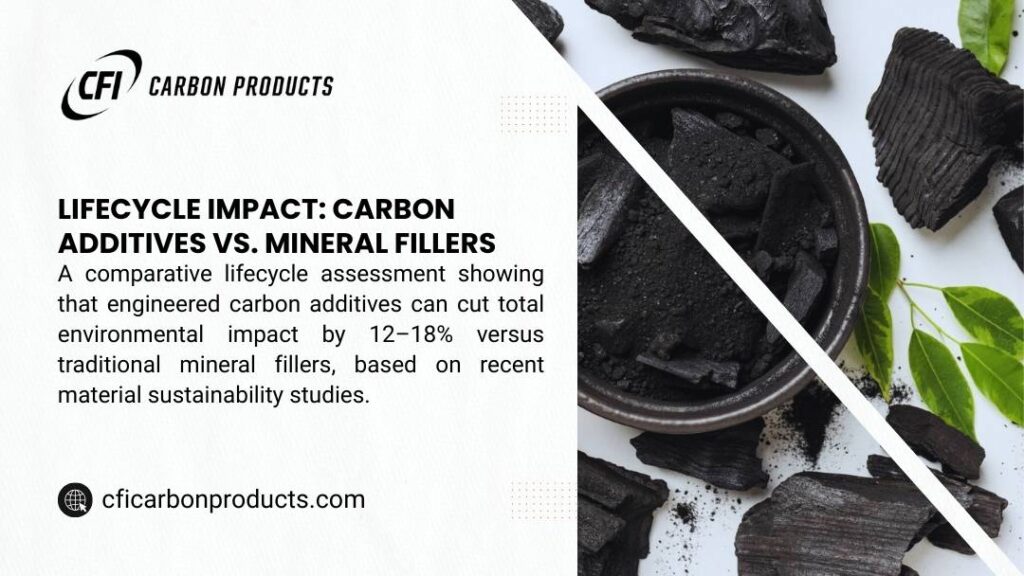
Finally, the shift from commodity to premium materials is clear: industries now expect added functionality, conductive pathways, UV resistance, reduced wear, and specialty carbon additives to meet those. For example, while the standard carbon black market is projected to grow at a modest 4.7% CAGR from 2025 to 2032 (from about USD 25.54 billion in 2025 to USD 35.21 billion in 2032), the specialty carbon black segment (USD ~3 billion in 2024 with a forecast to ~6.3 billion by 2034) grows much faster. Many manufacturers recognize this shift and replace traditional fillers with engineered alternatives to capture performance and sustainability benefits.
Technical attributes that matter
Selecting a specialty carbon additive is not simply a matter of asking “Is it cheaper?” but rather evaluating parameters that affect processing, performance, and part cost. Below is a breakdown of critical technical attributes, followed by how they influence outcomes.
| Parameter | Why it matters to manufacturers | Best-in-class indicator |
| Specific gravity/density | Directly affects part weight and material usage; lighter parts often cost less and perform better in many end uses | Lower density than standard fillers; allows part weight reduction of several percent |
| Particle size/distribution | Determines how easily the additive disperses in a host matrix, influencing mixing energy, cycle time, and homogeneity of properties | Fine powder with narrow size distribution, minimal agglomeration |
| Surface area/structure | Affects reinforcement capability, electrical/thermal pathways, and interaction with host polymer or coating matrix | Specifically tailored structure (for rubber vs plastics vs coatings) with optimized surface chemistry |
| Emission profile/production footprint | Resource and regulatory pressures mean filler manufacturing emissions become a decision criterion | Manufacturer discloses low CO₂ process, minimal secondary waste, transparent supply chain |
| Logistics & supply-chain control | Delays, inconsistent lots, or unverified sourcing add risk to production lines | Supplier situated near raw materials, global distribution network, and demonstrable supply reliability |
| Service/support offerings | Material alone is only part of the value; formulation assistance and packaging flexibility reduce time to market | Supplier offers lab sampling, toll-grinding, customised packaging, and regional technical support |
After reviewing these attributes, procurement and formulation teams should assess cost-not-just-price: calculate cost per part, cycle time improvements, scrap reduction, and potential sustainability benefits. The best specialty carbon additives will allow an integrated value proposition across cost, performance, and compliance.
Application-by-industry: How specialty carbon additives perform
Specialty carbon additives find applications across multiple manufacturing segments. The following tables show typical applications, key performance demands, and how a well-engineered powdered carbon meets those demands.
Rubber Industry
In rubber manufacturing, specialty carbon additives play a vital role in balancing durability, flexibility, and process efficiency. For products such as tires, belts, and hoses, abrasion resistance and tensile strength are critical to meeting OEM standards.
Conventional fillers often add weight and slow extrusion rates, but engineered powdered carbons like Austin Black 325 provide a low-density filler option that maintains reinforcement while improving processing speed. Our guide to low density filler options for rubber covers where that weight reduction comes from and how to load it without losing tensile strength.
In tire compounds, this results in up to 5–10% reduction in rolling resistance and measurable energy savings during mixing and curing.
Industrial rubber components, used in seals, gaskets, mounts, and vibration control systems, benefit similarly. Specialty carbon additives enhance dispersion uniformity, reducing micro-defects that lead to premature cracking or fatigue.
Manufacturers report that replacing traditional fillers with a specialty additive can extend product life by 15–20 % and lower maintenance costs through better ageing performance and dynamic stability.
Plastics Industry
In the plastics sector, the emphasis falls on lightweighting, recyclability, and aesthetics. Thin-wall injection-molded parts require precise flow and surface finish, and a finely divided carbon additive improves melt flow while keeping mechanical integrity intact.
Because of its lower specific gravity, a specialty filler allows manufacturers to achieve the same tensile performance with 8–12% less loading, which translates directly to material and cost savings.
For high-volume automotive plastics, such as dashboards, under-hood components, and trim panels, the benefits are even clearer. Lightweighting initiatives across automotive OEMs have placed pressure on suppliers to reduce polymer mass without compromising strength or appearance.
By integrating specialty carbon additives, compounders meet both mechanical and environmental targets; lighter parts contribute to improved fuel efficiency and reduced CO₂ emissions, aligning with the industry’s sustainability roadmaps that call for 30–40% emission reductions by 2030.
Silicone & Elastomers
Silicone rubber and other elastomers demand fillers that can maintain stability across temperature extremes and chemical environments. Specialty carbon additives developed with precise particle size distribution and controlled structure ensure predictable cure behaviour and consistent physical properties.
In applications such as electrical insulators, gaskets, and high-temperature seals, these additives help achieve stable mechanical integrity even after long-term exposure at 200 °C or higher.
Beyond insulation, engineered carbons are now formulated to provide controlled electrical resistivity or thermal conductivity in conductive and thermally managed elastomers. Studies from the Journal of Applied Polymer Science (2024) show that optimizing filler structure can tune resistivity across several orders of magnitude without degrading tensile or elongation properties. This has led to growing use in sensors, EMI-shielding materials, and automotive electronics.
Coatings & Surface Systems
In coatings, the filler does more than bulk the resin; it directly shapes rheology, adhesion, colour stability, and conductivity. Specialty carbon additives deliver uniform pigment dispersion, preventing flocculation and uneven toning often seen with commodity blacks.
In industrial protective coatings, they contribute to enhanced corrosion resistance by creating a dense, conductive barrier layer that mitigates electrochemical reaction at the substrate interface.
Architectural and sustainable coatings also rely on these additives. Because the filler is produced through low-emission processes, it helps manufacturers reduce the overall VOC footprint of their formulations.
The fine particle structure provides a smoother surface finish, higher durability, and better recyclability, all increasingly important metrics in green building certifications such as LEED and BREEAM. A 2023 report states that sustainability-driven coatings now account for over 40% of the market’s R&D investment, with carbon-based functional fillers cited as a key enabling technology.
Adhesives, Sealants, and Composite Materials
Specialty carbon additives also find growing application in adhesives and composite materials where strength-to-weight ratios are critical. In epoxy and polyurethane systems, they enhance modulus and bond strength while reducing density.
In construction composites, such as fibre-reinforced panels, adding a small percentage of low-density carbon filler can reduce overall composite weight by 5–7 %, improving ease of installation and cutting logistics costs.
As sustainability standards tighten, many formulators are replacing high-emission mineral fillers with engineered carbon additives to comply with EU REACH and U.S. EPA emission frameworks without sacrificing performance.
How this works in the real world: CFI Carbon Products’ offering
For over three decades, CFI Carbon Products has set the benchmark for precision-engineered carbon fillers in industrial manufacturing. Established in 1987, the company’s flagship product, Austin Black 325, is a finely milled organic filler derived from low-volatile bituminous coal.
Its naturally low specific gravity, uniform particle structure, and controlled emission profile make it a preferred choice for manufacturers seeking lighter, cleaner, and more efficient formulations.
Across rubber, plastics, silicone, and coatings applications, Austin Black 325 consistently delivers measurable value, reducing product weight, improving dispersion, and supporting lower-emission production.
CFI operates facilities in West Virginia and Virginia, strategically located near raw-material sources and logistics corridors, allowing fast, reliable supply to more than 30 countries through 11 distribution partners.
What truly distinguishes CFI is its technical partnership approach. Clients benefit from lab sampling, formula testing, toll-grinding, and customised packaging, ensuring seamless integration of the filler into their production lines.
A recent internal survey reported 94 % customer satisfaction, reflecting the company’s focus on consistency, responsiveness, and long-term reliability.
Manufacturers aiming to enhance process performance or reduce environmental impact can explore CFI’s full capabilities through its technical services for sampling and formulation support.
How to evaluate and select the right specialty carbon additive
Selecting a specialty carbon additive requires a structured decision process to avoid costly mis-specifications. The table below outlines key evaluation dimensions.
| Evaluation area | Critical questions to ask |
| Performance gap | Which property of your current formulation limits you (weight, process speed, durability, conductivity)? |
| Material comparison | How does the candidate additive compare to your current filler or alternatives in key specs like density, loading %, dispersion, and cost? |
| Cost-benefit | Even if the per-kg price is higher, does the total cost per part drop (through lower loading, faster cycle, weight reduction)? |
| Sustainability profile | What data supports the additive’s emissions, raw-material sourcing, and lifecycle impact? |
| Supply reliability & logistics | Is raw material access secure? Are delivery times acceptable? Is global distribution adequate for your footprint? |
| Technical support & service | Does the supplier offer lab sampling, formula testing, custom packaging, and scale-up assistance? |
| Application fit | Does the additive suit the specific host material (rubber, plastic, silicone, coating)? Are there proven case studies in similar segments? |
Data highlights & industry trends
The global market data paints a clear picture of why specialty carbon additives are gaining momentum across manufacturing sectors. Rapid industrial modernization, ESG mandates, and the push for lightweight materials have driven steady growth across all filler and additive categories. Independent research reports consistently show double-digit gains in specialty applications compared to generic fillers.
| Market Segment | 2024/2025 Value | 2030/2034 Projection | CAGR (%) |
| Performance Additives Market | USD 138.19 billion (2025) | USD 203.61 billion (2030) | 8.06 % |
| Specialty Carbon Black Market | USD 3 billion (2024) | USD 6.3 billion (2034) | 7.8 % |
| Polymer Filler Market | USD 60.32 billion (2024) | USD 98.64 billion (2034) | 5.04 % |
Together, these numbers highlight a compound annual growth trend of 5–8 % across the broader additive ecosystem. Manufacturers, compounders, and OEMs are increasingly replacing traditional fillers with engineered carbon materials that improve efficiency, reduce emissions, and deliver measurable performance gains.
Across automotive, construction, and electrical industries, sustainability policies, such as EU REACH compliance, EPA emission targets, and automotive CO₂ reduction mandates, continue to accelerate the use of low-emission, lightweight, and high-performance filler systems like those produced by CFI Carbon Products.
Common pitfalls manufacturers encounter and ways to steer clear
A common mistake arises when buyers select fillers purely on cost per kilogram without analysing cost per part, process impact, or lifecycle benefit. For example, swapping to a cheaper filler might increase mixing time or scrap rate, erasing any cost advantage.
Another frequent error is underestimating supply-chain risk; filler quality may vary between lots, or logistics disruption may stall production. Choosing a supplier with proven raw-material sourcing and global logistics infrastructure avoids such risk.
A third mistake lies in dismissing sustainability claims without verification. A filler listed as “low-emission” may lack transparency in production energy, raw material sourcing, and logistics. Failing this can undermine a product’s environmental credentials and expose the brand to audit risk.
Finally, failing to test in the actual application context is costly: fillers behave differently in rubber, plastics, or coatings. Not conducting a pilot with realistic processing and loading levels may result in a performance shortfall when scaled.
Avoid these missteps by structuring evaluation around performance, supply reliability, and demonstrated service support rather than simple material cost.
Ready to move ahead with smarter filler selection?
If your team is considering specialty carbon additives as part of a performance upgrade or sustainability initiative, the next step is to engage a trusted supplier offering not just materials but support. Evaluate your current filler base, define target improvements (weight, processing, emissions), run controlled trials, compare cost-per-part, and ensure end-to-end supply reliability. For deeper exploration of custom testing, formulation support, and packaging solutions, explore the Services section at CFI Carbon Products to learn how they assist manufacturers in adopting Austin Black 325 and other engineered filler solutions.
When your filler supports performance, sustainability, and supply chain integrity alike, you shift from cost-based selection to strategic material advantage.