
Manufacturing has always been about balance. Performance must meet cost. Cost must meet quality. And today, all of it must meet sustainability. Over the last decade, one material has quietly moved from “industry standard” to “industry question mark.” That material is carbon black. Carbon black alternatives now attract serious attention from manufacturers who once relied on traditional furnace black without a second thought.
Rising prices, environmental pressure, supply risks, and performance tradeoffs have changed the conversation. Those tradeoffs bite hardest in vehicles, where the automotive uses of carbon black span tire reinforcement, weatherable exterior parts, and conductive fuel system components. What used to work well enough no longer does. And that’s where carbon black alternatives enter the picture.
This article draws from real-world manufacturing experience, formulation work, and material evaluation across rubber, plastics, and coatings. It explains what carbon black alternatives are, why they matter now, how they compare technically, and how manufacturers can choose wisely. The goal is clarity, not marketing gloss.
What is Carbon black alternatives?
Carbon black alternatives refer to materials that replace or reduce traditional carbon black in industrial formulations while delivering similar or improved performance. These alternatives support reinforcement, pigmentation, UV stability, or processing efficiency without the drawbacks tied to fossil fuel–based carbon black.
For decades, carbon black served as the backbone of rubber reinforcement, plastic pigmentation, and coating durability. Yet carbon black alternatives now solve problems carbon black never could, including weight reduction, emissions control, dispersion stability, and cost predictability.
In practice, carbon black alternatives appear in rubber compounds, plastic masterbatches, elastomers, and industrial coatings. Some are organic carbon fillers, others are mineral-based, while newer options blend recycled carbon with engineered structures. Each class behaves differently, which is why material selection matters.
Why manufacturers began looking beyond carbon black
For years, manufacturers accepted carbon black’s drawbacks as the cost of doing business. That acceptance faded as markets evolved. One major concern is pricing volatility. Carbon black pricing often fluctuates with crude oil markets and regional energy costs.
Procurement teams struggle to forecast long-term expenses, particularly in high-volume applications such as tires, roofing membranes, and molded plastics. Another pressure comes from emissions reporting.
The U.S. Environmental Protection Agency regulates carbon black production due to emissions associated with its high-temperature manufacturing process, and regulatory oversight continues to expand, particularly across Europe and parts of Asia.
Carbon black alternatives respond directly to these pressures by lowering material intensity per unit, reducing emissions per ton, and offering more predictable supply chains.
Performance tradeoffs tied to traditional carbon black
Carbon black performs well in reinforcement and conductivity. No one disputes that. The problem lies in the side effects. High loading levels increase compound density. Higher density raises product weight. Weight increases shipping costs and energy use downstream. In rubber, excess carbon black raises heat buildup, which shortens fatigue life. In plastics, dispersion issues cause surface defects and brittleness.
Understanding the structure of carbon black helps explain these limits. Carbon black aggregates form complex networks that resist uniform dispersion. Carbon black alternatives often use controlled particle structures that disperse faster and more evenly.
What qualifies as a true carbon black alternative
Not every filler deserves the label. A true carbon black alternative must meet functional, economic, and processing criteria.
Functionally, it must reinforce, pigment, insulate, or stabilize the compound. Economically, it must deliver value per unit volume, not just per pound. From a processing standpoint, it must blend without extensive equipment changes.
In real production environments, materials that fail dispersion tests or disrupt cycle times don’t last long. That’s why alternatives succeed only when they align with actual plant conditions, not lab-only metrics.
Main Categories of Carbon Black Alternatives in Use Today
| Category | Core Strength | Typical Use Case |
| Organic carbon fillers | Low density and process efficiency | Rubber and plastics |
| Recycled carbon materials | Reduced footprint | Automotive and composites |
| Mineral fillers | Cost control | Construction materials |
| Hybrid fillers | Balanced performance | Specialty polymers |
Organic carbon fillers derived from controlled carbon sources have gained attention for their consistent structure and lower specific gravity. Hybrid systems combine carbon-based and mineral components to tailor properties more precisely.
Industrial Applications of Carbon Black Alternatives
Carbon Black Alternatives in Rubber Manufacturing
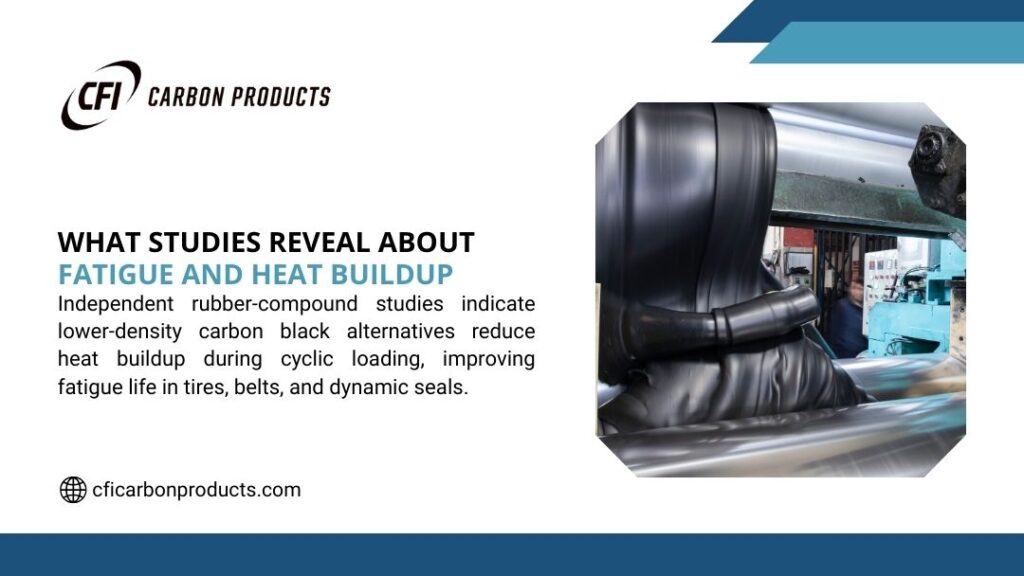
Rubber remains the largest consumer of carbon black, especially in tires, belts, and seals. Carbon black alternatives now play an increasing role in rubber reinforcement additives.
Lower-density fillers reduce compound weight without sacrificing tensile strength. For a closer look at the mechanics behind that, see our guide on choosing a low density filler for rubber and setting loading levels correctly. Heat buildup drops. Fatigue resistance improves. Processability improves, too, especially during extrusion and molding.
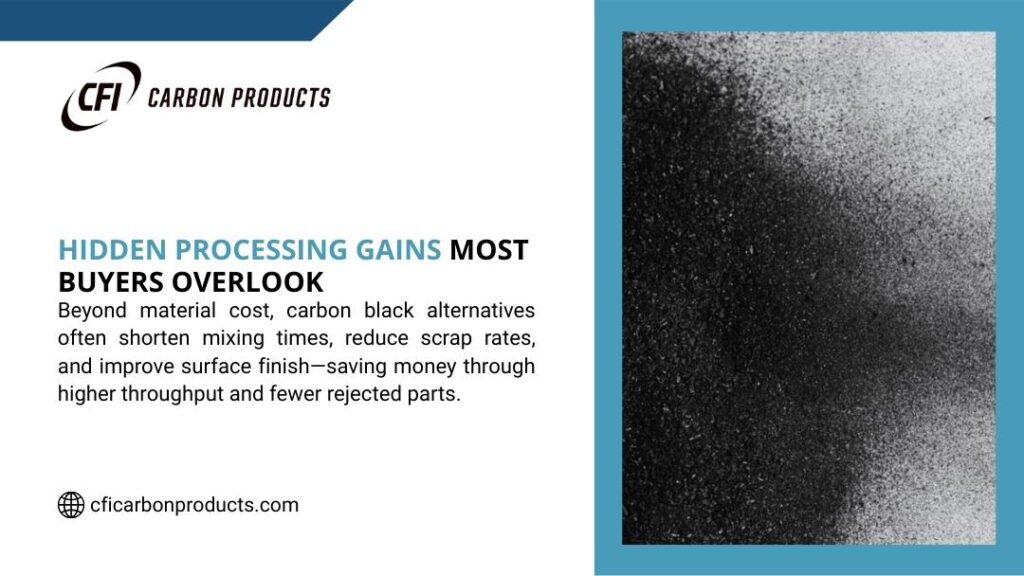
From firsthand trials, rubber processors often report faster mixing times and smoother surfaces when carbon black alternatives replace part of the formulation.
Carbon Black Alternatives in Plastics and Polymers
Plastics demand precision. Color consistency, dispersion, stiffness, and impact resistance all depend on filler choice. Carbon black alternatives allow polymer processors to fine-tune these properties.
Lower density matters more in plastics than many expect. Less filler weight per unit volume reduces resin demand. That improves cost control and lowers finished-part mass. Carbon black alternatives also reduce surface defects, which improves aesthetics in consumer-facing components.
Carbon Black Alternatives in Coatings and Surface Applications
Coatings depend on color depth, rheology, UV resistance, and flow control. Traditional carbon black delivers strong pigmentation but complicates viscosity control. Carbon black alternatives improve rheological behavior while maintaining opacity. They also reduce VOC pressure by supporting lower solvent use.
Many alternatives integrate well with modern coating additives, improving flow and finish while supporting sustainability goals. Lower emissions during production and application also help coatings manufacturers meet environmental targets.
In cabinet coatings and industrial paints, smoother finishes and fewer defects often justify the switch.
Density and Structure: Why They Matter
| Property | Carbon Black | Carbon Black Alternatives |
| Density | High | Lower |
| Particle structure | Aggregated | Controlled |
| Dispersion time | Longer | Shorter |
| Compound weight | Heavier | Lighter |
Density directly affects how much filler fits into a given volume. Lower density means fewer pounds per part, which compounds savings across production runs.
Electrical Behavior and Conductivity Considerations
Carbon black remains a preferred conductive filler. However, not all applications require conductivity. Many require insulation. Carbon black alternatives give manufacturers tighter control over resistivity instead of excessive carbon conductive behavior, which is essential in housings, coatings, and insulation layers that require stable and predictable electrical performance.
In non-conductive applications, alternatives often outperform by avoiding unintended electrical pathways.
Sustainability, Emissions, and Reporting Pressure
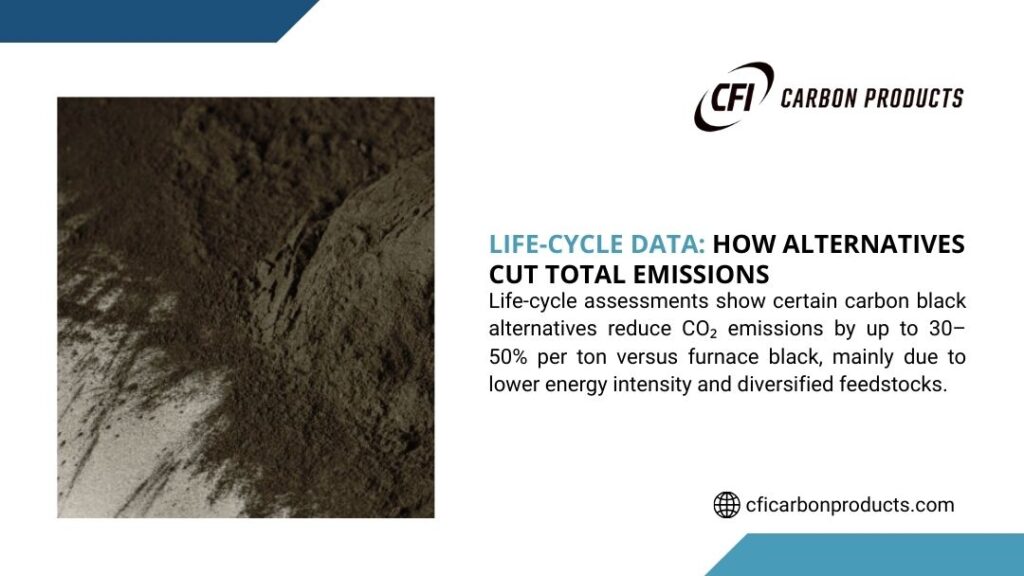
Environmental reporting increasingly shapes how manufacturers evaluate and select suppliers, especially in energy-intensive material chains. As sustainability metrics gain more weight, some producers explore alternatives to traditional carbon black to help lower emissions across the supply chain and improve material efficiency. In certain applications, these options can reduce overall material demand while supporting lighter-weight designs.
For manufacturers focused on sustainability targets, filler materials that perform well in life-cycle assessments are increasingly part of broader efforts to align production choices with long-term environmental goals.
Cost Control and Supply Chain Stability
Carbon black pricing fluctuates with oil markets and energy costs. Alternatives rely on broader feedstock sources, which stabilizes pricing.
In procurement meetings, predictable costs matter more than marginal performance gains. Carbon black alternatives win on that front.
How Manufacturers Evaluate Carbon Black Alternatives
Evaluation starts with lab testing, but success depends on production trials. Mixing behavior, surface finish, scrap rates, and cycle time all matter.
Many manufacturers work with suppliers that offer formulation testing and toll processing. Those services reduce risk during transition.
Firsthand experience shows that phased substitution often works best. Partial replacement delivers benefits without disruption.
Where the market continues to move
Carbon black alternatives no longer sit on the margins. They shape product design, sustainability reporting, and procurement strategies. Automotive suppliers, construction materials producers, and polymer processors increasingly specify alternatives by default. The shift reflects economics as much as ethics. Sustainable carbon solutions now define long-term competitiveness.
Why this shift matters now
The move toward carbon black alternatives isn’t about chasing trends, it’s about making steady, informed decisions that hold up over time. Manufacturers need materials that perform consistently, arrive on schedule, and won’t create headaches as environmental expectations continue to rise. Reliability still matters, and so does foresight.
CFI Carbon Products fits squarely into that mindset. With decades of manufacturing experience and carefully controlled processes, the company has developed proven alternatives such as Austin Black 325 that deliver dependable results without asking manufacturers to gamble on untested solutions. It’s a measured approach that balances performance today with sustainability goals tomorrow.
Exploring alternatives is no longer a leap, it’s a logical next step. For manufacturers looking to evolve without sacrificing stability or results, CFI Carbon Products offers a practical way forward that’s built on experience, not promises.