
Carbon black still rules many rubber and plastic formulas, but the pressure is real: cost swings, supply risk, and sustainability targets keep tightening. Tires, hoses, and seals set the toughest bar, so review how carbon black in automotive applications performs before judging any substitute. This guide breaks down carbon black filler alternatives that manufacturers actually use, compares performance and mechanical properties, and shows where the substitutes already work in the wild, without pretending every replacement is a perfect 1:1 swap.
What Are Carbon Black Filler Alternatives?
Carbon black filler alternatives are materials used to replace carbon black, partly or fully, when a formulation needs reinforcement, black color, UV screening, conductivity control, or simple cost reduction.
The tricky bit is that carbon black rarely performs just one job. In rubber, it often drives abrasion resistance and strength. In plastics and coatings, it may act more like a pigment plus a functional additive. So alternative doesn’t mean swap it ounce-for-ounce and walk away. It means picking a substitute that matches the job description your compound actually needs, then tuning the recipe so mechanical properties stay within spec to know more about carbon black filler alternatives.
The 12 Practical Options Manufacturers Use Today
1) Biochar (engineered biomass char)
Biochar shows up in real production when companies want lower fossil dependence and a credible sustainability story. It can darken compounds and contribute to reinforcement, but performance depends heavily on ash content, particle size, and how well it disperses.
In practice, biochar often works best as a partial replacement or as part of a hybrid filler strategy where carbon black still carries the heavy reinforcement load.
2) Recovered carbon black (rCB) from tire pyrolysis
rCB is one of the most direct carbon black filler alternatives because it targets similar functions, but quality varies by feedstock and process controls. When rCB quality is consistent, it can replace a meaningful fraction of virgin carbon black in rubber compounds, especially outside ultra-demanding tread applications. Manufacturers that succeed with rCB treat it like a graded raw material, not a generic recycled black powder.
3) Silica (often silane-coupled in rubber)
Silica isn’t carbon black, yet it’s a serious alternative in dynamic rubber systems, especially tires, where rolling resistance and energy loss matter. It can deliver excellent performance, but it usually demands coupling chemistry and disciplined mixing to avoid dispersion issues. That extra process discipline is exactly why silica substitution works brilliantly for some manufacturers and frustrates others.
4) Lignin (treated or compatibilized)
Lignin appeals because it’s bio-based and abundant. On its own, it may not behave like carbon black, but with surface treatment or compatibilization, it can support reinforcement and stiffness control. The biggest determinant is polymer compatibility; if the matrix and lignin don’t get along, you’ll see property drops or processing headaches.
5) Wood-waste bio-based black pigments
These substitutes target pigment function first. They’re often used in coatings, inks, textiles, and some plastics, where the priority is black coloration with a better environmental profile. Reinforcement may be limited compared with carbon black, but for pigment-driven applications, these materials can slot in with fewer mechanical penalties.
6) Calcium carbonate (GCC/PCC)
Calcium carbonate is a classic extender and cost reducer in plastics and coatings, and it can help tune stiffness and dimensional stability. It usually won’t replicate the reinforcement profile of carbon black in rubber, yet it can play a role in hybrid systems where carbon black gets reduced rather than eliminated.
7) Talc
Talc often enters the conversation for plastics, especially polypropylene and automotive parts, because it supports stiffness, thermal behavior, and dimensional control. As carbon black filler alternatives, talc grades typically solve structure and processing targets, while color and UV performance require separate solutions.
8) Kaolin clay
Kaolin has a long history in coatings and rubber goods for barrier behavior, rheology control, and cost management. It’s not a like-for-like reinforcement replacement, yet it works well when the formula aims to reduce carbon black while preserving workable viscosity and acceptable physical properties.
9) Wollastonite
Wollastonite is valued for its stiffness, thermal stability, and certain coating and plastic reinforcement. When manufacturers use it as one of the carbon black filler alternatives, it’s usually part of a broader performance package rather than a single-purpose replacement.
10) Short/chopped carbon fibers
Carbon fibers step in when structural reinforcement is the priority, and the product can justify the cost. They’re common in high-performance plastics and composites, where you need a big mechanical jump that carbon black cannot deliver at practical loadings.
11) Graphite and graphene-related materials
These materials are typically chosen for electrical and thermal behavior, especially where conductivity matters. They can contribute to reinforcement too, but the real appeal is controlled conductive networks at loadings that may be lower than traditional carbon black in specialty applications.
12) Carbon nanotubes (CNTs)
CNTs show up in premium formulations where conductivity and reinforcement must occur at very low loadings. They are not a budget replacement, and dispersion quality decides everything. When used correctly, CNTs can reduce the need for heavy carbon black loadings in conductive polymer systems.
Why Carbon Black Alternatives Suddenly Matter More Than They Used to
Carbon black has decades of proven performance behind it, so the market didn’t move away out of curiosity. The shift accelerated because three pressures now hit at the same time.
First, sustainability targets moved from branding to procurement criteria. Buyers increasingly ask for traceable sourcing, lower carbon footprints, and defensible environmental claims, especially in automotive supply chains and large consumer brands that publish emissions reporting.
Second, supply volatility and cost swings push manufacturers to qualify backup formulations. Even if you never plan to fully abandon carbon black, a validated alternative recipe protects production schedules when supply gets tight.
Third, product requirements evolved: lower rolling resistance, controlled conductivity, lighter parts, and cleaner VOC behavior can all favor certain carbon black filler alternatives in specific systems.
Rubber Applications: What Replacement Really Means
In rubber, carbon black does heavy lifting: it boosts abrasion resistance, influences tensile and tear behavior, and shapes hysteresis and heat build-up. That means replacement usually lands in one of three buckets.
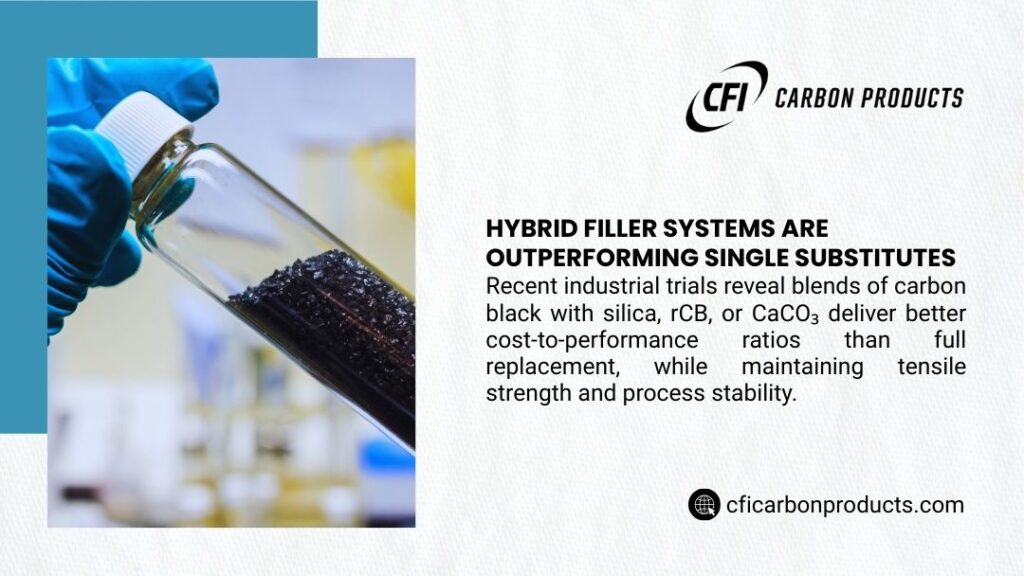
Sometimes it’s a partial cut where carbon black stays in the formula, but a portion gets replaced by rCB, silica, or another filler family to reduce footprint or cost. Sometimes it’s a functional split where carbon black remains the reinforcement backbone, while another additive takes over color, UV protection, or conductivity targets.
And in high-performance tire or dynamic rubber, replacement often becomes a redesign, mixing method changes, coupling agents enter, cure packages get tuned, and the whole compound gets rebalanced.
Sustainability, Cost, and Production Considerations
The sustainability case for carbon black filler alternatives depends on how the substitute gets produced, not what marketing labels it carries. Bio-derived fillers can reduce fossil reliance, yet their real footprint hinges on feedstock sourcing, transport distance, and process energy.
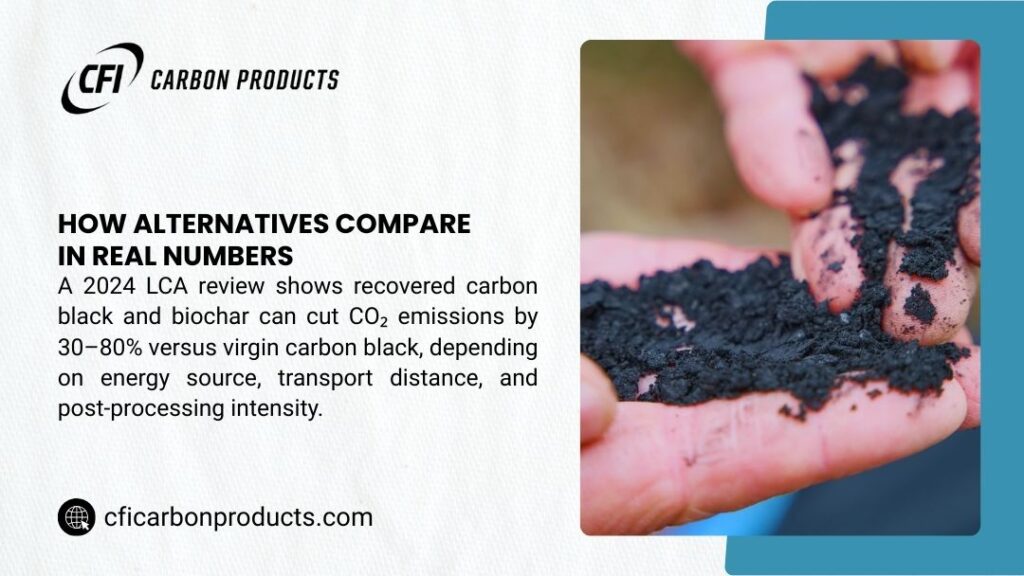
rCB can support circular manufacturing, but the carbon benefit varies by pyrolysis setup, upgrading intensity, and how consistently the output meets specs. In short, life-cycle comparisons require caution; the same category of alternative can land in very different environmental outcomes depending on execution.
Cost evaluation also tends to fool people at first glance. Raw filler price is only one line in the real equation. Mixing time, scrap rate, dusting control, dispersion stability, additional coupling agents, and any rework tied to mechanical property drift can erase the apparent savings.
That’s why manufacturers that adopt carbon black filler alternatives successfully treat qualification as a production exercise, not a lab-only test. If the compound runs slower, scorches more easily, or produces inconsistent hardness, finance will feel it immediately.
Production realities matter just as much as sustainability and price. Silica systems can demand tighter control of mixing temperature and coupling chemistry.
Biochar and lignin can require consistency in particle size distribution and ash content to prevent unpredictable viscosity swings. rCB performance often depends on feedstock uniformity and process control; one supplier’s rCB may behave nothing like another’s, even at the same loading.
If you want a grounding reference on the core functions carbon black provides, so you can measure whether an alternative truly replaces that role.
How to Choose the Right Substitute Without Wrecking Performance
The practical way to select carbon black filler alternatives is to start with the function you cannot lose. If abrasion resistance is non-negotiable, silica systems or hybrid reinforcement paths may make more sense than pure extenders.
If the primary requirement is black color and dispersion in coatings, bio-based pigments may solve the biggest problem while keeping the mechanical impact minimal. If cost control matters most for a plastic part, calcium carbonate or talc may deliver stable performance with predictable processing.
When a manufacturer wants a carbon-family replacement with strong processability and a sustainability narrative, Austin Black 325 is positioned as a carbon black alternative across multiple industries.
Where This Leaves Manufacturers in 2026
In 2026, carbon black filler alternatives are no longer a niche experiment; they’re part of risk management and product positioning. The manufacturers that win with alternatives don’t chase a trendy ingredient and hope for the best.
They define the target mechanical properties, choose substitutes that match the required function, validate processing behavior under plant conditions, and lock down supplier consistency. That approach protects quality, supports sustainability reporting, and keeps production stable when raw material markets turn chaotic.
If carbon black alternatives are part of your 2026 strategy, the difference comes down to execution. CFI Carbon Products works with manufacturers who want proven materials, predictable supply, and results that hold up in real production, not just on paper.