
Article Summary
A low density filler for rubber is a compounding ingredient with a low specific gravity, which lets a formulator add volume, adjust hardness, and trim material cost while keeping finished parts lighter. This article defines the category, separates reinforcing from non-reinforcing roles, and lays out the main filler families in scannable tables. It explains why specific gravity drives both cost-per-part and part weight, covers filler choices for silicone and urethane rubber, and closes with a decision framework and a look at the sustainability payoff. Throughout, low density fillers are treated as functional additives that shape processing and performance, not just cheap volume.
What a Low Density Filler for Rubber Actually Is
A low density filler for rubber is any particulate additive with a low specific gravity that a compounder blends into an elastomer to occupy volume, modify properties, and lower cost. Specific gravity, the weight of a material relative to water, is the deciding property here. A filler at 1.8 specific gravity packs almost twice the mass into the same volume as one near 1.0, so the lighter material stretches further in a mix and produces a lighter cured part.
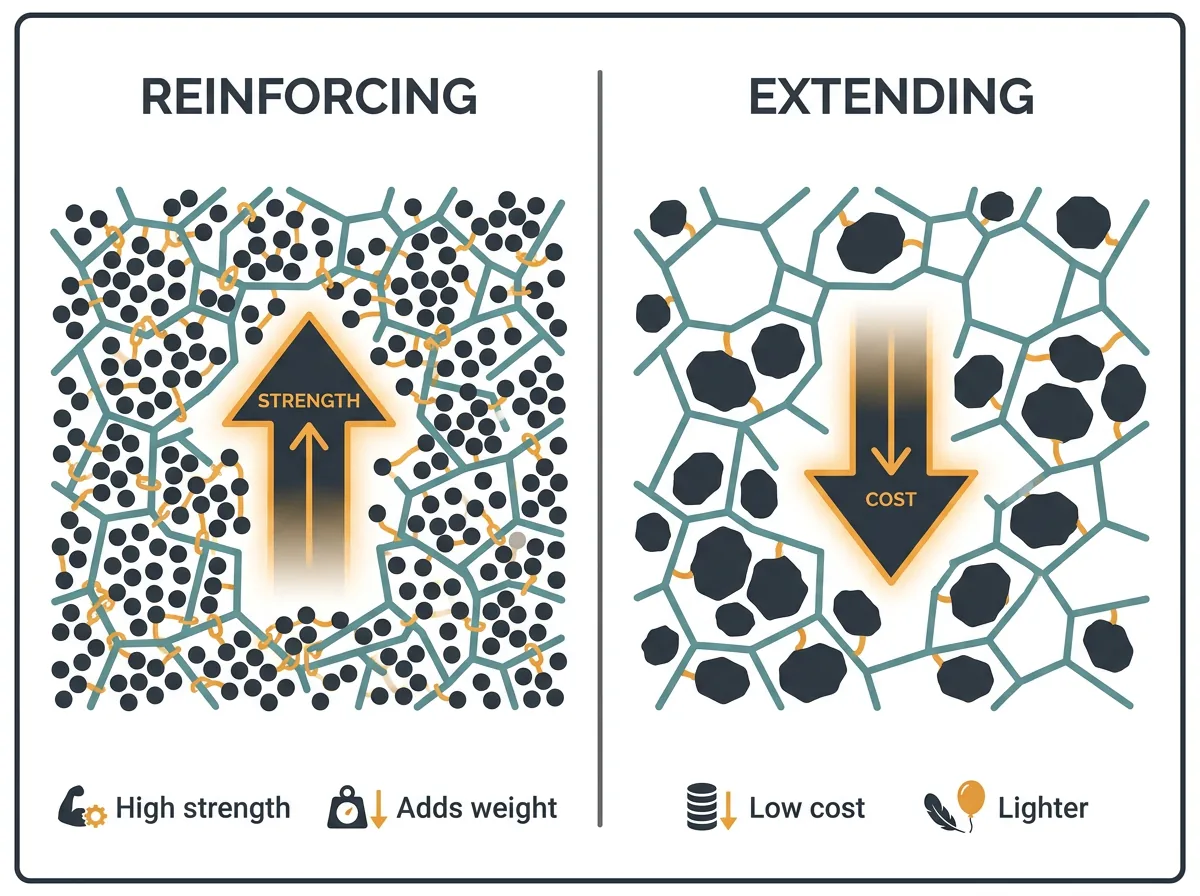
Fillers split into two working roles. Reinforcing fillers bond with the polymer network and raise tensile strength, modulus, and abrasion resistance. Non-reinforcing or extending fillers mostly add bulk and cut cost with a smaller effect on mechanical strength. A comprehensive overview of conventional and bio-based fillers for rubber groups these materials by particle structure and surface activity, the traits that decide whether a filler reinforces or simply dilutes.
The distinction matters because the classic reinforcing choice, carbon black, is also fairly dense. For a formulator chasing lower weight, the goal is to hold enough reinforcement while dropping specific gravity. Suppliers of reinforcement fillers for elastomers usually describe a spectrum from strong reinforcement to pure extension, and a low density strategy lives on that spectrum rather than at one end.
The density of rubber compound depends on the type of rubber and the type and amount of filler used in the compound.
Reinforcing vs. Non-Reinforcing Fillers
This table answers a common formulator question: what are non-reinforcing fillers for rubber, and how do they differ from the reinforcing grades of carbon black used in rubber compounds?
| Trait | Reinforcing filler | Non-reinforcing / extending filler |
|---|---|---|
| Main job | Raise tensile, modulus, abrasion resistance | Add volume, cut cost, adjust hardness |
| Particle size | Fine, high surface area | Coarser, lower surface area |
| Polymer bonding | Strong surface activity | Weak surface activity |
| Typical examples | Reinforcing carbon black, precipitated silica | Calcium carbonate, clay, talc, some organic fillers |
| Effect on cost | Higher unit cost, performance payback | Lower cost per volume |
Why Specific Gravity Drives Cost and Part Weight
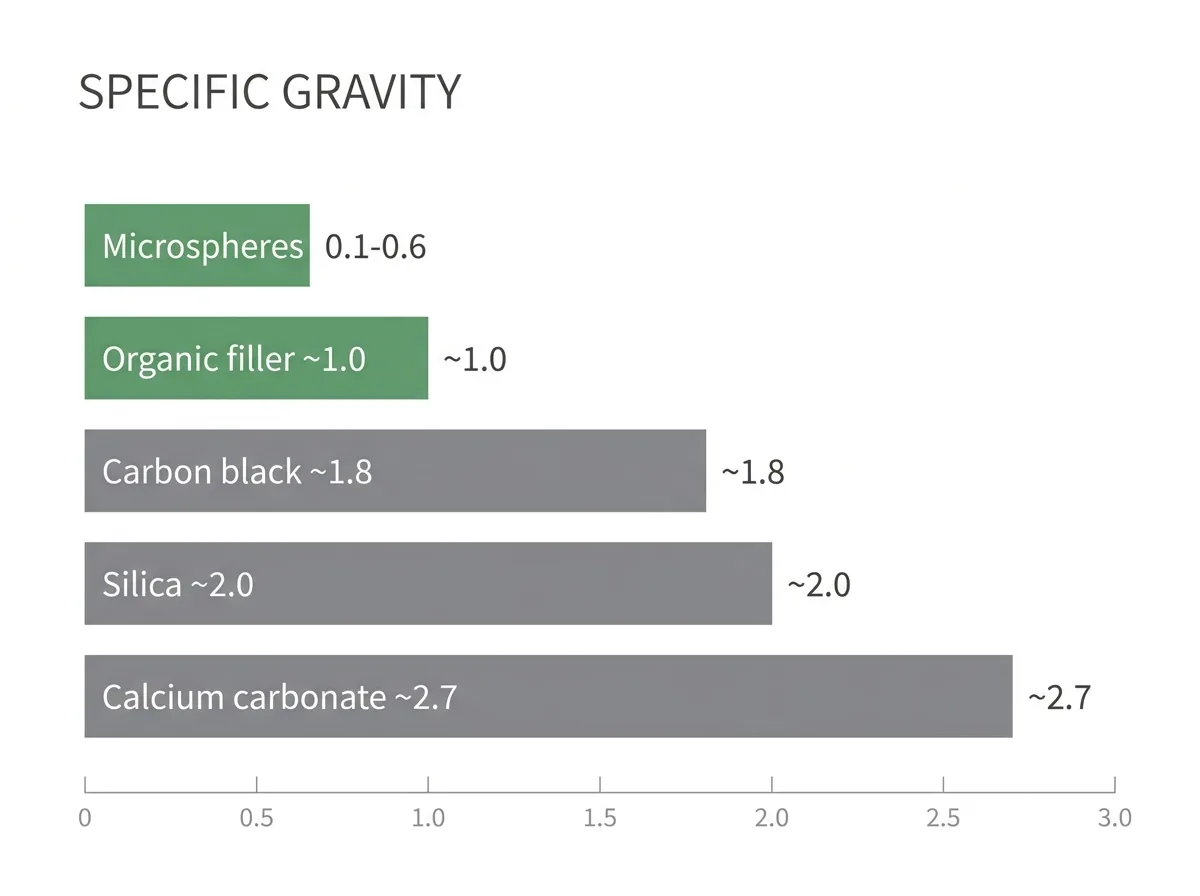
Specific gravity is where cost and weight meet. Rubber is often sold and priced by weight, but parts are built by volume. A lighter filler fills more of that volume per kilogram bought, so cost-per-part drops even when the price-per-kilogram looks similar. Automotive lightweighting follows the same logic: a lighter seal, mount, or hose lowers vehicle mass and supports fuel economy targets.
The table below shows accepted ballpark specific gravity values for common fillers. These are widely reported ranges, not exact grade specs.
| Filler | Approx. specific gravity | Reinforcement | Weight effect |
|---|---|---|---|
| Reinforcing carbon black | ~1.8 | High | Adds weight |
| Precipitated silica | ~2.0 | High | Adds weight |
| Calcium carbonate | ~2.7 | Low | Adds notable weight |
| Glass/polymer microspheres | ~0.1–0.6 | Low | Sharply lowers weight |
| Low-volatile organic filler | Low | Moderate/semi | Lowers weight |
Carbon black sits fairly high on this scale, one reason weight-driven projects look for alternatives or blends. A closer look at carbon black density shows why swapping part of the loading for a lighter material changes the finished mass. Cost matters too, so a review of carbon black pricing helps a buyer weigh reinforcement against the savings a low density filler can deliver.
The Main Families of Low Density Rubber Fillers
Low density fillers fall into three broad families. Each trades reinforcement, weight, and cost differently, so the right pick depends on the property a formulator most needs to protect. The master table gives a fast comparison, and the sections below add detail.
| Family | Density | Reinforcing behavior | Typical use | Main trade-off |
|---|---|---|---|---|
| Mineral extenders | Moderate to high | Low | Cost reduction, hardness | Adds weight despite low cost |
| Microspheres / microballoons | Very low | Low | Fairing, weight cut, syntactic foams | Fragile, limited strength |
| Lightweight organic / bio-based | Low | Semi to moderate | Weight cut with some reinforcement | Grade and source consistency |
Non-Black Mineral Extenders
Calcium carbonate, kaolin clay, and talc are the workhorses of low-cost extension. Calcium carbonate is the most widely used because it is abundant, inexpensive, and predictable. These minerals lower material cost and adjust hardness, but their specific gravity is not low, so they help the wallet more than the scale.
Microspheres and Microballoons
Hollow glass and polymer microspheres are the lightest fillers in common use, which answers a frequent search: what is the lightest filler? Their hollow structure gives specific gravity as low as ~0.1, so they cut weight dramatically. This is also the family behind West System 407 low density filler, a blended microballoon-based fairing filler for epoxy. Note that 407 is an epoxy fairing and shaping compound, not a reinforcing filler for cured rubber, so a formulator should not treat it as a drop-in rubber additive. Microspheres shine when the priority is mass reduction or a syntactic foam, and they underperform when strength is the goal.
Lightweight Organic and Bio-Based Fillers
The third family covers organic and bio-based materials such as vermiculite, rice husk and other lignocellulosic ash, and low-volatile bituminous organic fillers. Research on natural rubber and waste-derived nano-filler composites shows that particle scale strongly shapes how much reinforcement these renewable fillers can provide. This family is where low specific gravity and lower embodied carbon can meet, which is why formulators exploring eco-friendly rubber alternatives and broader sustainable rubber fillers tend to start here. CFI’s Austin Black 325, a finely divided powder from low-volatile bituminous coal, sits in this organic category with a low specific gravity that reduces end-product weight.
Low Density Fillers in Silicone and Urethane Rubber
Low density strategy is not limited to conventional rubber. Silicone and urethane systems have their own filler norms, and formulators often ask which materials suit each.
What fillers are used in silicone rubber? The primary reinforcing filler is silica, either fumed or precipitated, because its high surface area builds strength in an otherwise weak gum. Lightweight extenders then tune cost and density. Work on an aluminum lignin, silica, and fatty-acid hybrid filler shows how surface-modified and hybrid silica-based systems can balance reinforcement with other properties, the same balancing act silicone compounders manage. CFI’s work across the silicone industry reflects this mix of reinforcement and weight control.
Urethane casting follows a different logic. Mold makers and prop casters often reach for cheap, inert, light fillers such as vermiculite or microballoons, especially in brush-on molds where a lighter, bulkier mix is easier to build up. The table below compares the two systems.
| System | Primary filler | Common low density additions | Watch-outs |
|---|---|---|---|
| Silicone rubber | Fumed / precipitated silica | Lightweight mineral extenders | Cure interference, viscosity rise |
| Urethane / resin casting | Mineral or reinforcing filler | Vermiculite, microballoons | Moisture sensitivity, mix ratio drift |
How Particle Size, Shape, and Surface Activity Change Performance
The science of rubber fillers rests on four interdependent traits: particle size, shape, surface area, and surface activity. Smaller particles with more surface area and active surfaces reinforce more strongly, while coarser, less active particles mostly extend. A low density choice usually trades some reinforcement for weight and cost, so the skill is keeping that trade in balance. Understanding what carbon black actually does in a compound makes the comparison clearer, since carbon black is the reference point for strong reinforcement.
Seen this way, low density fillers are functional additives, not just bulk.
Alongside the other additives in a recipe, they shape dispersion, mixing behavior, and hardness. The next table maps each property to its effect.
| Filler property | Effect on the compound |
|---|---|
| Smaller particle size | Higher tensile and modulus, better abrasion resistance |
| Larger particle size | Easier processing, lower reinforcement, added volume |
| High surface area | Stronger polymer-filler bonding |
| Low surface activity | More extension, less reinforcement |
| Low specific gravity | Lighter parts, more volume per kilogram |
In rubber compounding, fillers are more than reinforcements—they directly impact curing time, scorch safety, and crosslink density. CaCO3- …
How to Select the Right Low Density Filler
The framework below matches a priority to a filler direction and flags the main risk, so a formulator can move from goal to shortlist quickly.
| If your priority is | Consider | Watch out for |
|---|---|---|
| Lowest possible weight | Glass/polymer microspheres | Fragile, minimal reinforcement |
| Weight cut with some strength | Low-volatile organic filler | Confirm grade consistency |
| Lowest cost per volume | Calcium carbonate, clay | Adds weight, limited reinforcement |
| Sustainability plus weight | Bio-based / organic fillers | Verify supply and purity |
| Silicone reinforcement | Fumed / precipitated silica | Viscosity and cure control |
A sound selection also depends on process fit: dispersion, mixing energy, and how the filler behaves on the mill or in the extruder. This is where lab work pays off. CFI’s low-specific-gravity organic filler, Austin Black 325, is a practical starting point when a project needs lower weight without abandoning reinforcement, and CFI’s formula testing and lab sampling services let a compounder validate a substitution before committing a full production run. Formulators weighing circular options can also study recycled material for rubber and, for demanding wear applications, review how a dedicated tire rubber filler performs under load.
Sustainability and the Lightweighting Payoff
Lower part weight is not only a cost lever. Less material per part means lower resource use, and lighter automotive components support fuel savings across a vehicle’s service life. Organic fillers produced with low CO2 emissions add a second benefit by lowering embodied carbon in the compound itself. CFI’s positioning around low-emission production ties these threads together, and the company’s broader sustainability approach frames lightweighting as part of a wider effort rather than a single feature. As bio-based and low-carbon fillers mature, the gap between performance fillers and greener fillers keeps narrowing.
Key Takeaways
| Topic | What to remember |
|---|---|
| Definition | A low density filler for rubber has low specific gravity and cuts part weight |
| Two roles | Reinforcing fillers add strength; extenders add volume and cut cost |
| Economics | Lower specific gravity means more volume per kilogram and lighter parts |
| Lightest option | Hollow microspheres, though weak in reinforcement |
| Organic route | Low-volatile organic fillers pair low weight with some reinforcement |
| Selection | Match filler to weight, strength, cost, process, and sustainability goals |
Frequently asked questions
What are non-reinforcing fillers for rubber?
What is the lightest filler?
What is West System 407 low density filler?
What fillers are used in silicone rubber?
What is the best low density filler for rubber?
A lighter, better-balanced compound usually starts with the right filler data in hand. Review the technical sheet for Austin Black 325, browse more formulator FAQs, and dig into supporting studies through CFI’s technical resources and spec sheets.