
Carbon additives rarely get discussed outside technical meetings, yet they shape how industrial products survive heat, stress, and time. The purpose of this article is to strip away the generic explanations and look at how carbon additives for industrial use actually behave inside materials, why manufacturers still rely on them, and where practical decision-making replaces theory.
Understanding Carbon Additives for Industrial Use
In industrial manufacturing, carbon additives are introduced for one reason: control. Control over strength, over electrical behavior, over how a material responds once it leaves the factory floor. They are not added casually, and they are not interchangeable.
Carbon additives for industrial use operate inside a formulation rather than on its surface. Once blended into rubber, plastic, or coatings, they influence how force travels through the material and how the material reacts to temperature changes or repeated stress. This internal role explains why two products that look identical can perform very differently in the field.
A common misunderstanding comes from treating all carbon-based materials as the same. In practice, each carbon additive behaves differently because of particle shape, internal structure, and carbon concentration. Those differences are the reason carbon additives for industrial use continue to appear in formulations that otherwise look modern and optimized.
The Role of Functional Additives in Industrial Manufacturing
A functional additive exists to solve a problem. That problem might be inconsistent flow, weak mechanical performance, or static buildup during use. Unlike bulk fillers, a functional additive earns its place by changing behavior rather than volume.
Carbon additives for industrial use often serve as functional additives because they interact physically with the surrounding material. During processing, they influence how a compound moves through equipment. After curing, they affect how the finished product resists wear or deformation. In some systems, they also regulate electrical behavior, which becomes critical in controlled environments.
In manufacturing systems, functional additives regulate viscosity during processing, reinforce load-bearing components, and influence electrical behavior where conductivity or insulation is required. Their effectiveness depends on dispersion quality, particle interaction, and compatibility with base polymers. Carbon additives for industrial use frequently outperform conventional fillers because they contribute to performance while supporting efficient processing.
The distinction between functional and non-functional materials becomes clearer when evaluating what are industrial additives and how they influence finished products beyond volume expansion.
Functional Role of Carbon Additives in Manufacturing Systems
| Manufacturing Objective | Functional Contribution | Resulting Benefit |
| Process stability | Controlled viscosity | Reduced defects |
| Mechanical reinforcement | Particle-matrix interaction | Increased durability |
| Electrical behavior | Conductive networks | Static control |
| Weight optimization | Low-density structures | Material efficiency |
Types of Carbon Additives Used Across Industries
Industrial use has created distinct categories of carbon additives for industrial use, not because of marketing, but because performance demands forced differentiation.
| Carbon Additive | Defining Characteristic | Why It Is Chosen |
| Carbon black | Highly structured particles | Reinforcement and durability |
| Calcined anthracite coal | Dense, flattened particles | Weight and flow control |
| Anthracite carbon fiber | Fibrous carbon form | Structural strength |
| Engineered carbon fillers | Controlled geometry | Processing stability |
These materials are often evaluated alongside plastic fillers and plastic filler material options to determine the most efficient formulation strategy.
Carbon Additives for Industrial Use
Carbon Black and Its Industrial Role
Carbon black is produced through controlled thermal processes that create extremely fine carbon particles. Those particles cluster together, forming a structure that grips polymers tightly. That grip is what gives carbon black its reinforcing power.
Its role in industry is straightforward. It strengthens rubber, improves abrasion resistance, and protects materials from environmental exposure. This explains its continued presence in tires, industrial rubber goods, coatings, and plastic compounds.
Yet carbon black also carries weight, both literally and figuratively. It increases compound density and comes with an energy-intensive production footprint. As manufacturing priorities shift, carbon black is no longer the automatic choice it once was, even though its performance remains difficult to replace.
Calcined Anthracite Coal and Alternative Carbon Materials
Calcined anthracite coal originates from high-carbon anthracite that has been thermally treated to drive off moisture and volatile compounds. What remains is a stable, carbon-rich material with a distinctly different physical profile from furnace-produced carbon black. The particles are typically flatter, more angular, and less prone to forming the complex aggregate structures associated with carbon black.
That particle geometry changes how the material behaves once it enters a formulation. Instead of aggressively reinforcing the surrounding polymer chains, calcined anthracite tends to occupy space more efficiently. This characteristic improves flow during processing and allows manufacturers to lower overall compound density without stripping carbon content entirely from the system.
From an industrial standpoint, calcined anthracite coal is commonly used where dimensional stability, process consistency, and weight control matter more than maximum tensile reinforcement. Rubber roofing membranes, molded rubber goods, plastic compounds, and certain coating systems rely on it to balance stiffness and workability. In these applications, the material helps maintain shape, reduces sag or deformation, and supports predictable processing at scale.
Anthracite carbon fiber represents a very different solution. Rather than acting as a filler or flow modifier, it functions as a structural reinforcement. Its fibrous form enables stress to transfer along the length of the fiber rather than dispersing through particle contact alone. This behavior makes it suitable for composite systems, specialty plastics, and industrial components where rigidity, load distribution, and mechanical strength are prioritized over material cost.
In practical terms, calcined anthracite coal serves industries focused on efficiency and manufacturability, while anthracite carbon fiber appears in applications where performance requirements justify higher expense. Both materials exist because industrial manufacturing rarely demands a single outcome; it demands controlled tradeoffs between strength, weight, processing behavior, and long-term reliability.
Electrically Conductive Carbon Additives for Industrial Use Systems
Electrically conductive carbon additives are designed to do one thing well: allow charge to move where it otherwise would not. This does not happen automatically. Conductivity emerges only when particles form a continuous path through the material.
Inside polymers or elastomers, conductive carbon particles must be close enough to one another to create that path. Once the threshold is reached, electrical behavior changes abruptly. This is why small formulation adjustments can produce large functional shifts.
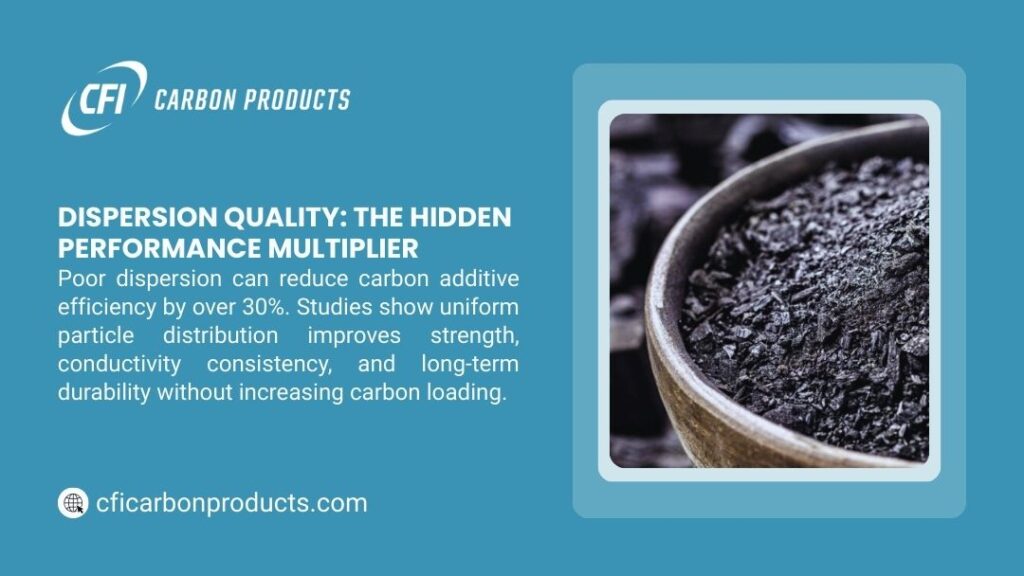
In industrial systems, this behavior supports static dissipation, controlled resistivity, and electromagnetic shielding. Success depends less on carbon quantity and more on dispersion quality.
How Particle Sizes Influence Performance and Processability
Particle size is often discussed as a specification, but in practice, it behaves like a lever. Fine particles increase interaction and strength, yet demand more energy during mixing. Larger particles simplify processing but limit reinforcement.
The choice of particle size affects how a compound flows, how surfaces finish, and how consistently products perform at scale. Manufacturers learn quickly that particle size decisions shape production efficiency just as much as material performance.
Mechanical Properties and Carbon Additive Selection
Mechanical performance emerges from how stress moves through a material. Carbon additives for industrial use influence that movement by bridging polymer chains or reinforcing weak regions.
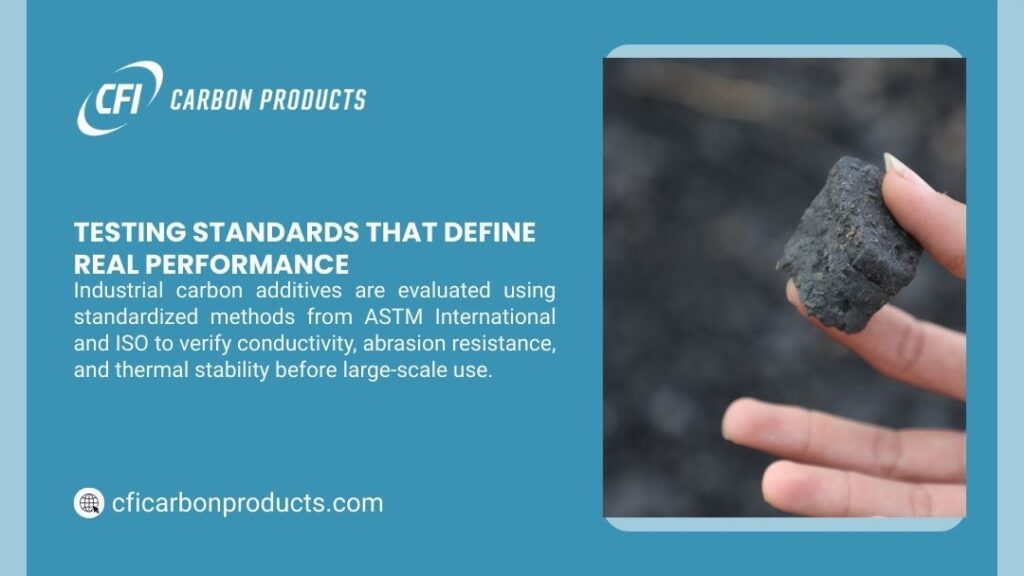
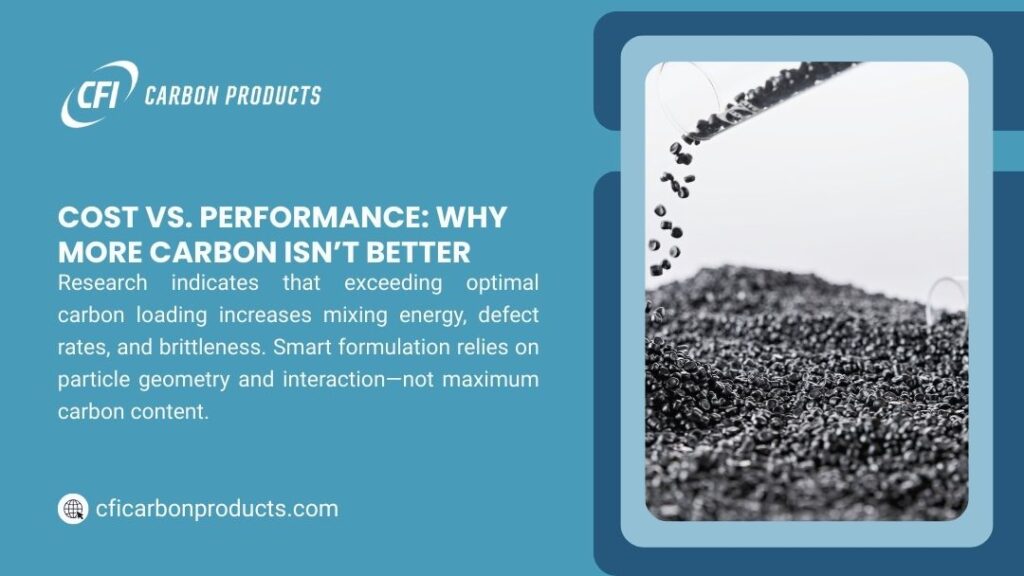
Too little reinforcement produces fragile products. Too much introduces rigidity and loss of flexibility. The correct balance depends on application, environment, and expected service life. This is why mechanical testing remains essential even for well-understood materials.
Sustainability Considerations in Carbon Additives for Industrial Use
Sustainability evaluation now extends beyond emissions to include material efficiency, transport impact, and lifecycle performance. Lower-density carbon additives for industrial use reduce shipping weight and material usage, offering measurable environmental advantages.
Manufacturers increasingly explore sustainable carbon solutions and eco-friendly carbon products to align with regulatory frameworks and corporate responsibility goals. Lifecycle assessments now influence procurement decisions alongside mechanical performance metrics.
The Future Direction of Carbon Additives in Industrial Manufacturing
Carbon additives for industrial use will remain foundational to manufacturing, but their evolution will emphasize efficiency over volume. Advances in material engineering focus on lower emissions, improved dispersion, and reduced dependency on energy-intensive processes.
Manufacturers that treat carbon additives for industrial use as strategic performance components rather than interchangeable fillers position themselves for long-term competitiveness. Technical evaluation, formulation testing, and collaboration with an experienced industrial carbon supplier enable smarter material choices.
For organizations seeking proven, cost-conscious, and sustainable carbon solutions, exploring advanced material options through a specialized manufacturer such as CFI Carbon Products provides a practical next step.