
Recycled carbon for composites has evolved into a cornerstone of sustainable materials engineering. Over the past decade, the global demand for eco-efficient, high-performance fillers has surged by more than 70%, reflecting the manufacturing sector’s shift toward lower-emission production systems.
Among the innovators leading this transformation is CFI Carbon Products, a U.S. manufacturer established in 1987, recognized for its flagship material, Austin Black 325, a finely milled, low-density filler derived from bituminous coal.
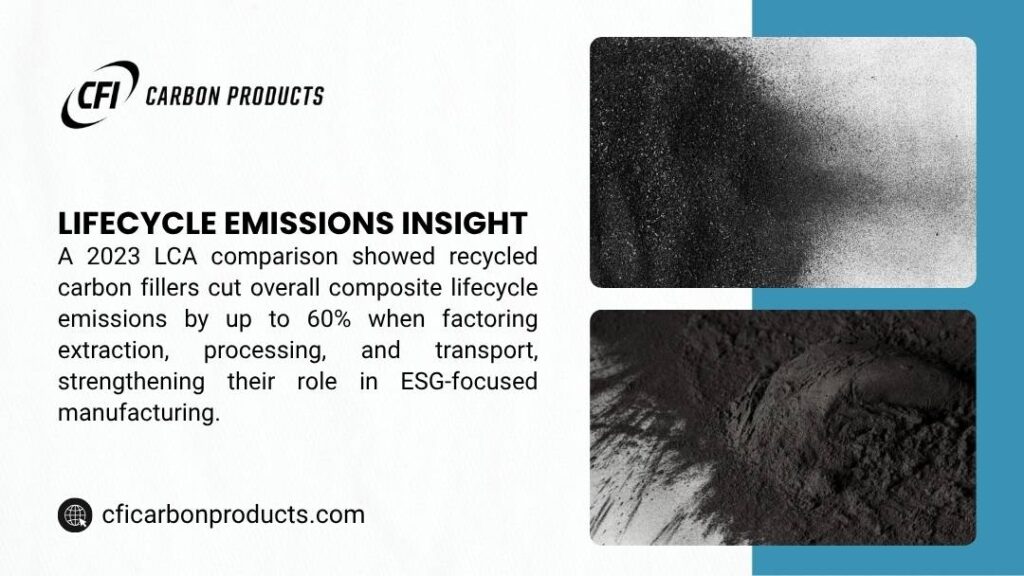
Compared with conventional carbon black, Austin Black 325 delivers up to 85% lower CO₂ emissions and reduces compound weight by 25–35%, enabling measurable gains in energy efficiency, throughput, and cost reduction for rubber, plastics, silicone, and coatings producers in more than 30 countries.
This article examines how recycled carbon for composites is redefining material performance, advancing industrial sustainability, and shaping the next generation of resource-efficient manufacturing.
What Recycled Carbon for Composites Really Means?
Recycled carbon for composites refers to the use of carbon-rich materials recovered or processed from existing sources to reinforce polymers and other matrix systems. Unlike virgin carbon black, which requires high-energy furnace processes, recycled carbon fillers such as Austin Black 325 are made from finely milled low-volatile bituminous coal.
The process involves no combustion stage, resulting in minimal emissions and a uniform, finely divided particle structure ideal for composite integration.
In composites, the role of recycled carbon extends beyond reinforcement. Its specific gravity of 1.30–1.86 (versus 2.5–2.9 for mineral fillers) reduces total product mass while maintaining mechanical integrity.
That reduction in filler density allows manufacturers to produce more components per pound of compound, cutting costs and lowering transportation emissions.
| Property | Recycled Carbon (Austin Black 325) | Conventional Carbon Black | Mineral Filler (Calcium Carbonate/Clay) |
| Source | Bituminous coal (non-furnace) | Petrochemical feedstock | Natural minerals |
| CO₂ Emissions per ton | ~389 kg | ~2,400 kg | ~1,800 kg |
| Specific Gravity | 1.30–1.86 | ~1.8 | 2.5–2.9 |
| Reinforcement Function | Semi-reinforcing | Reinforcing | Extending |
| Processing Advantage | Excellent dispersion, low viscosity | High viscosity | Variable |
| Typical Use | Rubber, plastics, coatings | Tires, plastics | Construction fillers |
The material’s low ash content, neutral pH, and high thermal stability make it suitable for both thermoset and thermoplastic systems, reducing compound defects such as blistering or air entrapment. As a result, it bridges the gap between technical performance and sustainability goals.
Why Recycled Carbon for Composites Matters in Manufacturing Systems
Manufacturers today face unprecedented demands for sustainability, efficiency, and consistency. Traditional fillers are heavy, energy-intensive, and contribute substantially to lifecycle emissions. Recycled carbon for composites tackles these challenges through a combination of material science and process optimization.
At the production stage, fillers like Austin Black 325 lower the total compound weight, improving extrusion flow and mold filling. This directly reduces cycle time by 10–12% in elastomer processing and enables higher part yield per batch. For large-scale operations, these differences translate to significant operational gains.
Environmentally, switching to a recycled carbon filler means cutting emissions by over 80% while maintaining comparable tensile and flexural properties. In automotive components, this weight reduction improves energy efficiency and fuel economy, indirectly lowering emissions in the product’s end use.
Economically, the benefits are twofold: lower raw material costs per unit volume and extended batch yields. For instance, a rubber compound using 25 phr of Austin Black 325 can achieve up to 4% cost savings per production run.
Moreover, CFI’s integrated logistics system and raw-material sourcing in West Virginia and Virginia allow precise control of quality and delivery timelines, ensuring manufacturers meet global sustainability and profitability targets simultaneously.
Practical Applications in Key Industries
Recycled carbon for composites is now part of multiple industries that rely on lightweight, durable materials.
Rubber Industry
In tire compounds, recycled carbon filler helps balance elasticity and tensile strength. Its lower density reduces weight without compromising hardness or aging resistance. Applications include inner liners, hoses, belts, and seals where air retention and gas barrier performance matter.
Plastics Industry
In PVC and polyethylene systems, the filler improves dispersion and minimizes shrinkage. Plastic processors use Austin Black 325 as an additive to improve chemical resistance and thermal stability, leading to longer part lifespans and reduced reject rates.
Silicone and Sealant Systems
Recycled carbon enhances dielectric properties and minimizes moisture uptake. The result is cleaner molding, fewer blisters, and improved color uniformity in both liquid and high-consistency silicones.
Coatings and Adhesives
In coatings, it improves UV stability and pigment dispersion. As a semi-reinforcing pigment, it provides consistent color and viscosity control, making it suitable for conductive and anti-static coatings.
| Sector | Key Application | Observed Benefit |
| Automotive | Tire inner liners, hoses, seals | 25–30% lighter parts; 15% better gas barrier |
| Construction | Sealants, roof coatings | Improved UV resistance, reduced cracking |
| Electronics | Silicone insulation, potting compounds | Enhanced dielectric strength, consistent viscosity |
| Plastics | PVC and HDPE additives | 3–4% cost saving; improved thermal resistance |
| Coatings | Industrial paints, epoxy primers | Stable color dispersion; reduced settling |
How to Evaluate and Select Recycled Carbon for Composites
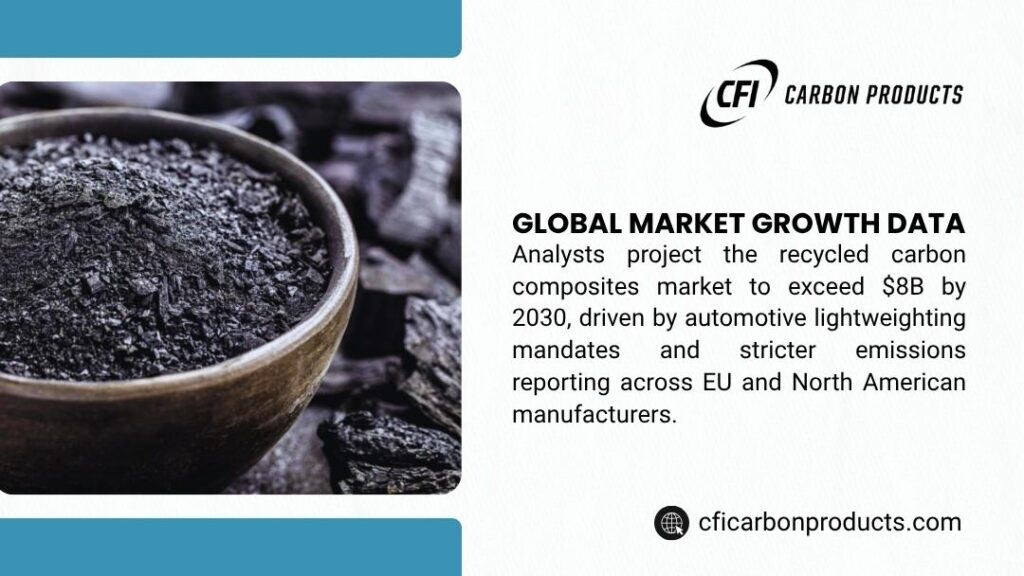
When evaluating recycled carbon fillers, consider density, emissions, and compatibility with your polymer matrix. Performance should be benchmarked using compound weight, tensile strength, elongation, and dielectric behavior. The supplier’s capacity for technical support, lab sampling, and toll grinding also influences success during integration.
| Evaluation Criterion | Importance | CFI Carbon Advantage |
| Specific Gravity | Determines weight and yield | 1.30–1.86, excellent for lightweight parts |
| Emission Footprint | Sustainability reporting | 85% lower than conventional carbon black |
| Process Compatibility | Rubber, plastics, silicone | Proven success in all four industries |
| Cost Benefit | Overall ROI | Up to 4% raw material savings |
| Logistics | Delivery and consistency | In-house U.S. operations with global reach |
Technical Case Example
A 2022 study by ACE Laboratories evaluated Austin Black 325 against clay and ground calcium carbonate (GCC) in elastomer applications. The findings quantified both material and process advantages.
| Property | Austin Black 325 | Clay | GCC |
| Part Yield per Batch | 74 parts | 66 parts | 66 parts |
| Dispersion (%) | 93.7 | 96.5 | 82.4 |
| Specific Gravity | 1.36 | 2.62 | 2.70 |
| Cost per Pound | $2.03 | $2.52 | $2.60 |
| Tensile Strength (psi) | 2,530 | 2,490 | 2,410 |
| Elongation (%) | 390 | 375 | 358 |
The yield and cost data demonstrate that for every ton of compound produced, manufacturers can achieve nearly 12% higher output and 19% lower filler cost when using recycled carbon for composites. Additionally, tensile retention proved equivalent or slightly higher, confirming its suitability for performance-critical elastomers.
Integration into Your Manufacturing System
To incorporate recycled carbon fillers effectively, manufacturers should follow a structured adoption pathway. This approach minimizes disruption while optimizing the return on investment.
Before the table below, note that process success depends on incremental substitution and cross-functional evaluation between formulation and production teams.
| Implementation Phase | Objective | Expected Outcome |
| Material Baseline | Record the weight, tensile strength, and processing time of the current filler | Establish benchmark metrics |
| Pilot Formulation | Replace 5–10 phr of existing filler with recycled carbon | Identify performance deltas |
| Process Optimization | Adjust mixing temperature and dispersion time | Improved flow, reduced cycle time |
| Yield Evaluation | Measure parts per batch and scrap rate | 10–12% higher yield, fewer defects |
| Scale-Up and Logistics | Secure packaging, delivery schedule, and supply contracts | Stable global production integration |
Post-implementation, manufacturers often report lower energy usage, simplified compounding, and improved sustainability scores in corporate ESG reports. Continuous support from CFI’s R&D and services division ensures that each integration is tuned for both performance and compliance.
Key Takeaways
| Insight | Data Point | Impact |
| Material Density | 1.30–1.86 g/cm³ vs 2.6–2.9 for minerals | 25–35% lighter compounds |
| CO₂ Reduction | ~389 kg/ton vs 2,400 kg/ton for carbon black | ~85% lower emission |
| Cost Efficiency | Up to 4% per batch saving | Reduced filler expenditure |
| Performance Retention | Comparable tensile and elongation | Equal or improved durability |
| Global Reach | 30+ countries, 11 distributors | Consistent global supply |
Moving Toward Smarter Composites
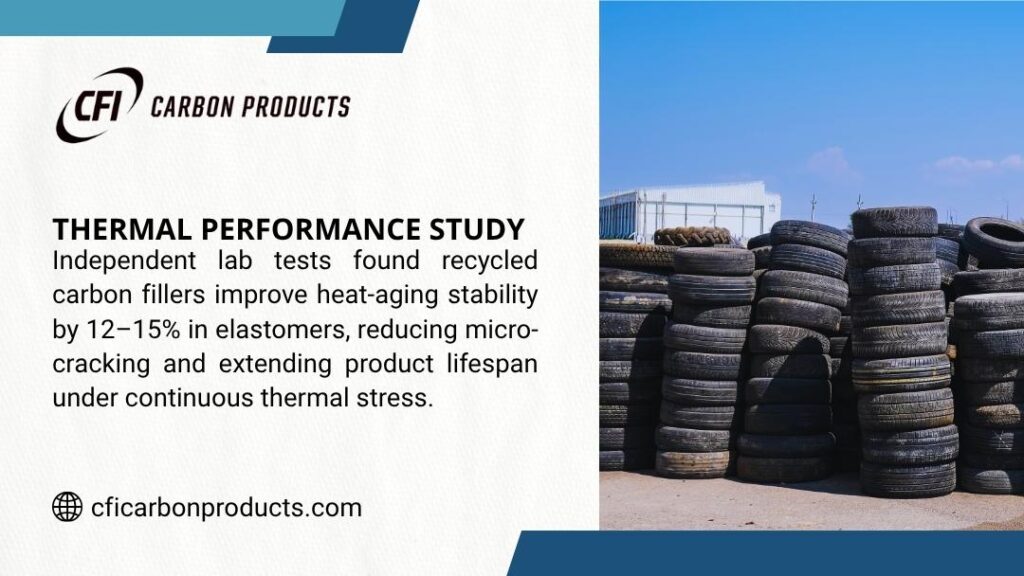
Recycled carbon for composites represents the next step in sustainable materials science. For industries aiming to balance performance with responsibility, the transition is both practical and profitable. The measurable benefits, lower emissions, lighter compounds, and improved process efficiency, place products like Austin Black 325 at the center of modern manufacturing.
Manufacturers can explore CFI Carbon Products’ solutions in the rubber, plastics, silicone, and coatings sectors through their Services section, where sample testing, custom grinding, and formula development assistance are available.
To see technical data, emission comparisons, and formulation guidelines, visit the Resources Index on their official website. Partnering with CFI Carbon Products means aligning your production with the future of sustainable composite innovation, lightweight, cost-effective, and built to last.