
Rubber manufacturers are under pressure from every side. Raw materials cost more. Customers still expect tight specs. Production teams still need clean batches, stable curing behavior, and parts that pass inspection on the first try. That is why the question is not only how to reduce rubber compound cost. The better question is how to do it without creating a new problem on the plant floor.
For rubber products made with natural rubber, synthetic rubber, or elastomer blends, the strongest savings often come from smarter filler choices, better yield, lower finished-part weight, and fewer rejected batches. A cheaper ingredient does not always mean a cheaper compound. If it raises scrap, slows processing, or adds unnecessary density, the savings can disappear before the product leaves the line.
That is where CFI Carbon Products fits into the conversation. Its flagship filler, Austin Black 325, gives rubber manufacturers a practical way to look past price per pound and focus on what matters more: cost per usable part, formula stability, low specific gravity, and production-ready performance.
Reduce Rubber Compound Cost by Looking Beyond Price per Pound
To reduce rubber compound cost, many teams start with the purchase order. That is understandable. Raw materials are visible, easy to compare, and painful when prices rise. But price per pound is only one piece of the story.
A filler that looks inexpensive in a spreadsheet may increase compound density, create more scrap, affect cure behavior, or force longer mixing cycles. Another filler may cost more per pound but help reduce the cost per finished rubber part by contributing more useful volume, improving flow, or supporting better processing.
That is the difference between buying cheaper materials and improving rubber formulation economics. One cuts a line item. The other protects the margin of the finished product.
CFI Carbon Products approaches cost control through that second lens. Austin Black 325 organic filler is a finely divided bituminous coal-based filler designed for use in rubber, plastics, silicone, coatings, sealants, adhesives, and other industrial materials. Its value is tied to low specific gravity, processability, cost control, and lower-emission production.
The key is not blind replacement. No responsible compounder should remove a material just because another one costs less. A better approach is to ask what the ingredient does, how much volume it adds, how it behaves during processing, and whether the final rubber products still meet the required physical properties.
Why Rubber Compound Costs Keep Rising Across the Rubber Industry
The rubber industry has always dealt with volatile input costs. Natural rubber prices can shift due to weather, crop yield, regional supply, freight, and global demand. Synthetic elastomers move with petrochemical markets. Carbon black, silica, oils, curatives, and specialty additives add their own cost swings. Then come energy, labor, packaging, warehousing, freight, quality checks, and customer chargebacks.
For many manufacturers, materials cost is the most obvious issue, but it is not always the biggest hidden drain. A rubber formula may look affordable on paper and still become expensive in production if it causes trapped air, rough extrusion, poor mold fill, weak tensile values, inconsistent cure, or rework.
Plant-floor scrap is where many cheap formulas reveal their real cost. A rejected batch not only wastes raw material. It also eats machine time, labor, energy, schedule capacity, and sometimes customer confidence.
That is why the best way to lower rubber compound costs is to treat the formula as a complete system. Each ingredient affects the next. A filler may change hardness, elongation, tear resistance, density, dispersion, surface finish, compression set, dielectric behavior, or air retention. Those changes can help or hurt depending on the product.
A tire component, roofing membrane, automotive seal, hose, gasket, conveyor belt, and molded industrial part do not need the same balance of properties. Cost reduction should match the job the rubber part has to perform.
Rubber Filler Selection and Material Cost Control
Fillers play a central role in rubber compounding because they affect cost, volume, processing, color, durability, and physical performance. Some fillers reinforce. Some extend. Some improve flow. Some support barrier properties. Others mainly help control the rubber raw material cost. In real production, filler selection can either reduce compound expense or quietly raise it.
Carbon black remains one of the most important materials in rubber because it can support reinforcement, black color, abrasion resistance, UV resistance, and certain electrical properties. Silica is common where rolling resistance, tear strength, or special performance targets matter. Calcium carbonate, clay, and talc often act as extender fillers in selected systems. Recycled carbon black, biochar, and other alternative carbon materials are gaining attention, but each one needs careful testing.
Austin Black 325 belongs in this discussion as a low-specific-gravity organic filler. CFI positions it as an alternative or complement to materials such as carbon black, clay, talc, and calcium carbonate in selected formulas. It is not the same as furnace carbon black, and that difference matters. It has its own density, structure, and performance profile.
For a compounder, the practical question is not which filler is cheapest? The better question is, which filler gives the right volume, processing behavior, and finished-part cost without breaking the specification?
Carbon Black Reduction, Not Blind Replacement
Carbon black is often expensive and energy-intensive, but it earns its place in many rubber compounds. It may provide reinforcement, color, UV resistance, abrasion resistance, and conductivity. Removing it without understanding its function can create serious quality issues.
A better way to reduce rubber compound cost is to study where full carbon black loading is truly necessary and where partial replacement or extension may work. Non-critical components, high-volume molded goods, certain seals, mats, roofing materials, and industrial rubber products may have more room for a lower-cost filler strategy. Performance-critical tread compounds, severe-service parts, and tight-spec applications need more caution.
CFI’s take on carbon black filler alternatives supports the same idea: carbon black often performs multiple functions in a compound, so formula changes need to account for that. The wrong carbon black reduction plan can save pennies in raw material and lose dollars in performance. The right plan starts with function, not price.
Clay, Calcium Carbonate, and Talc as Extender Fillers
Clay, calcium carbonate, and talc are familiar to rubber compounders because they can help lower material cost in rubber formulas. They may support stiffness, dimensional stability, basic extension, and cost control. They are also widely available and often less expensive than many performance carbon materials.
Still, price is not performance. A high-loading mineral filler can increase density, reduce elasticity, affect tear strength, alter cure behavior, or make the compound less forgiving during processing. It may reduce price per pound but raise cost per finished part if each part becomes heavier or if reject rates increase.
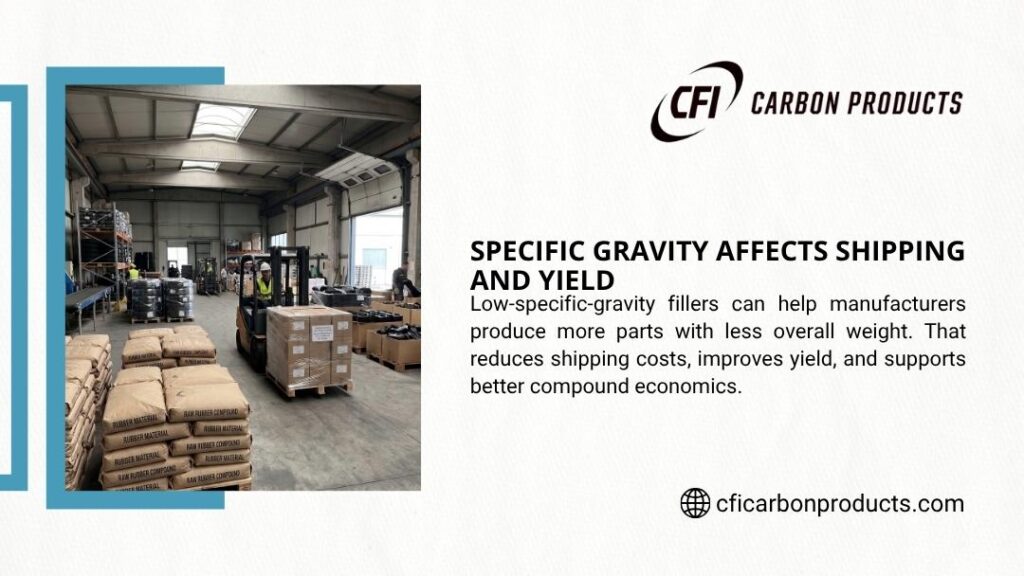
That is why low specific gravity deserves more attention. A lower-density filler can contribute useful volume without adding as much weight. For some rubber products, this can help reduce compound expense while also lowering finished-part weight.
This is one of Austin Black 325’s strongest commercial angles. It does not ask manufacturers to pack the formula with heavy filler just to chase a cheaper invoice. It gives them another route: volume efficiency.
Austin Black 325 as a Low-Specific-Gravity Organic Filler
Austin Black 325 is CFI Carbon Products’ flagship material. It is made from high-quality, low-volatile bituminous coal and supplied as a finely divided black powder. CFI highlights its low specific gravity, processability benefits, cost-saving potential, and lower-emission production profile.
For rubber manufacturers, the value is practical. Austin Black 325 may help reduce compound weight, improve processing, support additional loading, reduce air-related issues, and lower overall formulation cost. If weight reduction is your main lever, our guide to using a low density filler for rubber compounds shows how to capture those savings without performance loss. CFI reports are used across automotive seals, hoses, belts, conveyor belts, tires, mats, roofing, coatings, sealants, caulks, and related industrial applications.
The material is especially relevant when a compound does not need every reinforcing function of carbon black but still needs a black filler that supports cost, volume, and processing behavior.
In plain terms, Austin Black 325 gives formulation teams a way to cut waste from the cost structure without treating the compound like a commodity recipe.
The Cost Formula for Most Rubber
A rubber compound should not be judged only by the invoice cost of each raw material. The real cost includes density, loading, scrap, cure time, handling, packaging, storage, plant behavior, and the number of finished parts that pass inspection.
| Cost Factor | Why It Matters | What to Check Before a Formula Change |
| Price per pound | It is easy to compare, but it rarely tells the full story. | Supplier quote, freight, packaging, lead time, and volume discounts. |
| Specific gravity | It affects part weight, volume yield, and cost per molded or extruded item. | Compare cost per volume, not only cost per pound. |
| Filler loading | Higher loading can lower cost, but it can also damage performance. | Tensile strength, elongation, hardness, tear, and compression set. |
| Dispersion | Poor dispersion can cause defects, weak spots, and scrap. | Mixing time, mill behavior, surface quality, and visible specks. |
| Cure behavior | A filler change can alter scorch safety and cure speed. | Rheometer data, cure state, processing window, and reversion risk. |
| Scrap and rework | Rejects often cost more than the raw material savings. | Defect rate, rework hours, customer complaints, and returns. |
| Finished part weight | Heavy fillers can increase the cost and shipping weight of each part. | Part density, shipping weight, and number of parts per batch. |
This is where cost reduction becomes more technical. If a filler reduces the price per pound but adds density, the manufacturer may need more weight to make the same number of parts. If it slows the line or raises reject rates, the savings disappear. If it improves flow, reduces air entrapment, and keeps critical properties stable, it can reduce cost per finished rubber part measurably. The real win is not the lowest-cost ingredient. It is the lowest-cost approved product.
How Low Specific Gravity Helps Reduce Rubber Compound Cost
Specific gravity is one of the most useful numbers in filler economics. It tells the formulator how heavy a material is compared with water. In rubber compounding, that matters because a formula is not only a weight recipe. It is also a volume recipe.
A low-specific-gravity filler contributes more volume per pound than a heavier filler. That can help reduce rubber compound cost because the compounder may use less weight to occupy the same space in the finished product. In some cases, it also reduces part weight, improves compound yield, and supports better batch economics.
CFI frames this in its profitability and low-specific-gravity discussion. Austin Black 325 is positioned as a lower-density filler compared with common mineral fillers such as clay and calcium carbonate. That difference can matter in rubber products where weight, yield, and cost per part all affect margin.
The filler’s price per pound does not tell you how much product it helps create. Specific gravity does.
| Filler Type | Typical Role in Rubber | Main Cost-Benefit | Main Watchout |
| Carbon black | Reinforcement, black color, UV support, and abrasion resistance. | Strong performance in demanding compounds. | Cost, emissions, supply volatility, and overuse in non-critical areas. |
| Calcium carbonate | Extension, stiffness, cost reduction. | Low raw material cost and broad availability. | Higher density and limited reinforcement in many systems. |
| Clay | Extension, barrier support, stiffness. | Useful for cost control and certain property targets. | Cure effects, dispersion issues, and property trade-offs. |
| Talc | Processing support and dimensional stability. | Helpful in selected compounds and polymer systems. | Not a direct carbon black replacement. |
| Austin Black 325 | Organic filler, extender, processing aid, partial alternative in selected formulas. | Low specific gravity, process support, and cost-per-volume value. | Needs formula testing to confirm fit for the application. |
A plant does not sell pounds of compound. It sells rubber products that must pass specifications. That is why cost per part matters more than material price alone.
Processing Efficiency: The Cost Saver Hiding in Plain Sight
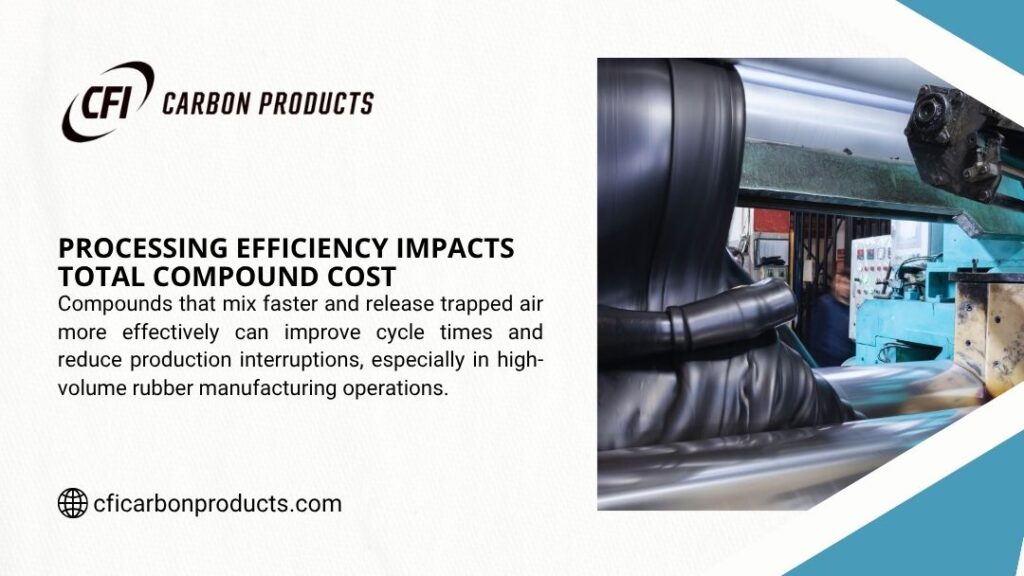
Processing behavior has a direct link to cost. A compound that mixes faster, flows better, releases trapped air, and runs with fewer defects can save money even when the raw material invoice looks similar.
Poor processability often shows up as trapped air, blisters, rough extrusion, surface defects, longer mix cycles, poor dispersion, mold fill problems, and inconsistent dimensions. These issues are not minor production headaches. They are cost events.
Every air pocket, blister, short shot, or surface defect has a price attached to it. The cost may show up as scrap, rework, downtime, extra inspection, or a delayed shipment.
CFI states that Austin Black 325 can support processability, flowability, air-release behavior, reduced end-product weight, improved air retention, and other formula benefits reported by customers. Those claims matter because they connect filler selection to production economics, not just lab data.
A useful expert point comes from Smithers’ rubber compounding guidance. “Process oils and plasticizers serve four primary functions,” including “reducing uncured compound viscosity” and “extending the compound to manage costs.” That quote supports a broader compounding truth: cost reduction and processing behavior are tied together, not separate issues.
If a formula becomes harder to process, it may look cheaper in the lab and more expensive in production. A better goal is a compound that saves money while still moving cleanly through the mixer, mill, extruder, calender, mold, or cure system.
How to Reduce Rubber Compound Cost Without Increasing Scrap
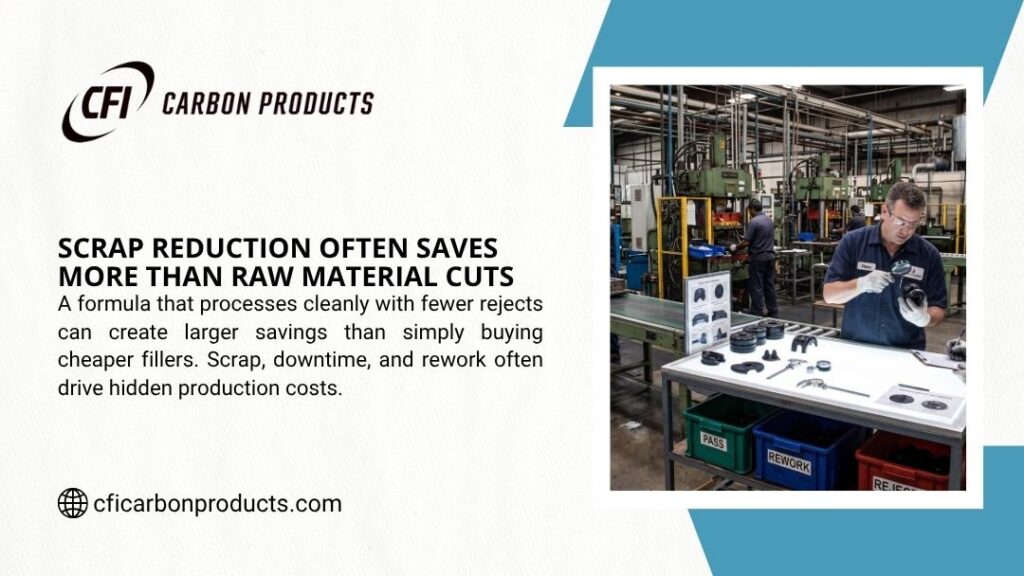
Scrap is one of the fastest ways to erase material savings. A cheaper formula that fails quality control is not cheaper. It is a liability.
To lower rubber compound costs without raising scrap, manufacturers should test changes in stages. A lab trial can show whether the compound still meets physical requirements. A pilot run can show whether it behaves well under realistic processing conditions. A controlled plant trial can reveal mix consistency, flow, cure profile, surface quality, and dimensional stability.
CFI supports this type of decision-making through formula testing and lab samples. The company offers lab samples, formula support, packaging options, toll grinding, and access to testing resources. That matters because filler changes need proof before procurement, engineering, and production teams can trust them at scale.
The safest cost-reduction plan is not aggressive. It is disciplined. Start with a clear target, test realistic loading levels, compare cost by volume, and measure the production result.
If the formula keeps its required properties and runs with fewer problems, the savings are real. If it causes rejection, the formula needs more work.
Application-Specific Cost Reduction for Rubber Products
Different rubber products need different cost strategies. A compound used in a tire tread is not the same as a compound used in a mud flap, mat, seal, hose, roofing membrane, or molded industrial part. The best strategy is to match the filler plan to the part’s performance requirements.
In tire and tire-related applications, cost reduction must respect performance demands. Tread compounds may need abrasion resistance, wet traction, rolling resistance control, and long-term durability. Other tire components or non-tread parts may offer more room for partial filler changes. CFI’s tire rubber filler material can support deeper research in this area.
Seals, gaskets, hoses, and belts often need flexibility, compression behavior, air retention, durability, and process consistency. These applications may benefit when a filler helps reduce weight, improve flow, or support better air-release behavior. CFI lists automotive seals, hoses, belts, and conveyor belts among the rubber uses for Austin Black 325, which makes the material relevant for compounders in these segments. The company also provides information on rubber industry applications.
Roofing and construction materials have another cost profile. EPDM and related roofing compounds often need weather resistance, durability, stable processing, and cost control at scale. Lower compound weight and efficient filler loading can matter when products are made in large volumes. CFI’s information on rubber roofing material gives more insight into this application.
One filler does not fit every formula. But the right filler, tested in the right compound, can help reduce compound expense without asking production teams to accept more risk.
Sustainability Can Also Support Cost Control
Sustainability is no longer only a marketing claim in industrial supply chains. Automotive, construction, roofing, and consumer product manufacturers face more pressure to understand the carbon impact of their materials. In many cases, lower-emission inputs can support both procurement goals and customer reporting needs.
CFI positions Austin Black 325 within a low-emission filler strategy, presenting it as an alternative to traditional and recycled carbon black. The company also states that SCS Global Services conducted a product carbon footprint and life cycle assessment for Austin Black 325, along with a greenhouse gas inventory for the business.
This can help manufacturers in two ways. First, if a lower-density filler reduces the amount of material needed per finished part, the economic benefit may be direct. Second, if a supplier can support sustainability documentation, that may help customers meet sourcing requirements, protect accounts, or compete for work where emissions data matters.
A lower-emission filler is strongest when it also earns its place in the formula. Sustainability helps the business case, but performance keeps the customer.
Rubber Compound Cost Reduction Checklist
A strong cost-reduction plan should be clear enough for procurement, technical, and plant teams to use together. The table below gives a practical way to review a formula before any change reaches full production.
| Step | Question to Ask | Why It Matters |
| Define the cost problem | Is the issue raw material price, scrap, processing time, density, or freight? | A clear problem prevents the team from fixing the wrong thing. |
| Protect critical properties | Which specs cannot move under any condition? | Tensile, tear, elongation, hardness, compression set, cure, and color may be customer-critical. |
| Compare cost by volume | What does the filler contribute per unit volume, not just per pound? | Low specific gravity can change the true economics of a compound. |
| Run lab trials | What happens at realistic loading levels? | Test work reveals cure shifts, dispersion problems, and property loss before scale-up. |
| Check plant behavior | Does the compound mix, flow, mold, extrude, or calender cleanly? | A formula that saves money in theory must still run on production equipment. |
| Measure scrap and yield | Does the new formula produce more saleable parts? | Lower reject rates can create larger savings than raw material cuts alone. |
| Review supplier reliability | Can the material arrive on time, within spec, and in the right packaging? | Supply consistency protects production schedules and customer commitments. |
This type of checklist helps teams control rubber raw material cost with fewer surprises. Procurement sees cost. Technical teams see performance. Plant managers see process behavior. Customers see quality.
When Austin Black 325 Makes Sense in a Rubber Formula
Austin Black 325 makes the most sense when a manufacturer wants to improve rubber formulation economics through volume efficiency, lower compound weight, better processing, and partial filler adjustment. It may be useful where the formula can benefit from a low-specific-gravity black organic filler rather than relying only on heavier mineral fillers or higher-cost carbon materials.
CFI reports that many customers use Austin Black 325 to reduce end-product weight, improve flowability, support air retention, reduce air permeation, and lower cost. The company also states that surveyed customers have reported cost savings, with some citing savings as high as 25 percent. Those figures should not be treated as a universal guarantee because every compound is different. They do, however, show why the product deserves a place in cost-reduction trials.
For manufacturers that want to explore broader commercial applications, cost-effective carbon solutions offer a practical path forward.
Austin Black 325 is not positioned as a shortcut. It is a testable option for manufacturers that want to lower material cost in rubber formulas while still respecting the plant, the product, and the customer specification.
Common Mistakes That Raise Rubber Compound Cost
Here’s the thing: the cheapest filler on paper can become the most expensive one on the plant floor. That happens when a cost-saving change causes defects, slows production, or creates customer failures.
One common mistake is to compare fillers only by price per pound. That ignores specific gravity, loading level, finished part weight, freight, and yield. Another mistake is chasing high filler loading without checking physical properties. Too much filler can reduce elongation, hurt tensile performance, change hardness, or make the compound harder to process.
A third mistake is skipping lab trials. A filler can look similar in a supplier brochure and behave very differently in a real compound. Particle size, structure, surface chemistry, moisture, ash, and compatibility all matter.
Another costly mistake is ignoring packaging and logistics. A material that arrives late, clumps due to moisture, or requires extra handling can add cost even if the invoice price looks attractive. CFI’s service model addresses this by offering multiple packaging formats and logistics support, which can matter for manufacturers that need consistency across plants or regions.
The best compounders do not treat cost reduction as a shortcut. They treat it as an engineering project with a financial target.
FAQs About Reducing Rubber Compound Cost
What is the fastest way to reduce rubber compound cost?
The fastest responsible route is to review filler loading, density, scrap rate, and process behavior. Raw material cuts alone can backfire if the formula becomes harder to process or fails quality checks.
Can filler selection affect sustainability?
Yes. Filler choice can affect material weight, production emissions, sourcing data, and finished product impact. Lower-emission filler options may help manufacturers meet sustainability goals when performance remains within spec.
What tests should be done before a rubber formula change?
Common checks include tensile strength, elongation, hardness, tear, compression set, cure behavior, dispersion, aging, density, and plant processing trials.
Why does specific gravity matter in rubber compounds?
Specific gravity affects how much volume a filler contributes per pound. A lower-specific-gravity material may help reduce compound weight and improve cost per finished part.
Is Austin Black 325 the same as carbon black?
No. Austin Black 325 is a bituminous coal-based organic filler. It is different from furnace carbon black in structure, density, and function, so it should be evaluated as a distinct material.
A Smarter Way to Lower Material Cost
Manufacturers do not need to gamble with cheaper inputs to reduce rubber compound cost. A better path is to compare cost by volume, protect critical properties, test the formula, and measure how the compound behaves in production. That approach gives rubber teams a fair chance to lower materials cost without creating scrap, delays, or customer complaints.
CFI Carbon Products fits this conversation because Austin Black 325 speaks to the pressures many rubber manufacturers face: high raw material costs, weight concerns, process issues, sustainability demands, and the need for dependable supply. It is not a magic substitute for every filler, and it should not be treated that way. But in the right formula, tested the right way, it can help reduce cost per finished rubber part while supporting practical production goals.
For manufacturers ready to review a formula, compare cost by volume, and test whether a low-specific-gravity filler can improve compound yield, the next step is simple: request a sample or discuss formula testing with CFI Carbon Products.