
Elastomers require reinforcement fillers to achieve specific mechanical strength, dimensional stability, and process consistency. These fillers transform soft, flexible materials into durable, high-performance components used across automotive, construction, and industrial sectors.
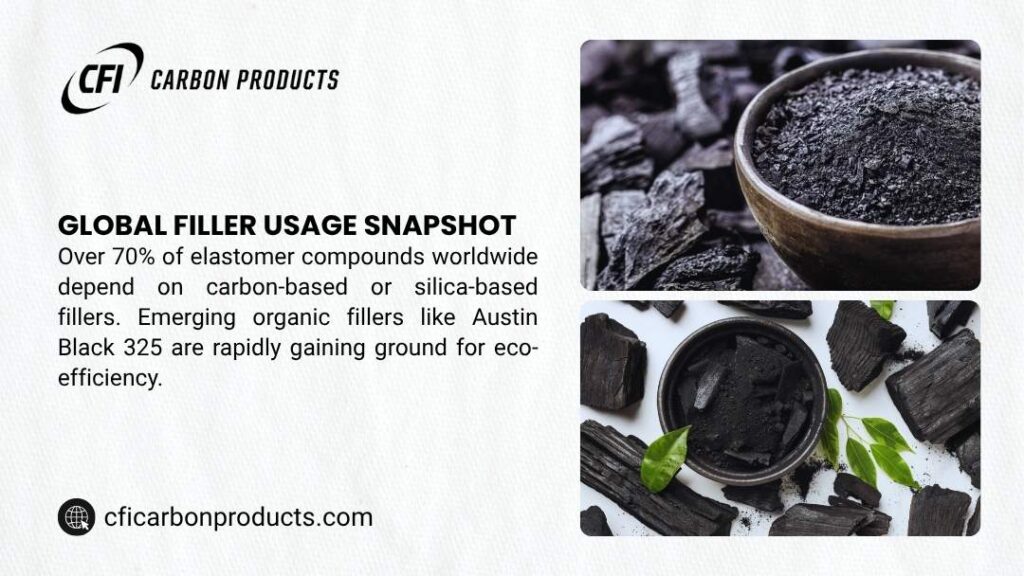
Recent data from global rubber and plastics markets show that more than 72% of elastomer compounds rely on carbon-based or silica-based fillers for reinforcement.
In this article, we explore the science behind reinforcement fillers for elastomers, types used in industry, and the innovation represented by Austin Black 325 from CFI Carbon Products, a filler designed to balance cost, performance, and sustainability.
The discussion includes mechanical property data, sustainability factors, and industrial applications across rubber, plastics, silicone, and coatings.
What Is Reinforcement in Elastomers?
Reinforcement in elastomers refers to the addition of particulate or fibrous fillers that improve mechanical behavior without sacrificing elasticity. Pure elastomers typically exhibit low modulus and poor wear resistance.
The inclusion of reinforcing fillers establishes physical and sometimes chemical interactions with polymer chains, forming a semi-rigid structure that enhances durability and tensile strength.
The degree of reinforcement depends on the filler particle characteristics (size, shape, surface area) and polymer–filler interface chemistry. Materials such as carbon black, silica, and advanced organic fillers like Austin Black 325 are used to fine-tune the balance between strength, flexibility, and weight.
Role of Reinforcement in Elastomers
Reinforcement fillers for elastomers provide measurable advantages in performance-critical environments. These materials create a network within the polymer matrix, allowing the elastomer to sustain repeated stress without permanent deformation.
| Mechanism | Description | Benefits of Elastomer Compound |
| Surface interaction | Polymer chains attach physically to filler surface sites | Improved tensile and tear strength |
| Network formation | Filler particles form a microscopic skeleton | Enhanced modulus and compression set |
| Dispersive/distributive mixing | Homogeneous filler distribution during compounding | Consistent mechanical behavior and lower defect rate |
| Low specific gravity filler | Use of lightweight filler in the compound | Weight reduction and energy savings |
This reinforcement network is the foundation for producing elastomeric goods that meet modern engineering and sustainability standards.
Why Reinforcing Fillers Matter in Industrial Applications
Across automotive, construction, and consumer industries, elastomers must maintain strength under stress, heat, and chemical exposure. The use of reinforcement fillers for elastomers directly influences:
| Property | Effect | Industrial Significance |
| Tensile Strength | Increases with proper filler-polymer bonding | Ensures durability in seals, gaskets, and belts |
| Tear Resistance | Reduces crack propagation | Extends the life of tires and hoses |
| Processability | Enables faster, smoother mixing | Reduces cycle times and manufacturing costs |
| Density | Lower filler density reduces compound weight | Supports fuel efficiency in automotive and aerospace parts |
| Cost Efficiency | Replaces more expensive or high-volume ingredients | Improves profitability in large-scale production |
In high-demand applications such as automotive tires, conveyor belts, or industrial hoses, achieving this balance defines product competitiveness.
Types of Reinforcement Fillers for Elastomers
1. Carbon Black
Carbon black remains one of the most commonly used reinforcing fillers for elastomers. Produced through controlled incomplete combustion of hydrocarbons, it delivers a high surface area and robust interfacial bonding with polymers.
When integrated into natural rubber or styrene-butadiene rubber, it enhances abrasion resistance and tensile strength.
More technical detail on how carbon black contributes to polymer reinforcement is explained in CFI’s resource, What Is Carbon Black, which outlines particle morphology and structural properties.
| Property | Typical Range | Benefit |
| Surface Area | 30–120 m²/g | Controls reinforcement strength |
| Structure | Low to high aggregate branching | Adjusts elasticity and modulus |
| Specific Gravity | ~1.8 | Dense material; increases product weight |
| Drawback | High CO₂ emissions during production | Environmental impact concern |
While effective, carbon black’s environmental footprint has prompted many manufacturers to explore alternatives such as Austin Black 325 or bio-derived fillers.
2. Precipitated Silica
Silica offers excellent reinforcing characteristics for polar elastomers and high-performance tire compounds. Its polar surface enables hydrogen bonding, improving tear resistance and wet traction. However, its high density and energy-intensive processing often lead to increased production costs.
| Property | Typical Range | Benefit |
| Particle Size | 10–40 nm | Fine dispersion and improved tensile strength |
| Specific Gravity | ~2.2 | High density increases compound weight |
| Reinforcement Effect | High for polar elastomers | Superior traction and resilience |
| Drawback | Poor compatibility with nonpolar polymers | Requires silane coupling agents |
While precipitated silica excels in specialty applications, industries seeking both performance and lower carbon output increasingly shift to organic fillers that offer competitive mechanical gains.
3. Organic Reinforcement Fillers (Austin Black 325)
Austin Black 325, developed by CFI Carbon Products, is a low-specific-gravity filler derived from high-quality, low-volatile bituminous coal. It functions as both a reinforcing and process-enhancing filler in elastomer compounds.
Its combination of density (~1.3–1.86 g/cm³) and volatile content (~17-20 %) enables excellent dispersion and cost savings compared with conventional carbon black.
| Property | Austin Black 325 | Comparative Advantage |
| Specific Gravity | 1.3–1.86 | Up to 30 % lighter than standard carbon black |
| Bulk Density | ~250 kg/m³ | Enables lower shipment and material costs |
| CO₂ Emissions | Up to 80 % lower than carbon black | Reduces carbon footprint |
| Performance | Balanced strength, processability, and color uniformity | Suitable for rubber, plastics, silicone, and coatings |
By combining mechanical reinforcement with sustainability and cost reduction, Austin Black 325 serves as an efficient alternative across industries using reinforcement fillers for elastomers.
How Austin Black 325 Optimises Reinforcement of Elastomers
The performance of Austin Black 325 lies in its microstructure and surface chemistry. Its low-volatile, organic composition enhances polymer adhesion while reducing compound viscosity. Manufacturers report smoother mixing behavior, faster extrusion, and improved dimensional stability.
The material’s success in automotive and industrial sectors is rooted in its dual advantage, lightweight reinforcement and emission reduction. In tire formulations, it can replace 10–40 % of carbon black without compromising hardness or tensile strength. In silicone and coating applications, it functions as a process aid that improves pigment dispersion and thermal resistance.
The integration of this filler aligns with the ongoing industry transition toward sustainable material innovation, a key principle discussed in CFI Carbon Products’ Sustainability and Profitability reports, which highlight data-driven environmental performance metrics for filler manufacturing.
Factors Affecting Filler Reinforcement Effect
The overall reinforcement effect of any filler depends on several interconnected parameters.
| Factor | Influence | Practical Consideration |
| Filler Particle Size | Determines available surface area for bonding | Finer particles provide better reinforcement |
| Surface Chemistry | Impacts polymer-filler adhesion | Modify the surface with coupling agents when required |
| Dispersive & Distributive Mixing | Ensures even filler distribution | Prevents stress concentration and micro-defects |
| Filler Loading | Controls stiffness, hardness, and elongation | Balance mechanical goals with processability |
| Density & Morphology | Affects overall weight and flow | Choose a filler that supports a lightweight design |
| Processing Compatibility | Impacts production speed and curing | Select filler that blends seamlessly with existing compounding lines |
Proper management of these variables ensures consistent product quality and repeatable mechanical performance.
Sustainability and Profitability in Reinforcement Fillers
The global drive for sustainable manufacturing demands fillers that contribute to carbon reduction while improving production efficiency. Conventional materials such as carbon black are resource-intensive, but newer options like Austin Black 325 have demonstrated substantial improvements.
From a profitability perspective, low-density fillers yield more output per ton of compound, reducing raw material consumption. This not only decreases material cost but also cuts shipping and storage expenses.
Independent studies and user feedback show that formulations containing Austin Black 325 achieve up to 25% total cost savings compared to traditional fillers due to improved flow and faster processing.
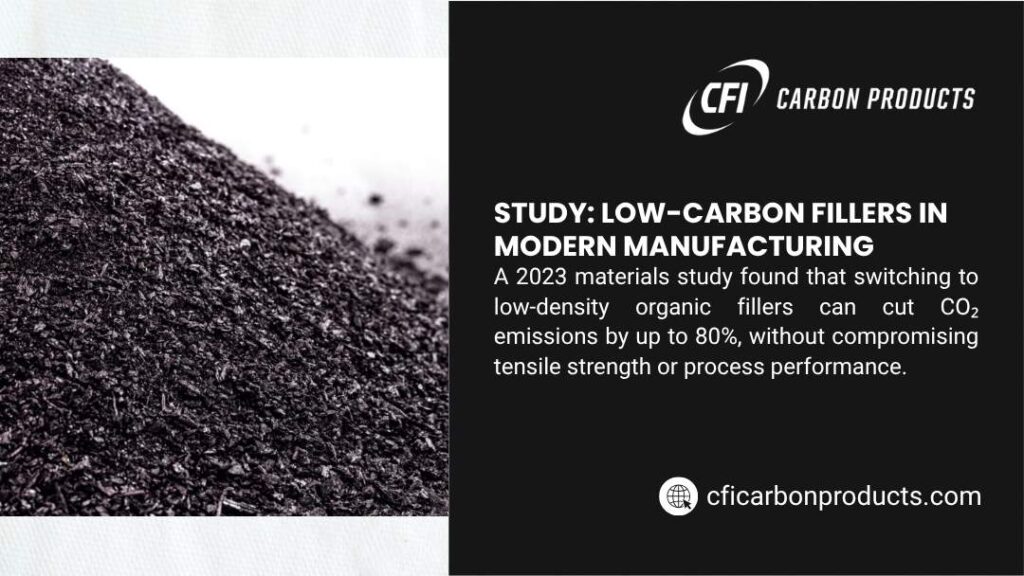
Environmentally, the product’s production process generates up to 80% fewer CO₂ emissions, addressing corporate ESG targets. By replacing heavier fillers, manufacturers reduce fuel consumption during transport and improve energy efficiency across their supply chain.
CFI’s Profitability framework connects these gains directly to measurable ROI metrics, making sustainability financially viable rather than optional.
Industrial Case Applications
Reinforcement fillers for elastomers are essential in several industrial domains, each requiring a specific balance of flexibility, resistance, and sustainability.
| Industry | Example Applications | Key Reinforcement Objective |
| Automotive | Tires, hoses, seals, and engine mounts | Maintain elasticity under thermal and mechanical stress |
| Construction | Expansion joints, roofing membranes | Weather and UV resistance, structural durability |
| Electronics | Cable insulation, vibration-damping pads | Thermal stability and dielectric consistency |
| Industrial Equipment | Conveyor belts, rollers, couplings | High fatigue strength and wear resistance |
| Coatings & Sealants | Industrial paints, silicone coatings | Pigment dispersion and improved adhesion |
For tire manufacturing, hybrid fillers combining Austin Black 325 with moderate carbon black loading improve rolling resistance while retaining tensile strength, crucial for fuel efficiency targets.
In rubber roofing materials, lower density translates to lighter installations without compromising load-bearing capacity. Within plastic composites, organic fillers enhance dimensional stability, allowing manufacturers to reduce costly additives such as titanium dioxide or heavy mineral fillers.
Each application demonstrates that filler choice directly correlates with performance longevity, operational cost, and environmental compliance.
Technical Properties
The key material characteristics that define efficient reinforcement fillers for elastomers can be quantified. The table below consolidates essential physical and mechanical parameters relevant to formulating elastomer compounds.
| Property | Ideal Range | Importance |
| Specific Gravity | 1.2–2.0 g/cm³ | Lower density reduces product weight |
| Particle Fineness | 200–400 mesh | Ensures uniform dispersion and surface contact |
| Volatile Matter | 15–20 % | Aids internal lubrication during mixing |
| Hardness Contribution | Shore A + 5–10 | Adds stiffness without brittleness |
| Color Uniformity | Deep black, consistent | Enhances visual and functional properties |
| Compatibility | Rubber, plastics, silicones, coatings | Supports multi-industry formulations |
Selecting fillers within this specification range enables predictable processing and sustained reinforcement without increasing energy use or production complexity. Engineers using Austin Black 325 report consistent property retention across batches, confirming material reliability in long-term production cycles.
Key Takeaways
| Insight | Explanation |
| Material Choice Defines Performance | The right filler improves mechanical and thermal behavior while reducing costs. |
| Low Density Means High Value | Lower specific gravity fillers yield more product per unit weight, enhancing profitability. |
| Process Efficiency Is Critical | Proper dispersion shortens mixing cycles and lowers power consumption. |
| Sustainability Adds Competitive Edge | Materials with lower CO₂ output strengthen brand and regulatory compliance. |
| Austin Black 325 Balances All Factors | It provides the optimal combination of reinforcement, processability, and environmental responsibility. |
A Material Future That Performs Better
The next era of material science depends on smarter reinforcement fillers for elastomers, materials that enhance tensile strength, reduce density, and lower emissions without sacrificing cost efficiency. This transition marks not only an evolution in compound design but also a necessary shift toward sustainable industrial growth.
CFI Carbon Products’ Austin Black 325 stands at the center of this progress. Its proven balance of performance and environmental responsibility helps manufacturers meet modern production targets while minimizing their ecological footprint. From rubber and plastics to silicone and coatings, Austin Black 325 supports the kind of consistent, high-quality output that forward-thinking manufacturers demand.
Producers aiming to develop lighter, more durable, and environmentally responsible compounds can explore the full technical specifications and service capabilities available on the Austin Black 325 page and through CFI’s extensive industry resources. Collaborating with CFI Carbon Products means working with a partner that understands the science and application of reinforcement fillers for elastomers, and knows how to convert that understanding into measurable profitability and performance in real-world production.