
Reinforcement materials for rubber indicate whether a product simply survives or thrives under pressure. Whether in tires, rubber sheets, or in industrial seals and roofing systems, the right rubber reinforcement materials will control for strength, abrasion resistance, flexibility, and long-term durability.
This article explains the function of rubber reinforcement materials, which brings benefits for rubber manufacturers, and how to avoid compromising cost or sustainability in rubber reinforcement.
Reinforcement Materials for Rubber: The Structural Backbone of Performance
Reinforcement materials for rubber exist for one reason: unreinforced rubber fails under mechanical stress. Natural and synthetic rubber materials stretch well, but tensile strength, tear resistance, and abrasion resistance remain limited without reinforcement.
Once reinforcement materials for rubber enter the compound, the polymer matrix changes behavior at a molecular level. Stress transfers from rubber chains to filler or fabric structures, allowing reinforced rubber to withstand load, deformation, and fatigue.
Industry data confirms this effect. Studies in rubber compounding consistently show that adding reinforcing fillers like carbon black can transform basic elastomers into high-performance materials, with tensile strength increases that often reach several times that of unfilled rubber when dispersion and formulation are optimized. The exact gains vary by compound design, but the takeaway is clear: reinforcement isn’t a minor tweak; it fundamentally changes how rubber performs under stress.
Why Reinforcement Materials for Rubber Alter Mechanical Behavior
Reinforcement materials for rubber do more than add bulk. They influence viscoelastic response, hysteresis, abrasion resistance, and thermal stability. When fillers disperse evenly, they restrict polymer chain movement while still allowing elastic recovery. This balance explains why reinforced rubber outperforms plain rubber material in dynamic environments.
Rubber sheets used for flooring, vibration isolation, and gasketing rely on reinforcement materials for rubber to maintain shape under load. Without reinforcement, compression set increases and dimensional stability drops. Reinforced rubber maintains structural memory longer, reducing failure rates in demanding applications.
The impact becomes even clearer in tire compounds. Research shows that filler-reinforced rubber directly affects tread wear, braking performance, and rolling resistance, all of which influence safety and fuel efficiency.
Carbon-Based Fillers as Dominant Reinforcement Materials for Rubber
In the first place, carbon fillers are among the most widely used materials for rubber reinforcement. More specifically, carbon black constitutes more than half of the overall global consumption of rubber reinforcement due to its scarcity and effectiveness in rubber reinforcement. An explanation of carbon black in rubber applications highlights some practical rubber compounds’ functionalities.
The rubber network comprises carbon black filler, forming a reinforcing composite material. For specific compounds in tires, belts, and hoses, the gradings of carbon black fillers have to be controlled for abrasion resistance and tensile strength, which is determined by the surface area and particle size of the carbon black fillers. However, during economic downturns, volatile pricing on carbon black fillers can affect the formulation of compounds.
Compounders looking at the grades of carbon black often do this because of the importance of grade selection to determine the reinforcing levels. For example, high-structure grades end up improving high elasticity and tear resistance, while low-structure high grades favor processability.
The table below best represents the comparison of the common carbon-based reinforcement to rubber.
| Reinforcement Type | Strength Gain | Abrasion Resistance | Density Impact | Typical Uses |
| Carbon Black | Very high | Excellent | Moderate | Tires, belts, hoses |
| Recycled Carbon | High | Good | Lower | Industrial rubber |
| Organic Carbon Fillers | Moderate | Moderate | Low | Lightweight rubber |
Carbon black performance characteristics, such as structure, density, and resistivity, determine how reinforcement materials for rubber behave electrically and mechanically. These properties also explain why carbon black remains central in discussions about whether carbon conducts electricity and how resistivity varies across grades.

Fabric Reinforcement and Structural Rubber Systems
While particulate fillers dominate small-scale reinforcement, fabric reinforcement addresses large-scale load distribution. Fabric reinforcement materials for rubber introduce tensile strength that fillers alone cannot provide. Woven polyester, nylon, aramid, and fiberglass fabrics are embedded within rubber layers, forming composite systems.
Fabric reinforcement proves essential in rubber roofing material, conveyor belts, expansion joints, and hydraulic hoses. The reinforcement fabric carries the load while the rubber matrix protects against environmental exposure. This division of labor explains the durability of reinforced rubber systems exposed to UV radiation, moisture, and temperature swings.
Fabric reinforcement also plays a role in the rubber material’s dimensional stability. Without fabric layers, large rubber sheets stretch unevenly under stress. Fabric reinforcement controls elongation and improves fatigue life, particularly in cyclic loading environments.
Silica, Clay, and Hybrid Reinforcement Materials for Rubber
Not every rubber compound needs maximum abrasion resistance. In many industrial and automotive uses, reinforcement materials for rubber must balance strength, flexibility, heat behavior, and processing efficiency. That is where silica, clay, and hybrid reinforcement systems enter the picture, each solving a different engineering problem.
| Reinforcement Material | Primary Function in Rubber | Key Performance Benefit | Common Applications |
| Silica | Reinforcing filler with surface activity | Improved tear resistance and lower heat buildup | Passenger tires, vibration isolators |
| Clay | Semi-reinforcing mineral filler | Cost control and dimensional stability | Rubber sheets, molded goods |
| Hybrid systems | Combination of fillers | Tuned balance of strength, weight, and durability | Automotive seals, industrial elastomers |
Silica reinforcement materials for rubber interact differently with polymer chains than carbon-based fillers, which explains their growing use in applications that demand lower rolling resistance and improved dynamic performance.
Clay fillers, while less reinforcing, remain valuable where compound stiffness and affordability matter more than extreme strength. Hybrid reinforcement materials for rubber blend these characteristics, allowing formulators to fine-tune performance without overloading the compound with a single filler type.
Reinforcement Materials for Rubber in Plastic and Composite Crossover Applications
Modern manufacturing uses rubber in conjunction with other materials in composite systems. Rubber cross-bonds with plastics, resins, or thermoset materials. In these crossover applications, reinforced rubber composites need to operate under mixed mechanical and thermal conditions.
Industry flooring applications incorporate reinforced rubber layers bonded to polymer substrates to control vibration while keeping structural integrity. Within rubber and reinforced polymer flooring, the rubber layers are bonded to the polymer substrates, and the rubber layers control the vibration while keeping structural integrity. In conveyor systems, the rubber and polymer flooring incorporates a rubber composite that contains carbon to provide a lightweight, abrasion-resistant flooring.
In the example of electrical enclosures, reinforced rubber gaskets are used. The gaskets are sealed to the enclosure and are incorporated to maintain the elasticity. The reinforced gaskets are incorporated to seal the enclosure and maintain the elasticity of the enclosure.
The insulative polymer components of the enclosure are bonded to the enclosure and are sensitive to heat and deformation. In this enclosure example, the enclosing materials that enhance the reinforced rubber influence the compressive characteristics and influence the sealing, and the gaskets are reinforced to eliminate creep over time.
These examples list the various departments needing reinforced components, particularly the integration of rubber and polymer. The selection of poor fillers results in bonded assemblies experiencing premature failure, delamination resulting in disbonded layers, and structural inadequacies resulting in unbalanced distributions of stress.

Sustainability Pressure Reshapes Reinforcement Materials for Rubber
Environmental scrutiny has changed how reinforcement materials for rubber are evaluated. Performance alone no longer drives material choice. Carbon footprint, lifecycle impact, and sourcing transparency now factor into compound design decisions.
Manufacturers increasingly explore recycled and low-emission reinforcement materials for rubber to meet regulatory targets without sacrificing mechanical integrity. Organic fillers, recovered carbon materials, and process-efficient fillers reduce energy demand during production while supporting circular material flows.
Research shows that filler selection can account for a significant share of a rubber product’s total emissions. As a result, reinforcement materials for rubber increasingly serve dual roles: mechanical reinforcement and environmental risk mitigation.
Performance Trade-offs When Selecting Reinforcement Materials for Rubber
No reinforcement material solves every problem. High reinforcement improves strength but increases hardness and reduces elongation. Low-density fillers reduce weight but sacrifice abrasion resistance. Fabric reinforcement adds strength yet increases cost and manufacturing complexity.
The table below illustrates common trade-offs engineers face.
| Performance Priority | Reinforcement Strategy | Result |
| Maximum abrasion resistance | High-structure carbon fillers | Longer service life |
| Lightweight design | Organic or low-density fillers | Reduced mass |
| Dimensional stability | Fabric reinforcement | Improved load control |
Understanding these trade-offs prevents over-engineering and keeps reinforced rubber products economically viable.
Real-World Impact of Reinforcement Materials for Rubber in Tires
Tires illustrate the strongest case for demonstrating how rubber reinforcement materials impact real-world performance. Traction, tread wear, rolling resistance, and heat dissipation are all heavily influenced by the chosen reinforcement strategy.
Compounds with high reinforcement improve the abrasion resistance of a given tread, but may cause an increase in the rigidity of that tread. Inversely, a tread with low-density reinforcements will improve the tread’s fuel efficiency, but will cause the tread to be more susceptible to abrasion. In order to optimize performance, manufacturers of tires have to adjust the selection of various fillers based on geography and regulations, as well as vehicle type and driving conditions.
Changes in the reinforcement materials for rubber can affect braking distance, noise, and the durability of tires. Tire development cycles invest in controlled testing and filler research instead of using reference recipes because of this sensitivity.
Future Direction of Reinforcement Materials for Rubber
Currently, the rubber reinforcement process is all about refinement. Rubber reinforcement materials like nanostructured fillers, surface-modified minerals, and multifunctional rubber reinforcements are forsaking the laboratories for commercial use.
Costs remain a significant factor, which favors scalable solutions and experimental materials. The most likely advancements involve improved dispersion techniques, hybrid filler systems, and reinforcement materials engineered for lower environmental impact.
Manufacturers increasingly value predictability. Reinforcement materials for rubber that deliver consistent results across production runs will outperform novel options that introduce variability or processing challenges.
The Path Forward for Reinforced Rubber Performance
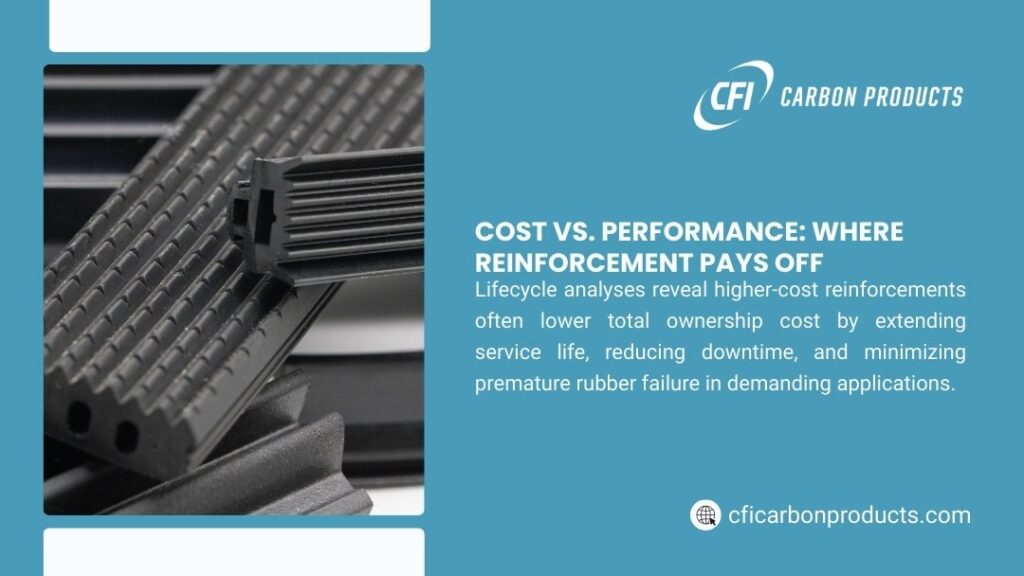
Reinforced rubber excels when the balance of strength, durability, price, and sustainability is achieved. Reinforcement materials for rubber influence that balance in a way that governs the performance of products long after they’ve left the factory.
Achieving this balance requires specialized knowledge, dependable materials, and a good understanding of the application. Reliable materials partners come into play here.
CFI Carbon Products provides manufacturers with reliable reinforcement materials for rubber, guidance with sustainable fillers, and solutions tailored for real-world applications. For teams refining formulations and adjusting reinforcement strategies, the value of a partner committed to consistency, innovation, and enduring value can be the difference between acceptable and reliable results.
If the objective is to achieve reinforced rubber that performs optimally, the right materials and accompanying expertise are paramount.