
Semi-reinforcing fillers for rubber sit between true reinforcing fillers such as carbon black and inert extenders such as coarse ground limestone. They raise modulus and hardness, hold compound cost down, and keep a batch easy to mix and extrude.
What they do not deliver is the tensile strength and abrasion resistance of a fine furnace black. For compounders who build hose covers, roofing sheet, molded industrial goods, and extruded profile, that trade is often the right one.
Article Summary
| Topic | Short answer |
|---|---|
| Class position | Between reinforcing fillers (carbon black, precipitated silica) and inert extenders (whiting, coarse mineral flour) |
| Typical particle size | Roughly 50 to 500 nm primary particle size, most grades 70 to 150 nm |
| Typical surface area | Roughly 20 to 80 m²/g by BET, well under that of reinforcing grades |
| Core materials | Hard kaolin, calcined clay, fine talc, precipitated calcium carbonate, coal-based organic filler |
| Gains | Modulus, hardness, dimensional stability, lower compound cost, smoother processing |
| Losses | Tensile, tear, and abrasion resistance versus a reinforced control |
| Written for | Rubber compounders, formulation chemists, and purchasing leads in industrial rubber goods |
What Semi-Reinforcing Fillers for Rubber Are
A semi-reinforcing filler is a mineral or organic particulate that delivers a measurable, repeatable gain in modulus and strength, but at a level well below carbon black or precipitated silica. Physical geometry defines the class more than chemistry does.
Primary particle size normally falls between 50 and 500 nm, most commercial grades cluster from 70 to 150 nm, and BET surface area typically runs about 20 to 80 m²/g.
Size alone does not settle the question. Surface activity, how strongly the filler surface interacts with the polymer chains, decides how much bound rubber forms around each aggregate. Two fillers with matched particle size and different surface chemistry will not give the same stress-strain curve.
Aggregate structure, the branched clusters that trap occluded rubber, is the third variable. Trade language varies: supporting filler, semi-active filler, and extending-reinforcing filler all cover roughly the same ground. The full guide to reinforcement materials for rubber sets out how these grades sit alongside silica and hybrid systems.
Reinforcing, Semi-Reinforcing, and Inert Fillers Side by Side
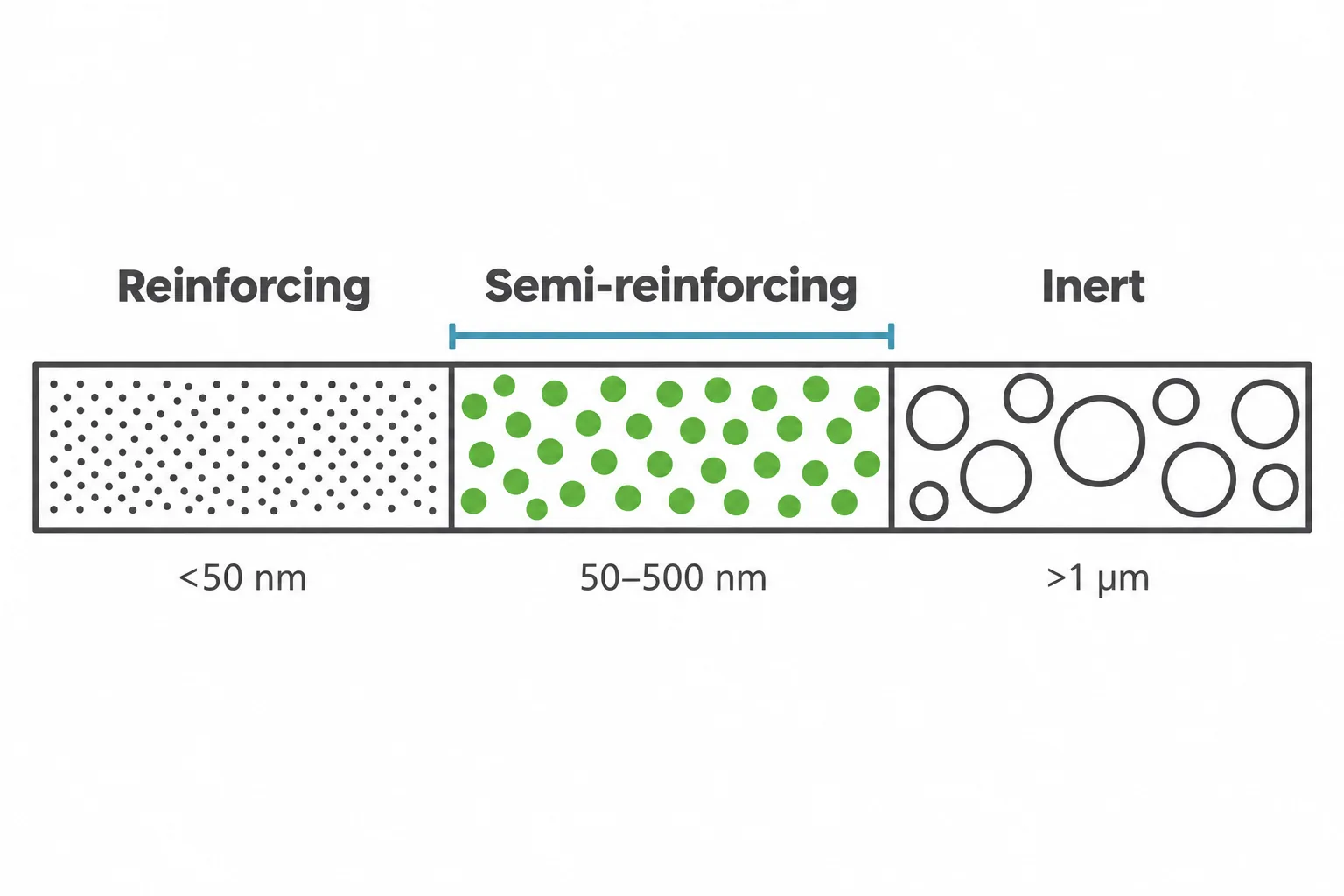
The fastest way to place a candidate filler is to check it against the boundaries of the three working classes. Carbon black stays the benchmark every other choice gets measured against, which is why formulators who want that baseline start with carbon black for rubber compounds.
| Property | Reinforcing | Semi-reinforcing | Inert / extender |
|---|---|---|---|
| Anchor materials | Fine furnace blacks, precipitated silica | Hard kaolin, calcined clay, fine talc, precipitated calcium carbonate, coal-based filler | Ground calcium carbonate, whiting, barytes, coarse mineral flour |
| Primary particle size | Below about 50 nm | About 50 to 500 nm | Above about 1,000 nm |
| BET surface area | High, often above 80 m²/g | About 20 to 80 m²/g | Low, often under 10 m²/g |
| Tensile effect | Large increase | Moderate increase | Flat to negative |
| Modulus effect | Large increase | Moderate increase | Small increase |
| Relative cost per pound | Highest | Middle | Lowest |
| Mixing energy | Highest | Moderate | Lowest |
Why Particle Size and Surface Area Cap Reinforcement
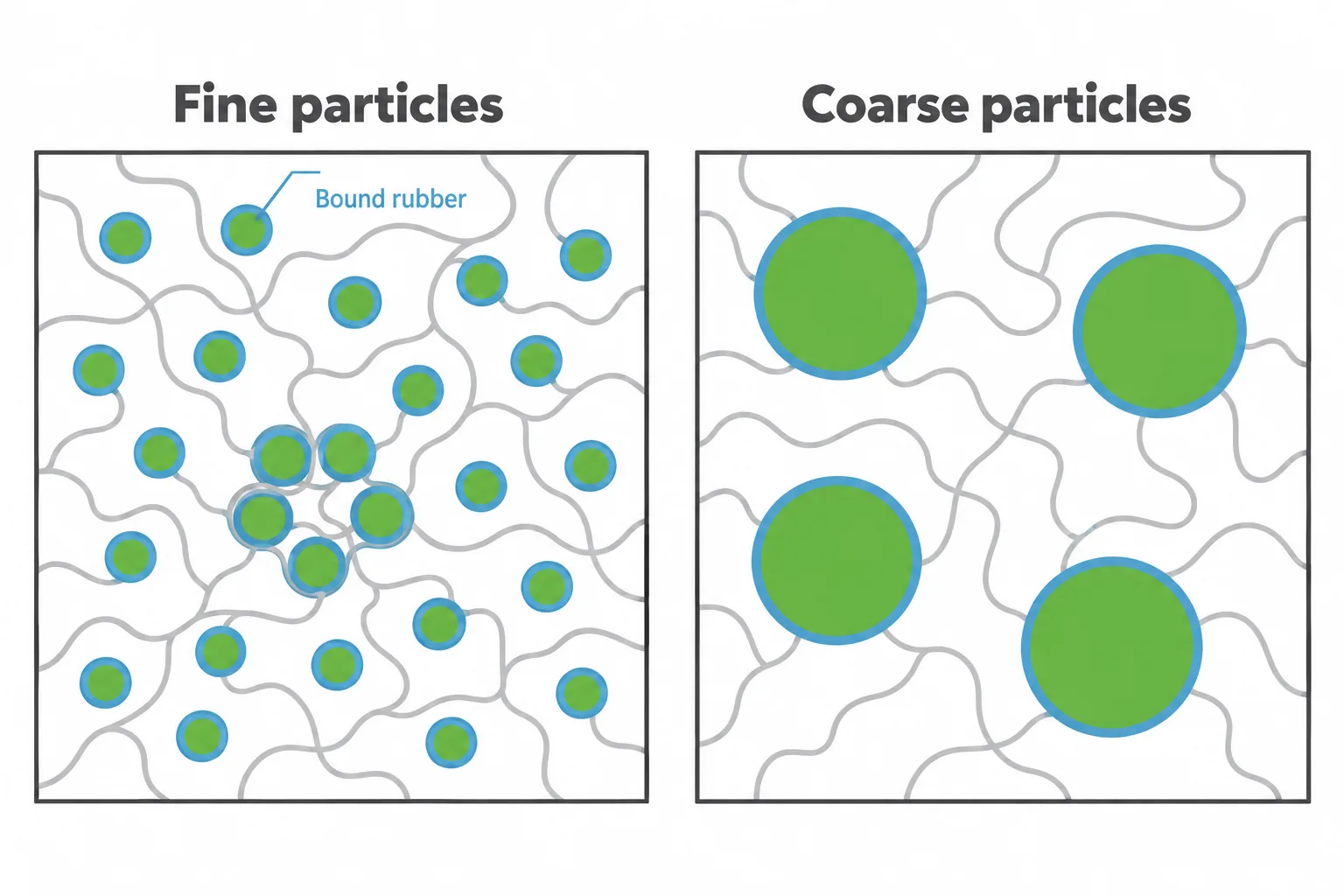
Reinforcement is an interface phenomenon. Divide the same filler mass into smaller particles and interfacial area per gram climbs sharply, so more polymer sits against a solid surface and stress transfers out of the matrix more efficiently. Past roughly half a micron, interfacial area drops far enough that the filler mostly occupies volume.
Structure comes next. High-structure aggregates with large void volume, measured through oil or DBP absorption, trap rubber inside the aggregate. That occluded rubber acts as filler rather than matrix, which is why structure drives low-strain modulus more than it drives tensile.
The morphology mechanics behind carbon black structure apply to carbon-based semi-reinforcing grades as well.
| Property lever | What it moves most | Practical note |
|---|---|---|
| Primary particle size | Tensile, tear, abrasion | Smaller particles raise reinforcement and viscosity together |
| BET surface area | Bound rubber, hysteresis | Tracks inversely with particle size |
| Aggregate structure | Modulus at low strain, die swell | High structure lifts stiffness and mixing energy |
| Surface chemistry | Cure rate, filler-polymer bonding | Clay edge hydroxyls and basic carbonate surfaces both shift scorch |
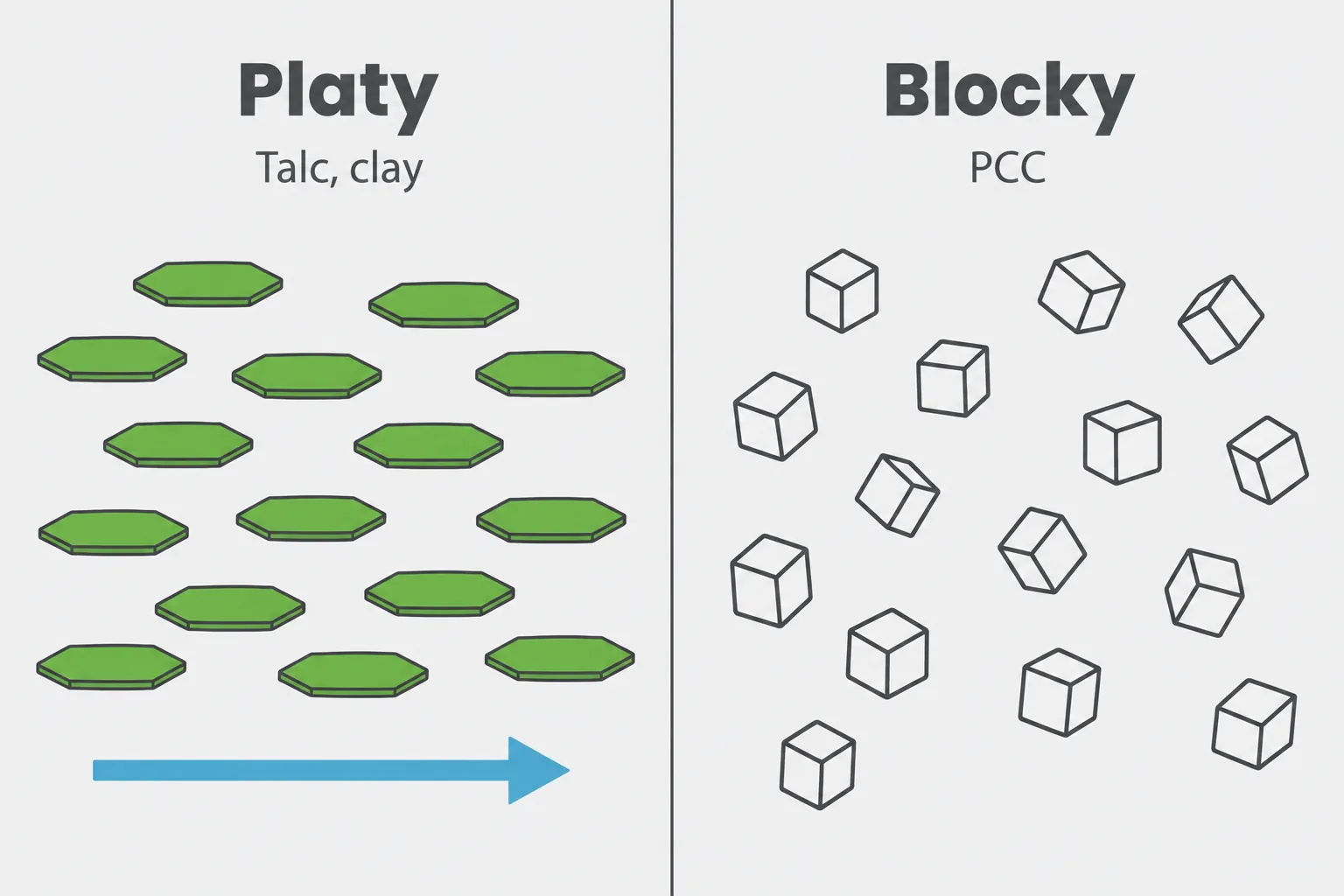
| Aspect ratio | Permeability, extrusion smoothness | Platy talc and clay orient during flow |
Common Semi-Reinforcing Filler Materials
Four material families cover most commercial practice. Each answers the question of which material serves as a filler for rubber in a different way, and each carries its own supporting cast of rubber additives such as dispersants, process aids, and plasticizers.
| Material | Composition | Typical particle size | Main contribution | Cost tier |
|---|---|---|---|---|
| Hard kaolin clay | Hydrous aluminum silicate | Fine, sub-micron fraction dominant | Modulus, green strength | Low to middle |
| Calcined clay | Dehydroxylated kaolin | Fine, low moisture | Electrical resistance, water resistance | Middle |
| Talc | Hydrated magnesium silicate, platy | Fine to medium | Lower permeability, smooth extrusion | Low to middle |
| Precipitated calcium carbonate | Synthetic CaCO₃ | Sub-micron | Modest stiffness, good dispersion | Middle |
| Coal-based organic filler | Ground low-volatile bituminous coal | Fine powder | Low specific gravity, processability | Middle |
Hard Kaolin and Soft Kaolin Clay
Kaolin trips up more formulators than any other filler choice, because one mineral name covers two performance classes. Particle size draws the line: reference work on china clay records that hard clay acts as a semi-reinforcing filler while soft clay is non-reinforcing.
Hard clay carries the finer fraction and gives higher green strength and modulus. Soft clay is coarser and functions as an extender.
Surface-treated grades move the needle further. Silane and amino-silane treatments couple the clay surface to the elastomer network, which raises modulus and recovers part of the tensile loss. The costs are real: clay can retard sulfur cures, raise compound viscosity, and pick up moisture in storage.
Talc and Calcium Carbonate
Talc plates are hydrophobic on their basal planes and orient during extrusion. That orientation cuts gas and moisture permeability and leaves a smoother die surface, with a modest stiffness gain alongside.
Calcium carbonate spans two filler classes. Precipitated grades are produced at a far finer particle size than ground grades, so precipitated carbonate can behave as semi-reinforcing while ground carbonate stays a plain extender. Stearate coatings on either grade improve dispersion and drop viscosity.
The same mineral chemistries turn up across adjacent specialty additive markets, from polyurethane additives to the mineral loads used in sealants and adhesive additives.
Coal-Based Organic Filler
Austin Black 325 from CFI Carbon Products is a finely divided powder produced from high-quality, low-volatile bituminous coal. Low specific gravity relative to clay, talc, and carbonate is its distinguishing property, so a given weight fills more volume, end-product weight falls at equal volume load, and the cost-per-volume math changes.
CFI produces it with low CO₂ emissions at plants in West Virginia and Virginia sited near raw material, and ships through 11 distributors into more than 30 countries.
It complements a reinforcing system rather than replacing one. Among the credible carbon black alternatives, it earns its place as a partial replacement inside a blended filler package, not as a drop-in substitute.
Formulators who weigh substitution against demand for eco-friendly rubber and lower-footprint rubber alternatives can compare options in the resource on eco-friendly rubber alternatives.
Load guidance and grade detail sit on the Austin Black 325 product page, and CFI runs formula testing, lab sampling, and toll grinding for compounders who want trial support before a plant-scale change.
Property Effects on the Cured Compound
A semi-reinforcing filler moves nearly every line on a physicals report. The direction is predictable even when the magnitude is not.
Related readingLow Density Filler for Rubber: A Formulator’s GuideRead the guide →| Property | Direction at moderate load | Comment |
|---|---|---|
| Tensile strength | Slight rise, then fall past the optimum | Stays well below a reinforced control |
| Elongation at break | Down | Falls steadily with load |
| Modulus at 100% | Up | Primary reason to use the class |
| Shore A hardness | Up | Roughly linear with load |
| Tear strength | Flat to down | Fine grades hold up best |
| Abrasion resistance | Down | Weakest point versus carbon black |
| Specific gravity | Up with minerals, down with coal-based filler | Drives part cost per piece |
To raise the tensile strength of a rubber compound, work the levers in order: a finer, higher-surface-area filler with a coupling agent first, then load level, then cure state and crosslink density. Filler choice outranks the rest, and that is why semi-reinforcing grades usually run blended with a reinforcing filler instead of alone.
The wider ingredient picture, from curatives to industrial additives, sits in the overview of industrial raw materials for rubber manufacturing. One habit worth keeping: price filler per unit volume, not per pound, since specific gravity decides how many parts a drum actually yields.
Load Levels, Dispersion, and Cure Interactions
Load windows shift with the elastomer, because backbone polarity and green strength change how much filler a compound tolerates.
| Elastomer | Semi-reinforcing load pattern | Note |
|---|---|---|
| NR | Low to moderate | Strain-crystallizes, so it tolerates modest reinforcement |
| SBR | Moderate | Needs reinforcement; blend with black |
| EPDM | High | Accepts heavy mineral loads |
| NBR | Moderate | Watch swell and surface treatment choice |
| CR | Low to moderate | Clay and carbonate both common |
Mix practice counts as much as selection. Stage the filler additions, watch dump temperature for scorch risk, and rate dispersion microscopically instead of trusting the mixer log. Upside-down mixes help at high mineral loads.
Cure chemistry needs a second look, too: acidic clay surfaces tend to retard sulfur cures, while basic carbonate surfaces can speed them up, so accelerator and activator levels get rebalanced whenever the filler package changes. High-volume compounders will recognize the same balance in tire rubber filler selection.
Ask every supplier for the same specification set: particle size distribution, BET surface area, specific gravity, moisture, pH, oil absorption, and sieve residue. Technical sheets and supporting documents are collected in the CFI resources index.
Applications That Favor Semi-Reinforcing Fillers
| Application | Dominant requirement | Filler strategy |
|---|---|---|
| Roofing membrane | Weather resistance, cost | High mineral load in EPDM, partial coal-based replacement |
| Hose cover | Extrusion quality, surface finish | Fine talc or hard clay with a black blend |
| Extruded profile | Dimensional stability, smooth die exit | Platy filler for flow orientation |
| Molded industrial goods | Hardness, cost per part | Clay plus carbonate blend |
| Wire and cable jacket | Electrical resistance | Calcined clay, mineral only |
| Footwear and mats | Weight, cost | Low-specific-gravity filler to cut part weight |
These are the jobs where maximum abrasion resistance is not the design driver, so cost, weight, and processing carry the decision. One caution on electrical work: mineral semi-reinforcing fillers insulate, and only carbon-based fillers shift conductivity.
Anyone who needs ESD control, or who asks whether carbon conducts electricity inside a filled compound, should check how conductive carbon actually is before a mineral-only package gets locked in.
Frequently asked questions
Which material is used as a filler for making rubber?
How is the tensile strength of a rubber compound increased?
What types of accelerators are used in rubber compounding?
What is the chemical compound for rubber?
What separates a semi-reinforcing filler from an extender?
Key Takeaways and Next Step
| Point | What to remember |
|---|---|
| Class boundaries | Roughly 50 to 500 nm particle size and 20 to 80 m²/g BET surface area |
| Material options | Hard kaolin, calcined clay, fine talc, precipitated carbonate, coal-based filler |
| Trade-offs | Modulus, hardness, and cost improve; tensile, tear, and abrasion give ground |
| Blend practice | Pair with a reinforcing filler rather than use the class alone |
| Cost logic | Compare cost per unit volume, since specific gravity decides part cost |
If a compound runs heavy, mixes hard, or costs more per part than the spec justifies, a trial with a lower-specific-gravity filler is a low-risk test of the alternative. Send a formulation to the CFI technical team through the services page to request a lab sample or formula testing support.