
Article Summary
Fillers are added to PVC formulations to adjust cost or performance. Depending on the formulation, a filler may replace some resin, but it does not automatically replace plasticizer. Whether a filler is more sustainable depends on its source, production impacts, effect on the finished part, and end-of-life route.
| Reader question | Short answer |
|---|---|
| Which filler families are considered? | Mineral fillers such as calcium carbonate and talc; recycled PVC or recovered mineral streams; bio-based materials such as wood flour or agricultural by-products; and coal-derived organic fillers such as Austin Black 325. |
| What affects the fit? | Application, loading, particle-size distribution, surface treatment, specific gravity, moisture, thermal stability, and the properties the compound must retain. |
| What should a trial measure? | The agreed performance targets, processing behavior, part quality, and material use per finished part. |
| What does this guide cover? | Common filler options, qualification questions, sustainability evidence, and CFI’s Austin Black 325 and testing support. |
What Makes a Filler Sustainable in a PVC Compound?
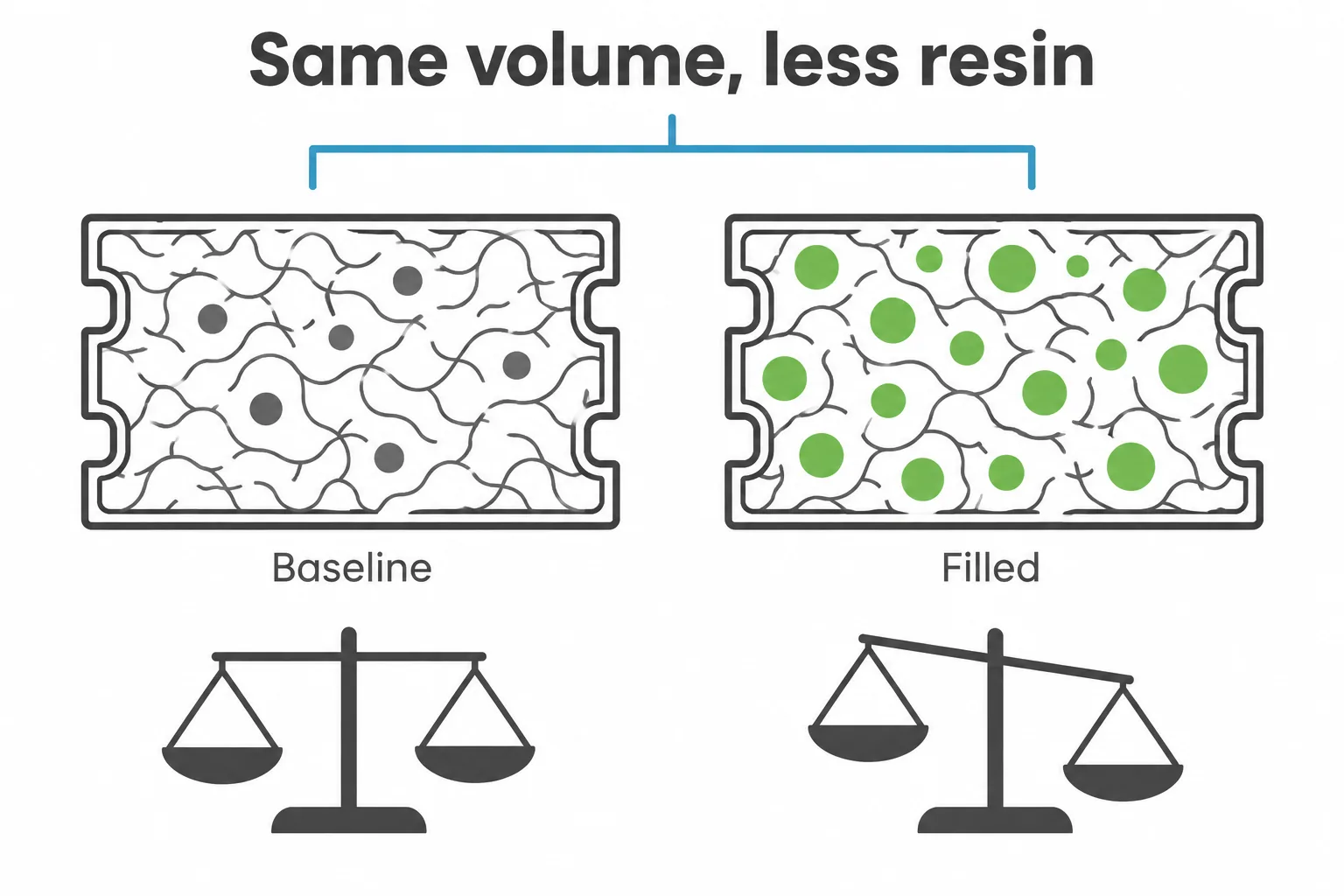
A filler’s sustainability cannot be established by its feedstock label alone. Buyers should compare the material’s origin and processing with its effect on the finished part and the part’s expected service life and end-of-life route. For a defensible comparison, request product-specific environmental data and check that both options use the same functional unit and assessment boundary.
A filler may reduce the PVC resin used in a formulation, but the environmental result depends on how much resin is displaced, whether the compound still meets its performance requirements, and what happens to the part after use. Lower filler density can reduce finished-part weight at a fixed volume, but that does not by itself prove lower freight cost or lifecycle impact.
Fillers are not inert. And in PVC, CaCO₃ may be the biggest silent variable in the room. It is often treated like a cost reducer.Read on LinkedIn ↗
Ask suppliers for feedstock origin, production and energy information, relevant technical data, and any product carbon-footprint or lifecycle documentation. A general sustainability statement is not a substitute for evidence tied to the grade being evaluated. CFI’s PVC additives guide gives additional context on how fillers fit within a broader additive package.
Is PVC a Sustainable Material? A Straight Answer
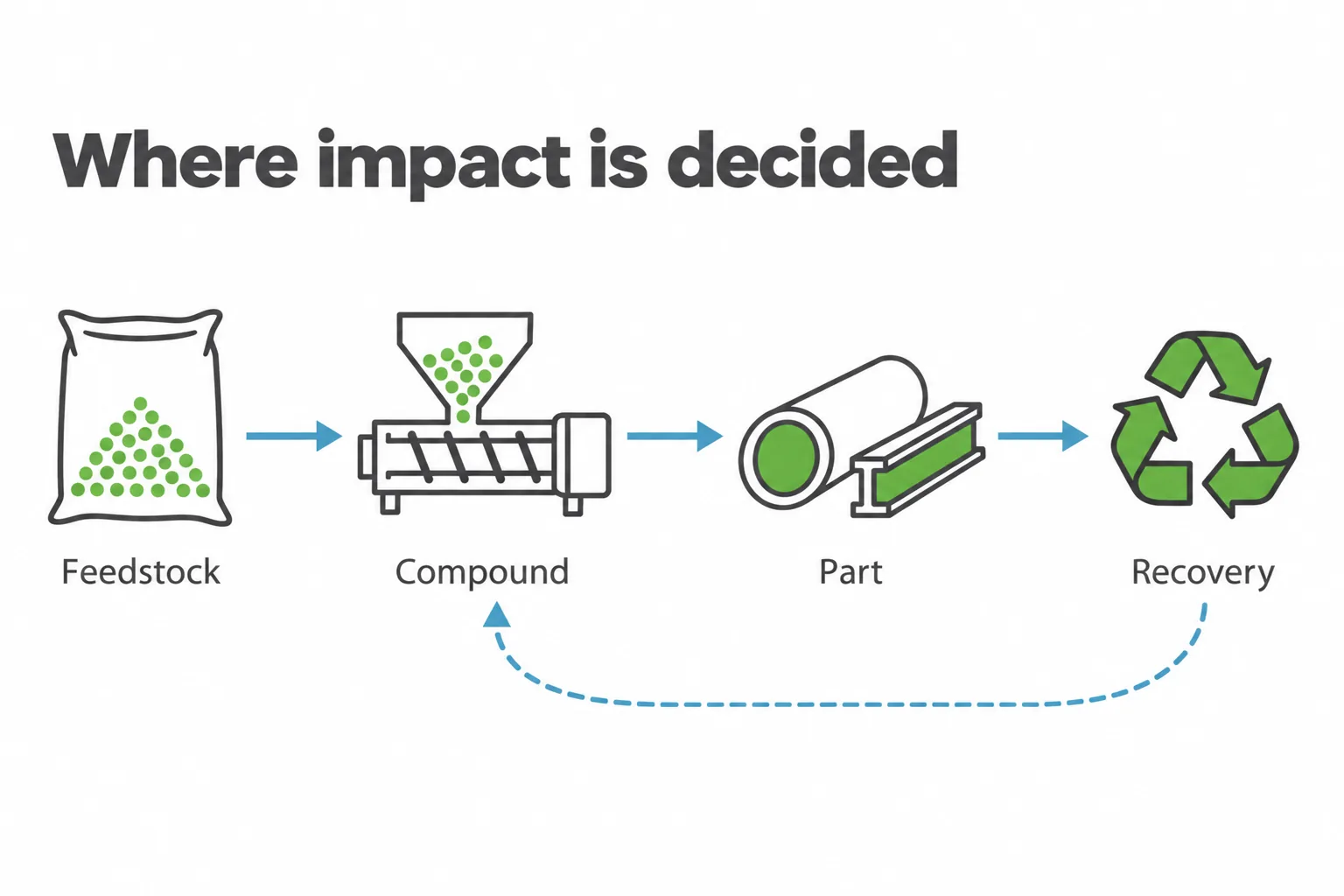
PVC has fossil-derived feedstocks, while its long service life and established recycling routes can be relevant to a product’s environmental assessment. Mechanical recycling is possible for suitable, sorted PVC streams, but compound composition, contamination, and legacy additives affect what can be recovered and how it can be used. The European Council of Vinyl Manufacturers’ overview of PVC recycling describes both multiple recycling and the challenges posed by composites and legacy additives.
For formulators, it helps to separate the resin’s inherent characteristics from choices made in the compound and the finished product. Fillers and additives can change weight, processing, performance, and the material mix, but a change should be evaluated against the finished part’s requirements.
| Factor | Influenced by | What to verify |
|---|---|---|
| Feedstock and chlorine content | PVC resin and supply chain | Resin and supplier documentation |
| Part weight | Formulation, density, part design | Weight per finished part at target performance |
| Recycled content | Feedstock and formulation | Source, consistency, and relevant contaminant screening |
| Recyclability | Product design, compound composition, local collection | Compatibility with the intended recovery stream |
| Scrap and process waste | Formulation and production controls | Trial and production data |
There is no single “most sustainable” plastic or filler for every application. Compare options for the same function, performance, geography, and end-of-life assumptions.
Common Filler Options for PVC Compounds: Benefits and Trade-offs
These categories describe materials formulators may evaluate; they are not all products supplied by CFI. The appropriate grade and loading depend on the application and should be confirmed through trials.
| Family | Examples | Potential role | Questions to qualify | Sustainability evidence to request |
|---|---|---|---|---|
| Mineral | Calcium carbonate, talc, kaolin | Cost, stiffness, or dimensional-property adjustment | Particle size, surface treatment, abrasion, impact retention | Source, processing data, and product-specific environmental data |
| Recycled or recovered | PVC regrind, recovered mineral streams | Reuse of suitable process scrap or recovered material | Composition, heat history, contamination, lot consistency | Recycled-content definition and traceability |
| Bio-based | Wood flour, hemp, rice husk, stone or shell flour | Renewable or residual feedstock; potential texture or density change | Moisture, heat history, dispersion, compatibility, fire behavior | Feedstock origin, treatment, processing, and end-of-life assumptions |
| Coal-derived organic | Austin Black 325 | CFI describes it as a low-specific-gravity organic filler for plastics | PVC-grade suitability, target properties, loading, color, processing | Exact emissions comparator and supporting product data |
There is no universal “best filler for PVC.” Match a candidate to the property that must be maintained, the process conditions, and the end-use requirements. CFI’s overview of plastic fillers provides broader context on filler functions in plastics.
Calcium Carbonate in PVC: Grade, Loading, and Trade-offs
Calcium carbonate is a widely used PVC filler, but its effect depends on grade, particle size, surface treatment, loading, and application. A formulator should not assume that a grade or loading suitable for one PVC product will work in another. For example, pipe requirements differ between pressure and non-pressure applications; Rollepaal’s PVC pipe filler guide discusses those application-specific trade-offs.
Review the supplier’s particle-size distribution, top size, grit, surface treatment, moisture, and specific gravity. Then evaluate the candidate in the intended formulation for dispersion, processing, surface quality, and the mechanical properties that matter to the part. Avoid stating a general loading limit unless it is tied to a named product type, test method, and source.
| Descriptor | What to request or measure | Why it matters |
|---|---|---|
| Particle-size distribution | Distribution data, including relevant fine and coarse fractions | Can affect dispersion, surface quality, and compound properties |
| Top size and grit | Supplier limits and inspection method | Oversize particles may affect finish or create defects |
| Surface treatment | Treatment type and grade-specific data | Can affect wetting and dispersion |
| Specific gravity | Grade-specific value | Helps estimate compound density; confirm with finished-part measurements |
Bio-Based Fillers: Real Gains, Real Process Limits
Bio-based fillers can add renewable or recovered feedstock to a PVC formulation, but they can also introduce moisture, heat-history, dispersion, and compatibility challenges. The size of each effect depends on the filler grade and formulation. Research on plasticised PVC and wood composites illustrates that processing and material properties need to be evaluated together.
Before a production trial, ask for moisture limits, particle-size data, thermal information, treatment or compatibilizer details, and recommended handling conditions. Measure processing behavior and part properties rather than assuming that drying, pelletizing, or a coupling agent will resolve every issue.
| Bio-based material | Qualification questions | Possible evaluation focus |
|---|---|---|
| Wood flour | Moisture, size, treatment, heat history | Dispersion, moisture-related defects, part properties |
| Hemp or other plant fiber | Fiber dimensions, moisture, thermal history | Feeding, dispersion, processing consistency |
| Rice husk | Ash and silica content, size, moisture | Abrasion, surface quality, compound performance |
| Stone or shell flour | Composition, size, treatment, lot consistency | Dispersion, appearance, mechanical properties |
Do not describe a bio-based filler as a reinforcement by default. Confirm whether it improves a target property in the actual PVC formulation; otherwise, present it as a potential feedstock or cost option, with limitations clearly stated.
Recycled and Recovered Filler Streams
Recycled and recovered materials can vary by source and processing history. Before increasing recycled content, establish material identity, consistency, contamination limits, thermal history, and suitability for the intended application. Screening for legacy additives may be relevant to some PVC streams; the necessary checks depend on the source and market requirements.
| Stream | Qualification checks | Possible initial evaluation |
|---|---|---|
| In-house post-industrial regrind | Source recipe, heat history, contamination, sizing | Controlled trial in a defined product layer or non-cosmetic application |
| External post-industrial PVC | Composition, stabilizer history, screening requirements, color variation | Trial only after source and compliance review |
| Recovered mineral stream | Grit, moisture, ash, composition, batch consistency | Partial substitution in a controlled formulation trial |
Do not assume a recycled input will preserve properties or improve the environmental profile automatically. Compare the finished formulation and document the recycled-content basis.
Austin Black 325 in PVC: Evaluate by Grade and Application
CFI describes Austin Black 325 as a dry, finely divided powder made from low-volatile bituminous coal, with low specific gravity. CFI also lists PVC among the plastic applications for its product. Those statements establish a reason to evaluate it; they do not establish that it will suit every PVC formulation or meet every target. Review the Austin Black 325 product information and confirm suitability through application-specific testing.
CFI states that Austin Black 325 emits less CO₂ than virgin and recycled carbon blacks and attributes that comparison to G3C Technologies. Keep any emissions statement within that stated comparison; it does not establish lower emissions than calcium carbonate or every other filler.
For a PVC trial, define the target first, such as finished-part weight, processing behavior, or a mechanical property, and compare the incumbent formulation with a controlled loading ladder. CFI’s plastics industry describes its product positioning in plastics.
How to Specify and Qualify a Sustainable Filler
Use a controlled trial and keep the incumbent formulation as a comparison. Change one main variable at a time where practical, record process conditions, and agree on pass/fail criteria before testing.
Related readingEnvironmentally Friendly Plastic Filler for Sustainable PlasticsRead the guide →| Step | Action | Decision it supports |
|---|---|---|
| 1 | Define the property that must not regress and its test method | Sets a measurable pass/fail criterion |
| 2 | Select trial loadings based on supplier guidance and the application | Shows how performance changes with loading |
| 3 | Record processing conditions and assess fusion or torque where relevant | Checks process behavior in the chosen system |
| 4 | Test the properties required by the part specification | Confirms whether the formulation meets requirements |
| 5 | Inspect molded or extruded parts for finish and defects | Identifies quality issues that lab numbers may miss |
| 6 | Compare cost and material use per acceptable finished part | Evaluates the commercial result at target performance |
Request a grade-specific data sheet, safety documentation, particle-size information, moisture limits, specific gravity, and any relevant thermal or environmental data. Add other tests based on the product specification rather than asking every filler supplier for an identical generic data set.
How to Evaluate Suppliers and Request a CFI Trial
Compare suppliers on the grade they can provide, available technical documentation, packaging, logistics, lot consistency, and support for qualification. CFI’s published services include formula testing and lab samples. Ask CFI whether it can support the specific PVC application and trial plan before treating those services as confirmed for your formulation. See the CFI services for its listed capabilities.
CFI’s relevant product in this guide is Austin Black 325. The other filler families are included as formulation context, not as a claim that CFI supplies them.
Key Takeaways
| Question | Short answer |
|---|---|
| How do I compare sustainability? | Compare product-specific evidence using the same function and assessment boundary. |
| Which filler should I choose? | Select by end-use requirements, process conditions, grade data, and trial results. |
| How do I verify a candidate? | Set measurable criteria, run a controlled trial, and assess the finished part. |
| What should I ask a supplier? | Request grade-specific technical, safety, traceability, and environmental documentation relevant to the application. |
FAQs About Sustainable Fillers for PVC Compounds
What is the best filler for PVC?
Can Austin Black 325 be evaluated for PVC compounds?
What is the most eco-friendly plastic?
What data should I request when comparing PVC fillers?
How much filler can a PVC compound take?
Talk Through Your Formulation
Bring the target application, current formulation baseline, and required properties to a technical discussion. CFI can confirm whether Austin Black 325 and its listed testing support are relevant to the proposed PVC trial. Contact us about your formulation.