
Two powders at the same loading, in the same polymer, can give parts that behave nothing alike. The mineral filler vs reinforcing filler decision sets whether a compound gets cheaper and holds tolerance, or gets stronger and tougher.
What follows separates the two roles, shows what each does to measured properties, and lays out a decision path for rubber, plastic, silicone, coating and adhesive formulas.
Article Summary
| Point | What it means for your formula |
|---|---|
| Two different jobs | A mineral (particulate) filler fills volume. A reinforcing filler bonds to the polymer and carries load. |
| Mineral filler payoff | Lower resin demand, less mold shrinkage and warpage, added stiffness, better opacity, smoother surface. |
| Reinforcing filler payoff | Higher tensile strength, tear strength, modulus, abrasion life and fatigue life. |
| What decides the label | Particle size, surface area, particle shape (aspect ratio) and surface chemistry, not the mineral’s name. |
| The usual trade | Stiffness rises with almost any rigid filler. Strength rises only when the filler bonds to the matrix. |
| Cost reality | Cost per pound misleads. Cost per cubic inch of finished part is the number that pays the bills. |
| Production practice | Most commercial compounds run a reinforcing package plus an extender package, not one or the other. |
| Low-density organic option | Grades such as Austin Black 325 add volume and improve processability at a specific gravity below common minerals, so parts stay lighter at equal volume. |
What a Filler Does Inside a Polymer Compound
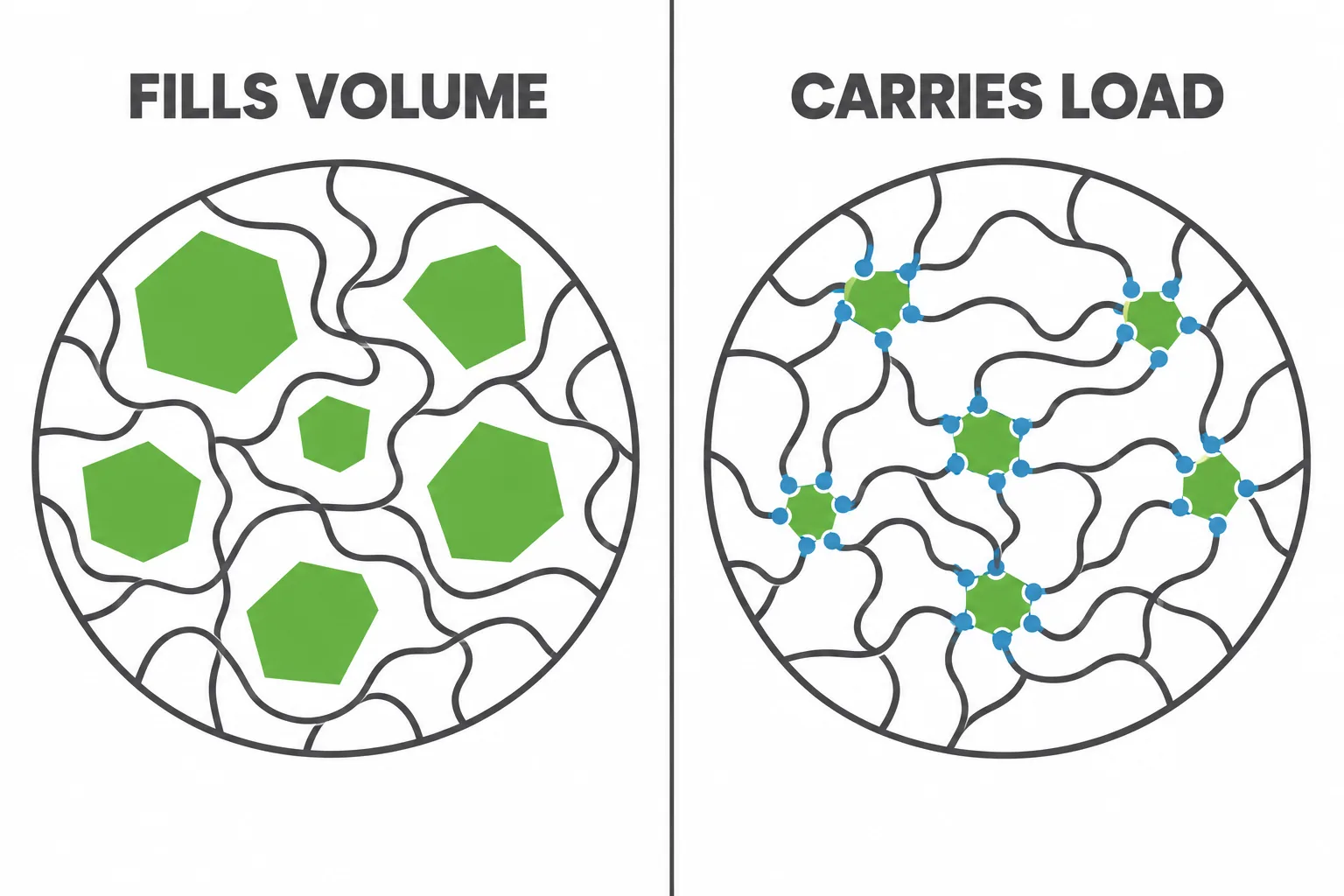
A filler is a finely divided solid dispersed through rubber, plastic, silicone or a coating vehicle. It does not dissolve. It stays a separate phase, so compound behavior comes from three things: the polymer, the filler, and the boundary between them. That boundary is the whole argument in a mineral filler vs reinforcing filler comparison.
Fillers earn their place in three ways. They occupy volume that would otherwise be resin or elastomer. They change how a batch mixes, flows and cures. They shift the finished part’s mechanical, thermal, electrical and optical behavior. Few grades do all three well, which is why real recipes carry several.
Units matter. Rubber formulators state loading in phr (parts per hundred rubber). Plastics and coatings work in weight percent, sometimes volume percent. A swap that looks even by weight can be far off by volume when two fillers differ in density, and volume is what fills a mold cavity.
One point before any data sheet gets opened: “filler” and “reinforcement” mark the ends of a range, not two sealed boxes. A coarse ground grade behaves as a pure extender. A fine, surface-treated grade of the same mineral moves toward semi-reinforcing.
The label belongs to the grade in a specific polymer, never to the mineral name. That logic runs through the whole family of particulate fillers used in thermoplastics.
Mineral Filler Defined
Mineral fillers are inorganic particulates, either mined and ground or chemically precipitated. The names on a purchase order are calcium carbonate, talc, kaolin clay, mica, wollastonite, barite and silica flour. Typical grades sit in the micron size range, carry modest surface area, and show low surface activity toward most polymers.
Their value shows up in four places. Resin replacement, since the filler costs less per unit volume than the polymer it displaces. Dimensional control, since a rigid mineral phase does not shrink as the polymer cools, so molded parts hold tolerance and warp less. Appearance and opacity. Thermal mass and heat transfer during cycling.
The penalty is weight. Mineral fillers run at specific gravities well above the polymers they go into, so a compound gains weight as mineral loading climbs, even while cost per unit volume falls. Run any yield calculation on volume, with the carbon filler density figures and mineral gravities in hand, before calling a substitution a win.
Readers often arrive from two non-polymer uses of the same phrase. Mineral filler in asphalt refers to the fine dust fraction that passes the No. 200 sieve and stiffens the binder by packing between larger aggregate. Mineral filler in concrete plays a comparable packing and paste-volume role.
Different industries, same physics: fine particles occupy space between coarse ones and change the behavior of the phase holding everything together.
Common Mineral Fillers and What Each Contributes
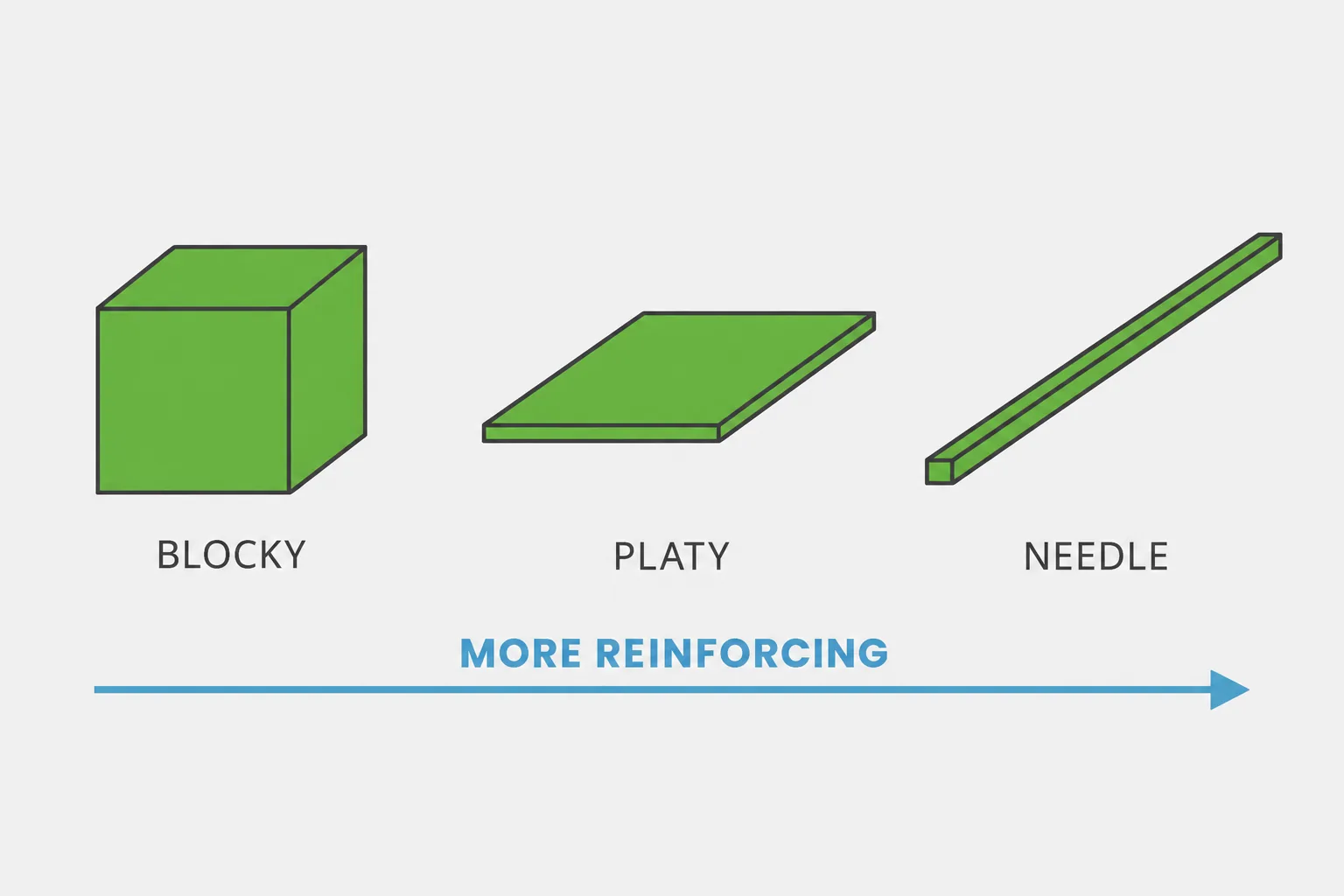
Shape drives most of the difference between these grades. Blocky particles add volume and stiffness. Platy and needle-shaped particles push into semi-reinforcing territory because they spread stress over a longer particle dimension.
| Mineral filler | Typical particle shape | Relative cost position | Main property gained | Usual sacrifice |
|---|---|---|---|---|
| Calcium carbonate | Blocky, low aspect ratio | Lowest | Volume, cost per part, surface smoothness | Little strength gain, added weight |
| Talc | Platy | Low to moderate | Stiffness, heat deflection, dimensional stability | Impact strength, sometimes gloss |
| Kaolin clay | Platy | Low to moderate | Electrical properties, surface finish, print quality | Viscosity rises with fine grades |
| Mica | Platy, high-aspect-ratio | Moderate | Stiffness, barrier, low warpage, thermal stability | Impact strength, surface appearance |
| Wollastonite | Acicular (needle-like) | Moderate | Partial strength and modulus gain, heat resistance | Abrasive to equipment, brittleness |
| Silica flour | Angular, hard | Low to moderate | Hardness, wear surface, chemical resistance | Heavy tool and screw wear |
| Barite | Blocky, very dense | Moderate | Mass, sound damping, radiation shielding | Large weight increase |
Talc and mica sit closest to the line. Both raise stiffness and heat resistance far more than an equal load of blocky carbonate, and both cut permeability. Wollastonite straddles the line outright: its needle shape delivers a slice of fiber-like behavior without fiber pricing.
Reinforcing Filler Defined
Reinforcement is defined by the interface, not by origin. A reinforcing filler bonds or strongly interacts with the polymer chains around it, so applied stress transfers from the soft matrix into the rigid particle instead of tearing the matrix apart.
The everyday examples are carbon black in rubber compounds and precipitated silica in rubber, glass fiber, carbon fiber and nanoclays in plastics, and fumed silica in silicone.
Three grade properties create that interface. Fine primary particle size gives a large contact area per unit weight. Aggregate structure traps polymer inside branched clusters, which behaves as extra rigid volume.
Surface chemistry decides how well the chains anchor. In rubber, the result gets measured as bound rubber: polymer that stays attached to filler after solvent extraction.
The property outcome is consistent. Tensile strength rises. Tear strength rises. Modulus rises. Abrasion resistance and flex fatigue life rise. In thermoplastics, glass fiber pushes tensile strength and flexural modulus up sharply.
The costs are equally consistent. Compound viscosity climbs, mixing energy and cycle time climb with it, and heat build-up under dynamic load gets worse.
Fiber reinforcement adds anisotropy: properties and shrinkage differ along the flow direction versus across it, so warpage becomes a design problem. Notched impact toughness often drops as the compound gets stiffer and stronger.
Mineral Filler vs Reinforcing Filler: Side-by-Side Comparison
According to a study by Francis W. Starr, T. B. Schroeder, and S. C. Glotzer, published by the National Institute of Standards and Technology (NIST), fillers are widely used to modify polymer properties. The researchers state:
> “Fillers are commonly used in industrial applications to alter the properties of polymer materials. However, little is known about the microscopic details of polymer-filler interactions, limiting the development and application of new filled polymers. In particular, fillers can shift the glass transition temperature $T\_g$ in polymers, which influences crystallization, aging, frictional properties, and material hardness.”
Read the left column as the question a spec sheet is asking, then check which filler class answers it.
Related readingHow to Increase Rubber Abrasion Resistance: Testing GuideRead the guide →| Attribute | Mineral (particulate) filler | Reinforcing filler |
|---|---|---|
| Primary job | Occupy volume, control dimensions | Carry load, raise strength |
| Typical particle size | Micron range | Sub-micron primary particles or continuous fibers |
| Surface area per gram | Low | High to very high |
| Aspect ratio | Near 1 for blocky grades, higher for platy | Aggregated structures, or fibers well above 1 |
| Bond to polymer | Weak, mostly mechanical | Strong interaction, chemical or physical |
| Tensile strength | Flat or lower | Higher |
| Modulus and stiffness | Higher | Higher |
| Elongation at break | Lower | Lower, though tear energy improves |
| Tear and abrasion resistance | Little change | Clear improvement |
| Cost per pound | Low | Higher |
| Cost per unit volume of part | Usually the reason it is there | Justified by property gain, not price |
| Compound viscosity | Moderate rise | Large rise |
| Cure behavior | Mostly neutral, watch pH and moisture | Can accelerate or retard, surface-dependent |
| Mold shrinkage | Lower and more uniform | Lower but often directional |
| Typical loading | Moderate to very high | Moderate, set by the property target |
Reinforcement is measured, not claimed.
Mix the compound, cure a plaque, pull tensile and tear specimens, and let the numbers assign the label.
A supplier description of a grade as “reinforcing” means nothing until it has run in your polymer at your loading. The same discipline applies when you compare reinforcing and non-reinforcing grades for rubber side by side.
Particle Properties That Decide Reinforcement
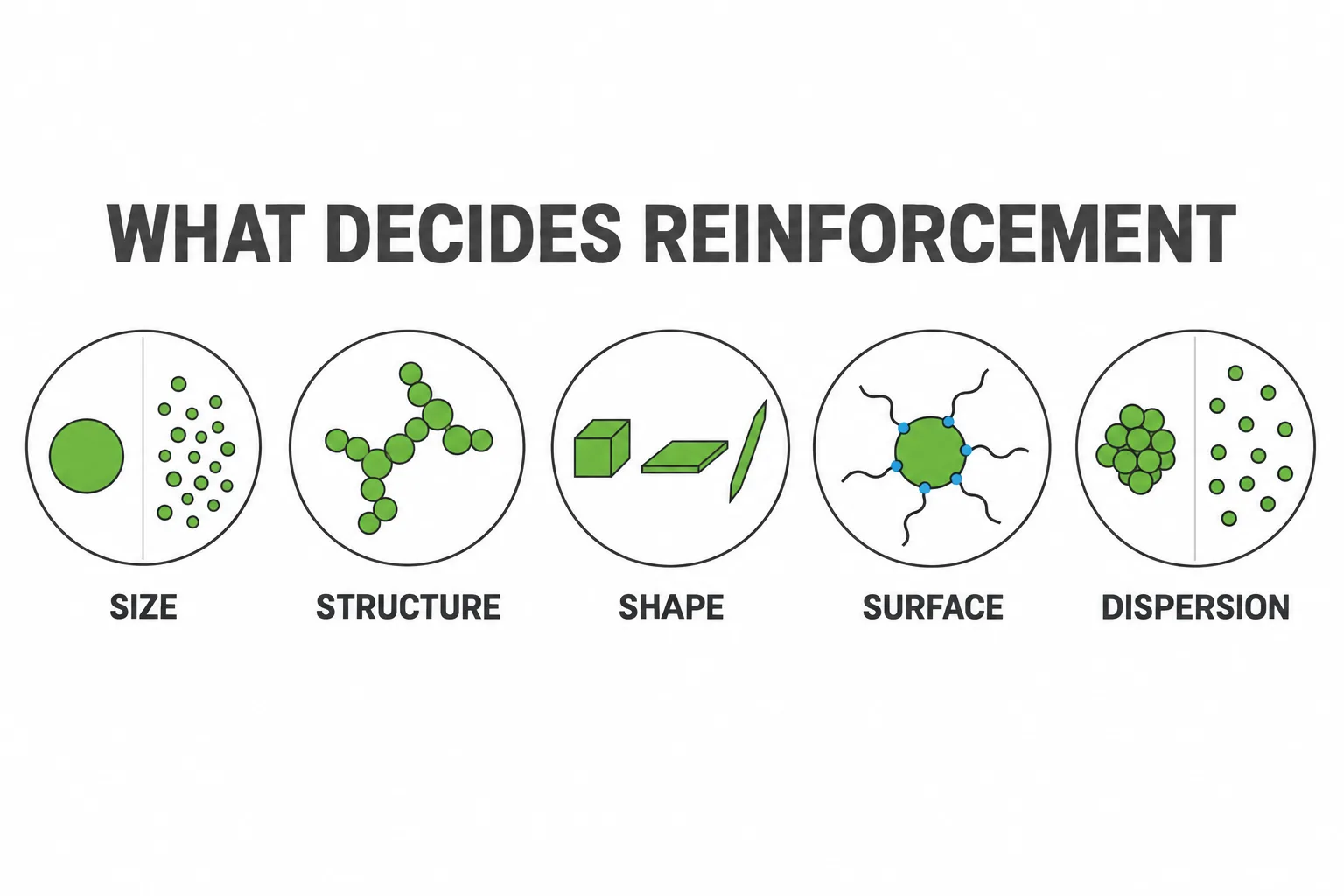
Four grade characteristics decide which side of the line a filler lands on, and a fifth decides whether the grade ever shows what it can do.
Particle Size and Surface Area
Reinforcement starts when particles get small enough for polymer-filler contact area to dominate compound response. Coarse grades never reach that point, whatever the loading.
Reinforcing carbon black grades carry far finer primary particles and far more surface area per gram than a typical ground mineral. Exact figures belong to each grade’s data sheet and vary widely inside one product family.
A technical report prepared for the U.S. Environmental Protection Agency by Radian Corporation, Industrial Process Profiles for Environmental Use: Plastics Additives (1985), explains how kaolin particle size can affect the properties of plastics:
“Coarse kaolins tend to increase tensile strength, whereas finer particle sizes improve compressive strength and surface finish.” (Source: EPA-sponsored report)
Structure
Branched aggregates trap polymer in their voids. That occluded polymer stops behaving like free matrix and acts as more rigid phase, which is why two grades with matching surface area can still give different modulus.
Particle Shape
Shape sets how stress transfers across the particle.
| Shape class | Example fillers | What it drives | Note |
|---|---|---|---|
| Spherical or blocky | Calcium carbonate, glass beads | Volume, flow, isotropic shrinkage | Lowest property gain, easiest processing |
| Platy | Talc, mica, kaolin | Stiffness, barrier, low warpage | Semi-reinforcing in stiffness, not in tensile |
| Acicular | Wollastonite | Partial strength and modulus gain | Between mineral and fiber behavior |
| Aggregated fine particles | Carbon black, precipitated and fumed silica | Tensile, tear, abrasion | Reinforcement through interface area |
| Fibrous | Glass fiber, carbon fiber | Tensile and flexural strength | Strong but directional |
Surface Chemistry
This is the lever that turns a passive mineral into a semi-active one. Silane coupling agents build a chemical bridge between mineral surfaces and the matrix. Stearate coatings on carbonates improve wetting and dispersion and hold viscosity down at high loading. A treated grade can beat an untreated grade of the same mineral by a wide margin.
Dispersion
An undispersed reinforcing filler performs like an expensive extender, and agglomerates act as flaws that start cracks. Mixing sequence, temperature and energy input all belong in the comparison. Judge a filler only after a dispersion check confirms it was mixed properly.
Property Effects Compared: Stiffness and Strength vs Cost and Shrinkage
Directions matter more than numbers while a formula is still on paper. This table gives the expected direction of travel when each filler class goes into an unfilled baseline.
| Property | Mineral filler added | Reinforcing filler added | Comment |
|---|---|---|---|
| Tensile strength | Flat to down | Up | Only bonded filler transfers load |
| Flexural modulus | Up | Up | Any rigid phase stiffens the compound |
| Impact strength | Down | Down, varies with type | The usual casualty on both sides |
| Heat deflection temperature | Up, best with platy grades | Up | Rigid phase resists softening |
| Mold shrinkage | Down, more uniform | Down, often directional | Strongest technical case for mineral loading |
| Warpage | Down with platy fillers | Can rise with fibers | Fiber orientation drives it |
| Specific gravity | Up | Up, depends on type | Heavier part at the same volume |
| Surface finish | Usually smoother | Can show fiber read-through | Cosmetic parts care about this |
| Cost per finished part | Down | Up | Judge by volume, not weight |
The shrinkage row deserves attention. Polymers keep contracting after ejection as chains relax and crystallize. A rigid filler phase does not, so each percentage point of filler volume removes polymer that could shrink.
Talc- and carbonate-filled polypropylene normally holds tolerance better and moves more evenly in both directions than the unfilled resin.
For tight-tolerance housings, brackets and closures, that alone justifies mineral loading, whether or not a single pound of cost gets saved.
Impact behavior splits by shape. Platy fillers cut impact toughness as they raise stiffness. Fibers keep more energy absorption unnotched but lose it at a notch or weld line. Elastomer-modified systems and coupled grades recover part of the loss, which is where the full reinforcement options for plastic parts enter the conversation.
On cost, the trap is simple. Filler priced per pound looks cheap, then the finished part weighs more, so fewer parts come out of every pound bought. Convert everything to cost per cubic inch or per finished piece. A lighter filler at a higher price per pound can still land a lower cost per part.
When to Use a Mineral Filler
Reach for a mineral filler when the mechanical spec is already satisfied and something else needs attention.
High-volume parts with comfortable strength margins are the clearest case: the compound has strength to spare, and resin replacement drops cost at low risk.
Tight-tolerance molded parts are the second case, where shrinkage and warpage, not tensile strength, cause the scrap. Parts that need opacity, sound damping, flame-retardant support or a smooth paintable surface make up the third.
Non-critical rubber goods live here too: mats, mounts, pads, low-pressure hose covers, footwear soles and roofing membranes. These need hardness, weather resistance and a workable price, not tire-tread abrasion life.
Coatings and inks follow the same logic, and the balance tips further toward particulates. Hiding power, film build, sheen control and rheology govern selection, so extender pigments and a rheological additive do more for a finished film than mechanical reinforcement ever will.
Formulators who work on additives for wood coatings, powder coating additives or a paint additive for cabinets manage flow, block resistance and burnish resistance rather than tensile numbers.
Dark color refinishing paint formulation adds its own constraint, since jetness and undertone track the carbon-based pigment choice as much as the binder. Those calls sit inside the wider set of coating additives that control film properties.
When to Use a Reinforcing Filler
Reach for reinforcement when the part fails without it.
Dynamic, load-bearing and abrasion-exposed components come first: tire treads, drive belts, bushings, engine mounts, conveyor covers, structural housings, anything under repeated flex.
Second, any spec written as a minimum tensile, tear or flexural modulus value, since those numbers need a bonded filler phase. Third, cases where one field failure costs far more than the raw material premium.
Carbon black brings side benefits no mineral matches. It blocks UV, which is why black compounds outlast light-colored ones outdoors, and it covers ground that a dedicated UV stabilizer additive would otherwise hold in plastic and paint systems. At high loading with the right grade, it also lowers electrical resistivity enough for antistatic and conductive duty.
There is also a middle path. A partial swap, where some reinforcement gives way to a semi-reinforcing or extender grade, protects the properties that matter while it trims cost and improves processability. Choosing a swap partner sensibly means knowing the grade families of carbon black and what each family actually delivers.
Blended Filler Systems: The Practical Answer
Almost no production compound is purely reinforced or purely extended. A typical recipe carries a reinforcing package sized to the mechanical spec, plus an extender package sized to cost, processability and density targets. In practice, the mineral filler vs reinforcing filler question becomes a ratio question.
This worked example shows the direction of travel across three versions of one compound. Directions are typical, not guaranteed, and every swap needs bench data before a plant trial.
| Compound version | Reinforcing loading | Extender loading | Tensile | Hardness | Specific gravity | Compound cost |
|---|---|---|---|---|---|---|
| Baseline, fully reinforced | High | None | Highest | Target | Baseline | Highest |
| Partial mineral substitution | Reduced | Mineral added | Lower | Up slightly | Up | Down |
| Partial organic filler substitution | Reduced | Low-density organic filler added | Slightly lower | Near target | Down | Down |
The third row is the one formulators tend to miss. Parts sell by the piece, not by the pound, so a filler with low specific gravity stretches every pound of compound across more parts. Add a heavy mineral and cost per pound falls while cost per part may not.
That is the role Austin Black 325 plays. It is a finely divided powder produced from low-volatile bituminous coal, organic rather than mineral, with a specific gravity below that of common mineral fillers. It adds volume, improves processability and reduces finished part weight, and its low-emission production suits formulators who also carry sustainability targets.
In rubber it belongs to the same conversation as other carbon black alternatives and the broader push for eco-friendly rubber and greener rubber alternatives, where compounders want less cost and less weight without losing the properties the part was designed around.
Validate the swap before a production line commits to it. Formula testing and lab sampling at small scale, with cured plaques pulled beside the incumbent, cost far less than a failed batch.
Filler Selection Checklist for a New Compound
Work through these checks in order. Most bad filler decisions skip one of them.
| Check | Question to answer | Why it matters |
|---|---|---|
| Property spec | Which numbers are minimums, and how much margin exists? | Minimums decide whether reinforcement is optional |
| Volume vs weight | Is the part sold by piece, weight or volume? | Sets whether low density is worth paying for |
| Cure compatibility | Do the filler’s pH, moisture or extractables interfere with cure? | Scorch and under-cure trace back here often |
| Equipment wear | Is the grade abrasive? | Silica flour and some clays wear screws and dies; talc and carbonate are gentle |
| Color and appearance | Is the compound dark, white or pastel? | Dark compounds accept carbon-based fillers; light ones do not |
| Dispersion plan | What mixing sequence and check confirm dispersion? | Judge performance only after proper dispersion |
| Regulatory | Any food contact, dust or restricted substance limits? | Cheaper is irrelevant if the grade cannot be used |
| Supply reliability | Single source or multiple, and how far from the plant? | Property consistency and lead time both depend on it |
No filler works in isolation. It interacts with plasticizers, stabilizers, process aids and cure chemicals, so evaluate it as part of the full polymer additive system rather than as a drop-in line item.
Application Snapshot by Industry
Same physics, different priorities. Each industry has one property that governs the decision.
| Industry | Common mineral choice | Common reinforcement | Governing property |
|---|---|---|---|
| Rubber goods | Calcium carbonate, clay, talc | Carbon black, precipitated silica | Abrasion and tear life |
| Thermoplastics | Talc, carbonate, mica | Glass fiber, carbon fiber | Stiffness with dimensional control |
| Silicone | Ground quartz, diatomite | Fumed and precipitated silica | Tear strength, since unfilled silicone is weak |
| Coatings | Extender pigments, clay | Rarely mechanical | Hiding power and film build |
| Adhesives and sealants | Carbonate, talc, fumed silica | Fumed silica, short fibers | Rheology, sag resistance, gap fill |
Silicone is the extreme case. Unfilled silicone gum has almost no useful strength, so nearly all of its tear resistance comes from a reinforcing silica. Adhesive and sealant lines sit at the other end, where sag resistance, tooling behavior and gap fill outrank tensile numbers, and where additive choices for adhesives are usually rheology decisions in disguise.
PVC additives, polyurethane additives and the wider families of industrial additives and specialty additives follow the same split: some are there for volume and flow, some for measured mechanical performance.
Filler Terms and What They Actually Mean
Vocabulary causes more confusion in this subject than the physics does.
| Term | Meaning |
|---|---|
| Filler | Any finely divided solid dispersed in a polymer, whatever its function |
| Extender | A filler used mainly to replace resin volume and cut cost |
| Reinforcement | A filler that bonds to the matrix and raises strength, tear and abrasion properties |
| Semi-reinforcing | A filler that improves some mechanical properties without full reinforcement, often platy or surface-treated |
| Functional filler | A filler chosen for a specific property gain such as flame retardance, conductivity, barrier or color |
| Structural filler | In composites, a filler or core material that contributes load-bearing capability rather than only volume |
| Repair filler | A consumer or shop product (wall filler, wood filler, body filler) used to fill holes before finish, unrelated to polymer compounding |
That last row heads off a common mix-up. Searches for the best filler for walls or for plastic repair land on the same word but a different product class: hardware-store pastes and putties that harden inside a cavity. Compounding fillers are powders dispersed through a polymer before the part exists.
Carbon-based compounding fillers are black to dark gray, which answers the related question about what color carbon is in this context. This overview of what carbon black is covers it in more detail.
Frequently asked questions
What is a structural filler?
Is every mineral filler non-reinforcing?
Can a mineral filler replace carbon black entirely?
What is the difference between wood filler and all-purpose filler?
What filler is best for plastic?
Does filler choice affect the electrical conductivity of a compound?
How much filler is too much?
Key Takeaways
| Scenario | Decision rule |
|---|---|
| Strength spec already met with margin | Add mineral filler for cost and dimensional stability |
| Part fails on tensile, tear or abrasion | Add or keep a reinforcing filler |
| Warpage or tolerance problems | Platy mineral filler, watch fiber orientation |
| Part weight or cost per piece is the target | Prioritize low specific gravity, calculate by volume |
| Coating or sealant work | Rheology, hiding and film build outrank mechanical reinforcement |
| Cost pressure on a reinforced compound | Partial substitution, validated with cured plaque data |
Two sentences carry the whole mineral filler vs reinforcing filler comparison. Reinforcement is a measured interfacial effect that raises strength, tear and abrasion life.
Mineral loading is a volume and dimensional-control effect that cuts cost and shrinkage. Blends beat purism in nearly every commercial formula, because most parts have to hit a property target and a cost target at once.
Run the Substitution on Your Own Formula
Directional tables get a formulation started. Cured plaque data settles it. CFI Carbon Products has manufactured filler materials for rubber, plastics, silicone and coatings since 1987, and offers formula testing, lab sampling, toll grinding and custom packaging to support that work.
See the services available for formulation trials, or pull the Austin Black 325 technical data sheet and related technical answers from the resources index. Request a sample, run it beside your incumbent filler at equal volume, and let the tensile, hardness and density numbers make the call.