
Rubber rarely fails from abrasion for one simple reason. It may be the wrong elastomer, a weak filler package, poor dispersion, too much oil, an uneven cure, excess heat, rough contact surfaces, or a test method that never matched the real job in the first place.
For manufacturers, the practical answer is to treat abrasion resistance as a compound design problem, not just a hardness problem. The right polymer, filler system, cure package, process control, and validation test can help rubber parts last longer without pushing cost, density, or production efficiency out of balance.
To improve rubber abrasion resistance, manufacturers need to match the elastomer to the wear mechanism, reinforce the compound with the right filler system, control plasticizer levels, fine-tune vulcanization, improve filler dispersion, and confirm the result with recognized abrasion testing. For rubber compounders, CFI Carbon Products supports this process with Austin Black 325, lab samples, formula testing, and technical support for industrial rubber applications.
How to Increase Rubber Abrasion Resistance
The best way to answer how to increase rubber abrasion resistance is to start with the compound itself. A rubber part resists abrasion when the polymer network can absorb stress, hold its surface, resist crack growth, and keep its properties under load, heat, friction, and chemical exposure.
That performance comes from several connected choices. The elastomer must fit the application. The filler package must reinforce the rubber without making it difficult to process. The curing system must build enough strength without making the material brittle. The finished compound must then be tested under conditions close to real service.
In practical terms, how to increase rubber abrasion resistance comes down to six decisions: choose an elastomer that fits the wear mechanism, reinforce it with the right filler, avoid over-softening the compound, control the cure system, improve filler dispersion, and test the material before production scale-up.
A conveyor belt cover, tire tread, rubber liner, roofing membrane, seal, hose, or molded automotive part may all need abrasion resistance, but each one sees wear differently. That is why one rubber formulation cannot solve every abrasion problem.
For manufacturers that work with industrial rubber compounds, filler choice can make a measurable difference. CFI Carbon Products supports manufacturers with rubber filler solutions for industrial compounds, including Austin Black 325, a low-specific-gravity carbon-based filler used in rubber, plastics, silicone, coatings, roofing, belts, hoses, seals, tires, and related applications.
CFI describes Austin Black 325 as a finely divided powder derived from high-quality, low-volatile bituminous coal. In suitable formulations, it can support processability, lower end-product weight, and improve formula economics.
What Is Wear Resistance in Rubber?
Wear resistance is the ability of rubber to withstand surface loss from friction, scraping, rolling, impact, or repeated mechanical contact. In shop-floor language, it answers one question: how long can the rubber keep doing its job before the surface wears away, cracks, tears, or loses its shape?
That is why what wear resistance is more than a definition. For a plant manager, it affects downtime. For a purchasing team, it affects replacement cost. For an engineer, it affects safety margins and performance. For a compounder, it affects every part of the recipe.
Abrasion resistance is one form of wear resistance. It focuses on the rubber surface and how well that surface holds up when another surface, particle, or operating condition rubs against it.
A rubber compound may have good tensile strength and still fail early from abrasion if its surface is too soft, its filler is poorly dispersed, or its cure state is not right. That is the detail many short articles miss.
Why Rubber Abrasion Resistance Fails in Real Applications
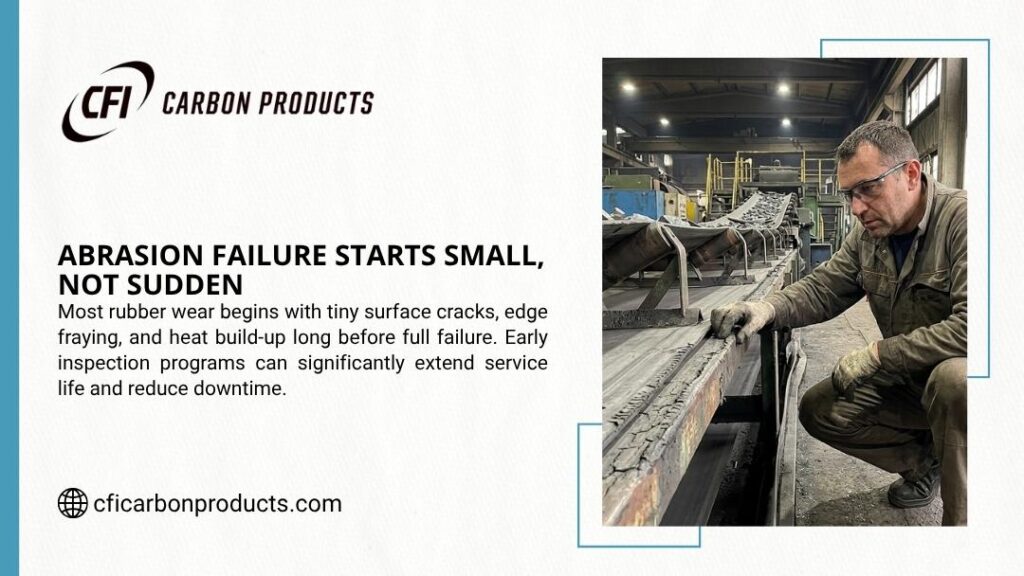
Rubber wear rarely starts as a dramatic failure. More often, it begins with small surface loss, heat build-up, micro-cracks, edge damage, or tiny cuts that grow under repeated stress. Once the surface opens up, the compound becomes easier to attack. Dirt, sharp particles, oil, water, ozone, or heat can speed that damage along.
One common mistake is to assume that hardness alone creates wear-resistant rubber. Hardness matters, but it is not the whole story. A hard compound may resist indentation yet crack under flex. A softer compound may absorb impact yet lose material too fast under sliding abrasion. A highly filled compound may reduce cost but hurt rebound or tear strength.
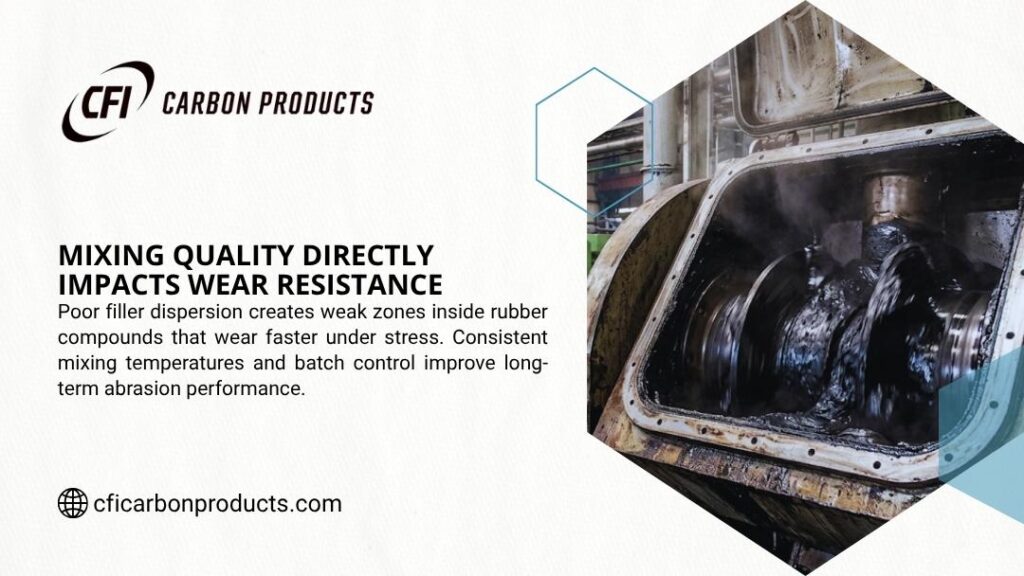
Poor mixing is another quiet problem. If carbon black, silica, mineral filler, or a carbon-based filler does not disperse well, the rubber surface can develop weak zones. Those weak zones become abrasion points. The part may pass a basic visual inspection and still fail earlier than expected in the field.
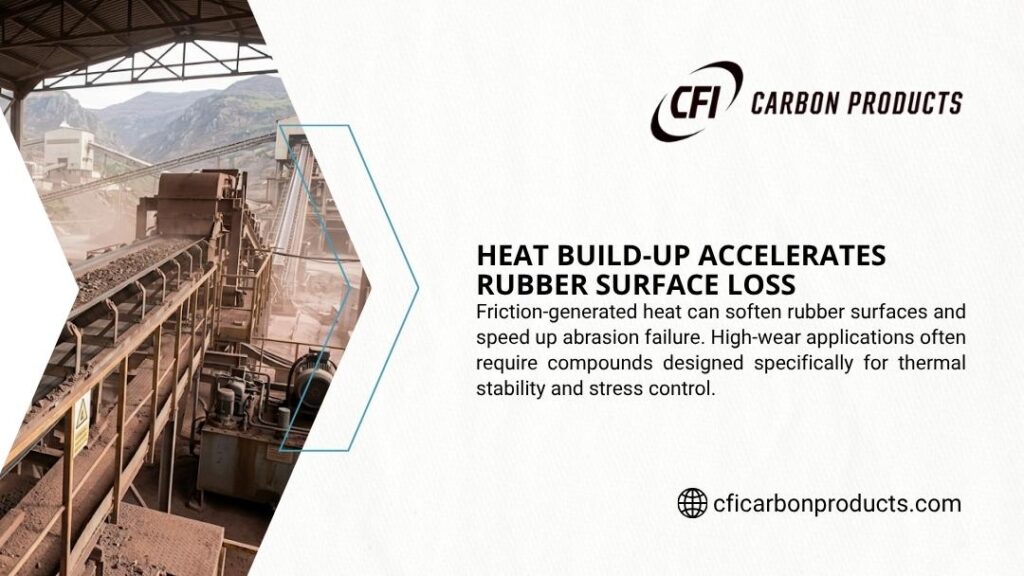
Heat also changes the equation. A formula that performs well at room temperature may lose wear resistance under frictional heat. This matters in tires, belts, rollers, gaskets near engines, industrial linings, and parts that work under constant contact.
Choose the Right Elastomer for Wear-Resistant Rubber Parts
The base polymer sets the ceiling for wear performance. Fillers and additives can improve a compound, but they cannot fully rescue the wrong elastomer from the wrong environment. Natural rubber, SBR, BR, NBR, EPDM, silicone, and polyurethane all behave differently under abrasion, oil, heat, weather, and flex.
| Rubber Type | Abrasion Profile | Best Fit | Watch-Out |
| Natural Rubber | Strong tear and cut resistance with good resilience | Liners, rollers, impact-prone parts, heavy-duty goods | Weak against oils, fuels, and some outdoor exposure |
| SBR | Balanced wear resistance and cost | Tire tread blends, belts, molded rubber goods | Needs a strong filler system for demanding wear |
| BR | Very good abrasion performance and rebound | Tire treads, high-wear blends, dynamic parts | Often works best as a blend, not alone |
| NBR | Good wear resistance with oil resistance | Seals, hoses, gaskets, and industrial parts | Poorer ozone and weather resistance than EPDM |
| EPDM | Good weather, ozone, and water resistance | Roofing, outdoor seals, weather-exposed parts | Not always ideal for severe sliding abrasion |
| Silicone | Strong heat resistance but lower abrasion strength | Heat-exposed seals and specialty parts | Needs reinforcement when wear is critical |
| Polyurethane | Excellent abrasion resistance in many uses | Wheels, liners, rollers, high-wear components | Heat and environment can limit performance |
This is why how to increase rubber abrasion resistance should always start with the actual application. A belt cover in a mining facility, a tire tread, and a door seal do not need the same compound, even if all three need longer service life.
Improve Rubber Wear Resistance with Reinforcing Fillers
Reinforcing fillers help rubber resist wear by strengthening the compound, improving surface toughness, reducing material loss, and supporting mechanical performance. Carbon black, silica, clay, calcium carbonate, talc, fibers, and specialty carbon-based fillers all have a place, but they do not behave the same way.
Carbon black is widely used because it can improve tensile strength, tear resistance, abrasion resistance, conductivity, and UV protection, depending on grade, loading, structure, and surface area. Silica can improve certain wear and rolling-resistance properties, especially with the right coupling system. Mineral fillers may help with cost, processing, stiffness, and volume, though not all mineral fillers reinforce rubber equally.
CFI’s Austin Black 325 carbon-based filler belongs in this conversation because it is positioned as a low-specific-gravity organic filler that can help manufacturers improve processability, reduce end-product weight, support cost savings, and contribute to lower-emission formulation goals where the compound allows it.
For a rubber manufacturer, the better question is not simply which filler is strongest. The better question is this: which filler package delivers the best mix of wear resistance, weight, dispersion, processing, and cost-effective rubber reinforcement for long-term performance.
Balance Carbon Black, Silica, and Alternative Rubber Fillers
Adding more filler is not the same as improving the compound. Too much filler can raise viscosity, slow processing, reduce elongation, hurt rebound, increase heat build-up, or make the compound harder to mix evenly. Too little reinforcement can leave the surface vulnerable to fast wear.
A good filler package has a job. It may reinforce the rubber, lower cost, improve processing, reduce density, adjust color, reduce air permeation, or improve specific properties such as stiffness, tear strength, or abrasion resistance. The best formulas usually balance those goals rather than chase one property at the expense of the whole part.
CFI’s Austin Black 325 is relevant where manufacturers want to review compound economics and performance together. CFI states that its low specific gravity can help fill more volumetric space compared with heavier mineral fillers, which may support lower compound cost and reduced end-product weight in suitable formulations.
That matters for companies that need wear-resistant parts but also care about shipment weight, cycle behavior, mold fill, and cost per finished unit. A practical formula review may include traditional carbon black, silica, or a specialty filler such as Austin Black 325, then compare results through abrasion, tensile, tear, hardness, density, and process trials.
For manufacturers that need a commercial view of filler selection, understanding cost-effective filler strategies for profitability gives a useful starting point.
Best Filler Strategy by Rubber Application
Different applications need different filler priorities. A tire tread may need abrasion resistance, rebound, heat control, and rolling efficiency. A roofing membrane may need weather resistance and dimensional stability. A conveyor belt cover may need cut resistance, tear strength, and heavy-duty wear performance. The filler package should match the damage pattern.
| Application | Main Wear Challenge | Filler Strategy to Consider | Why It Helps |
| Tire tread compounds | Rolling abrasion, heat, and road friction | Carbon black, silica, and selected carbon-based fillers | Balances wear resistance, rebound, heat behavior, and cost |
| Conveyor belts | Cutting, gouging, sliding abrasion | Reinforcing carbon black, specialty fillers, and tear-supporting systems | Helps the cover resist surface loss and crack growth |
| Rubber roofing | Weathering, foot traffic, UV, thermal movement | Low-density fillers, weather-stable additives, and process-friendly filler systems | Supports durability without unnecessary weight |
| Hoses and seals | Friction, oil, pressure, heat | Filler package matched with NBR, EPDM, or specialty elastomer | Helps preserve sealing performance under operating stress |
| Molded industrial parts | Surface wear, compression, repeated contact | Balanced filler loading with strong dispersion control | Improves repeatability, surface quality, and service life |
This is where a technical filler supplier can help. CFI does not need to replace the entire compound strategy. In many cases, the value is in testing whether Austin Black 325 can support cost, density, processability, and sustainability targets while the compound still meets its performance requirements.
Control Crosslink Density and Vulcanization
Cure control has a direct effect on abrasion resistance. Under-cured rubber may be weak, tacky, or prone to deformation. Over-cured rubber may become brittle, lose elongation, or crack under repeated stress. Either direction can reduce wear life.
Crosslink density is the technical heart of the issue. The rubber network must be strong enough to hold shape under abrasion, but flexible enough to absorb stress without surface cracking. Sulfur cure systems, peroxide cure systems, accelerator packages, cure temperature, cure time, scorch safety, and post-cure conditions can all affect the finished part.
This is one reason why increasing rubber abrasion resistance is not only a material-purchasing question. It is also a production-control question. Two compounds with the same recipe can perform differently if one batch has poor temperature control, uneven cure, or a different mixing history.
For production teams, small process shifts can matter. A few minutes of cure time, an uneven mold temperature, or poor batch consistency may create a part that looks acceptable but loses material faster in service. Abrasion resistance depends on repeatability.
Reduce Softener and Plasticizer Problems
Oils, plasticizers, and softeners help the rubber process better. They can improve flexibility, reduce viscosity, support mixing, and make certain compounds easier to mold or extrude. But there is a tradeoff. Too much softener can reduce surface strength, lower hardness, increase tack, change compression set, and weaken wear resistance.
This does not mean softeners are bad. It means they need discipline. A formula may need enough oil to process cleanly, but not so much that the surface becomes easy to abrade. If a part shows fast wear, high surface smearing, or early deformation, the plasticizer package should be reviewed along with the filler and cure system.
After a field failure, the answer may be less dramatic than a full reformulation. It might require a better oil type, lower plasticizer loading, a different filler balance, or tighter mixing control. That sort of adjustment can preserve processing while improving service life.
Improve Filler Dispersion During Mixing
Good fillers cannot help much if they are poorly dispersed. Agglomerates act like weak spots. They can create rough surfaces, inconsistent hardness, poor tear resistance, and uneven wear. This is especially true in compounds that use fine carbon black, silica, or specialty fillers.
Mixing order, temperature, rotor speed, dump temperature, fill factor, mill handling, and re-mill practice all affect dispersion. Silica systems may also need the right coupling agent and moisture control. Carbon black systems need enough shear to break down agglomerates without damaging the polymer or overheating the batch. Alternative fillers need the same kind of attention.
This is where lab support becomes valuable. CFI offers formula testing and lab sample support through its technical service model, including lab samples, formula support, toll grinding, and customized packaging options.
For manufacturers, that kind of testing can help answer a practical question: did the new filler package actually improve the compound, or did it only look promising on paper?
Use Elastomer Additives for Friction, Fatigue, and Aging Control
Abrasion does not work alone. Fatigue, heat aging, ozone attack, UV exposure, oil swell, and chemical contact often make wear worse. That is why elastomer additives matter.
Antioxidants and antiozonants help protect rubber from aging. Waxes can form a protective surface bloom in some compounds. Processing aids can improve mixing and flow. Coupling agents can help silica bond more effectively with the polymer network. Internal lubricants may reduce friction. Fibers can improve tear and cut resistance in selected applications. Graphite, PTFE, and other low-friction materials may help where sliding wear is the main problem.
Abrasion resistance improves most reliably when the whole system works together: elastomer, filler, cure, additive package, and process. The phrase how to increase rubber abrasion resistance can sound like a single-action problem. In real compounding, it is more like a balance sheet. Improving one line item too aggressively can cause another one to suffer.
Polyurethane Abrasion Resistance vs Rubber Abrasion Resistance
Polyurethane abrasion resistance is often excellent, and for some applications, it may outperform conventional rubber. Wheels, rollers, liners, mining parts, and high-wear industrial surfaces often use polyurethane for that reason. It can offer strong cut resistance, toughness, and long wear life.
Still, polyurethane is not automatically the best answer. Rubber may be preferred for elasticity, damping, sealing, weathering, compression behavior, flexibility, dynamic fatigue, or cost. Natural rubber may work better in impact-heavy conditions. NBR may make more sense around oil. EPDM may be the right choice outdoors. Silicone may be chosen for heat, even if abrasion is not its strongest property.
So, when comparing polyurethane abrasion resistance with rubber abrasion resistance, the question should be application-specific. What is the contact surface? What is the temperature? Is the wear sliding, rolling, cutting, or fatigue-based? Is the part exposed to oil, ozone, water, fuel, sunlight, or cleaning chemicals? What matters more: rebound, hardness, damping, tear, cost, or service life?
A polyurethane part can be excellent in the right place. A rubber compound can also be engineered for impressive wear resistance when the polymer, filler, cure, and testing method match the job.
Test Abrasion Resistance Before Scaling Production
A compound should not move to full production just because the recipe sounds right. Abrasion testing gives manufacturers a way to compare materials before field failure becomes expensive.
“ISO 4649:2024 specifies two methods for the determination of the resistance of rubber to abrasion by means of a rotating cylindrical drum device.” This ISO language matters because abrasion resistance needs a defined test method, not guesswork. The standard applies to vulcanized or thermoplastic rubber and uses a rotating cylindrical drum device for comparative abrasion testing.
ASTM D5963 is another recognized method. It covers rubber property, abrasion resistance by rotary drum abrader, which makes it useful for comparing rubber compounds under controlled conditions.
Testing does not remove the need for field trials. A lab result is comparative, not magic. Still, it helps narrow the field. It can show whether a new filler package, cure system, polymer blend, or plasticizer change is worth further production trials.
| Test or Check | What It Helps Compare | Why It Matters |
| ISO 4649 | Rubber abrasion loss with rotating cylindrical drum methods | Useful for controlled comparison of rubber compounds |
| ASTM D5963 | Abrasion resistance with rotary drum abrader | Common rubber property test for comparative wear data |
| Hardness test | Surface resistance to indentation | Helps compare compound firmness, but does not prove wear life alone |
| Tensile and elongation | Strength and stretch before break | Shows whether reinforcement hurts flexibility |
| Tear resistance | Resistance to cut and crack growth | Critical in rough or sharp-particle environments |
| Density check | Weight and volume impact | Useful when filler changes affect cost and part weight |
| Process review | Mixing, cure, flow, and batch quality | Confirms whether the compound can scale reliably |
Testing also keeps marketing claims honest. If a compound is meant to reduce wear, the data should show it. If a filler lowers cost but weakens abrasion resistance, that needs to be known before production. If a new additive improves abrasion but hurts tear strength, compression set, or processing, the formula may need another pass.
Match the Compound to the Actual Wear Mechanism
Not all abrasion is the same. A rubber part can fail from cutting abrasion, rolling abrasion, fatigue abrasion, two-body wear, three-body wear, or heat-assisted wear. Each mechanism calls for a slightly different formulation strategy.
A rubber chute liner may face sharp particles and impact. A tire tread faces rolling contact, heat, friction, and road texture. A conveyor belt may see sliding material, repeated flex, and gouging. A seal may see low-level friction, compression, oil, and heat. A roofing membrane may face weather, foot traffic, UV exposure, and thermal movement.
If a team asks how to increase rubber abrasion resistance without naming the wear mechanism, the answer will stay too broad. The compound must fit the damage pattern.
| Wear Type | What Happens | Formula Direction |
| Cutting abrasion | Sharp particles cut or slice the rubber surface | Improve tear strength, filler reinforcement, and polymer toughness |
| Fatigue abrasion | Repeated flex and stress create small cracks | Balance elasticity, cure state, antidegradants, and heat build-up |
| Rolling abrasion | Contact pressure rolls or tears the surface | Improve rebound, surface strength, and dynamic properties |
| Three-body wear | Loose particles move between the rubber and another surface | Review hardness, friction, filler, and surface design |
| Heat-assisted wear | Friction raises the temperature and weakens the surface | Improve heat aging, reduce heat build-up, and check cure stability |
This is where field data matters. A lab can test abrasion. A plant can show what kind of abrasion is actually happening. The best compound decisions use both.
Design and Maintenance Choices That Extend Rubber Service Life
A better compound helps, but poor design can still destroy a rubber part. Edge geometry, part thickness, surface finish, alignment, load, speed, lubrication, tension, and contact pressure all affect wear. A rubber part that drags across a rough steel surface will fail faster than the same compound in a cleaner contact design.
Maintenance matters too. Misaligned belts, trapped debris, sharp buildup, poor cleaning, overloaded systems, and worn mating surfaces can turn a good rubber compound into a short-life part. In abrasive service, the mating surface should be reviewed along with the rubber.
This point often gets overlooked in formulation-heavy discussions. Many abrasion problems are part compound, part equipment, and part operating condition. When teams study how to increase rubber abrasion resistance, they should also ask whether the rubber is being asked to solve a mechanical design issue.
Sustainable Ways to Improve Rubber Abrasion Resistance
Sustainability in rubber manufacturing is not only about raw materials. Longer wear life can reduce replacement frequency, downtime, scrap, shipping, and disposal. A compound that lasts longer may reduce total material use, even if its first cost is higher.
Filler selection also matters. CFI positions Austin Black 325 as a low-emission filler option and describes its production process as lower in carbon emissions than traditional carbon black. For manufacturers that need to align performance with environmental responsibility, CFI’s information on sustainable rubber filler materials and CFI’s sustainability approach can help frame the discussion.
The key is practical sustainability. A material must process well, meet performance requirements, and fit the economics of production. A low-emission filler is more useful when it also supports product consistency, supply reliability, and manufacturing efficiency.
Common Mistakes That Reduce Abrasion Resistance
Many abrasion problems come from small decisions that add up. A compound may use the wrong elastomer, carry too much oil, rely on hardness as the main performance marker, or skip dispersion checks. It may have a filler package that works in one application but fails in another. It may be tested with the wrong abrasion method or compared against another compound under uneven conditions.
| Mistake | Why It Causes Trouble | Better Approach |
| Chasing hardness only | Hard rubber can still crack, tear, or heat up | Balance hardness with tear, rebound, elongation, and flex life |
| Adding too much softener | The surface may wear faster or deform under load | Adjust oil type and loading through testing |
| Assuming more filler always helps | Overfilling can hurt processing and dynamic properties | Compare filler loading against full compound data |
| Ignoring dispersion | Agglomerates create weak points and uneven wear | Review mixing sequence, temperature, and batch quality |
| Skipping cure checks | Under-cure and over-cure both reduce service life | Use cure curves and production controls |
| Using the wrong test | Lab data may not match the field condition | Match the test method to the wear mechanism |
| Forgetting the environment | Heat, oil, ozone, UV, and chemicals change wear | Test under realistic exposure conditions |
A strong rubber formulation process avoids these traps early. It treats abrasion resistance as a performance system rather than a single property.
Practical Formula Improvement Checklist for Rubber Manufacturers
A rubber compound review should not begin with a guess. It should begin with the current failure pattern, then move through polymer choice, filler package, plasticizer level, cure system, additive protection, mixing quality, and test method.
| Improvement Area | What to Review | Why It Matters |
| Base polymer | NR, SBR, BR, NBR, EPDM, silicone, polyurethane | Sets the upper limit for wear performance |
| Filler package | Carbon black, silica, Austin Black 325, minerals, fibers | Affects reinforcement, cost, density, and processability |
| Cure system | Crosslink density, cure time, temperature, and accelerator choice | Controls toughness, flexibility, and surface durability |
| Plasticizer level | Oil type, loading, compatibility, volatility | Too much can weaken surface wear resistance |
| Additive system | Antioxidants, antiozonants, waxes, coupling agents | Protects rubber from aging, ozone, UV, and fatigue |
| Mixing quality | Dispersion, temperature, sequence, batch repeatability | Prevents weak points and inconsistent wear |
| Testing plan | ISO 4649, ASTM D5963, hardness, tear, tensile, field trial | Confirms whether the change truly improves performance |
This table is also a useful way to manage internal discussions. Purchasing may focus on cost. Engineering may focus on wear life. Production may focus on processing. Sustainability teams may focus on emissions and waste. A structured review keeps those goals in the same room.
When to Work with a Filler Supplier or Testing Partner
A filler supplier becomes valuable when the formula needs more than a price quote. If a rubber compound must reduce weight, lower cost, improve flow, support abrasion resistance, or fit sustainability targets, the filler package deserves technical review.
CFI Carbon Products is a privately held U.S. filler supplier for rubber, silicone, plastics, and coatings, with Austin Black 325 as its signature product. The company’s technical value is not limited to supplying material. It also supports manufacturers through samples, testing, packaging options, toll grinding, and practical formulation support.
Manufacturers that need a deeper assessment can explore CFI’s high-performance rubber filler or its work on rubber reinforcement additives. The practical value is not just product selection. It is the ability to compare a filler in a real compound, assess the data, and decide whether the change supports the full performance target.
That is especially important for companies that ask how to increase rubber abrasion resistance while also trying to control cost, reduce carbon impact, improve processing, or reduce product weight.
FAQs About Rubber Abrasion Resistance
What is the best way to increase rubber abrasion resistance?
The best way to increase rubber abrasion resistance is to match the base elastomer to the application, reinforce the compound with the right filler package, control plasticizer loading, improve dispersion, fine-tune vulcanization, and verify the result through abrasion testing. No single additive can fix every wear problem.
Does carbon black improve rubber abrasion resistance?
Carbon black can improve rubber abrasion resistance, depending on the grade, structure, surface area, loading level, and dispersion quality. However, more carbon black is not always better. Overloading the compound can hurt processing, rebound, elongation, or heat build-up.
Can Austin Black 325 be used in rubber compounds?
Yes. Austin Black 325 is used in rubber and related industrial applications. CFI positions it as a low-specific-gravity carbon-based filler that can support processability, formula economics, end-product weight reduction, and sustainability goals in suitable compounds.
Is polyurethane more abrasion-resistant than rubber?
Polyurethane often has excellent abrasion resistance, especially in wheels, rollers, liners, and heavy-wear industrial parts. Still, rubber may be the better choice when the application needs elasticity, sealing, damping, oil resistance, weather resistance, or specific dynamic properties.
Which test is used for rubber abrasion resistance?
Common rubber abrasion tests include ISO 4649 and ASTM D5963. ISO 4649 uses a rotating cylindrical drum device for vulcanized or thermoplastic rubber, while ASTM D5963 covers rubber abrasion resistance by rotary drum abrader.
Better Wear Performance Starts with the Compound
The most reliable answer to how to increase rubber abrasion resistance is not a single additive, filler, cure system, or polymer. It is a disciplined compound strategy. Choose the right elastomer. Build the filler package around the wear mechanism. Keep plasticizer levels under control. Set the cure system with care. Improve dispersion. Test the result before scale-up. Then check whether the part design and operating environment support the compound instead of working against it.
For manufacturers, that approach can help reduce premature wear, improve service life, control cost, and support more consistent production. It can also make sustainability goals more practical, since longer-lasting rubber parts may reduce waste, downtime, and replacement frequency.For rubber manufacturers that need a more cost-conscious, process-friendly, and sustainability-minded filler strategy, CFI Carbon Products can support compound development with Austin Black 325, lab samples, formula testing, technical support, and experience across rubber, plastics, silicone, and coatings. The next step is simple: compare the material in a real formula, review the data, and let performance guide the decision.