
Sustainable rubber fillers sit at the intersection of performance, cost control, and environmental pressure. This guide explains how sustainable rubber fillers behave inside rubber compounds, where they match or exceed conventional systems, and how manufacturers choose them without sacrificing tensile strength or durability. The focus stays practical, evidence-based, and grounded in production realities.
Sustainable rubber fillers: definition, purpose, and why manufacturers are switching
Sustainable rubber fillers are materials added to rubber compounds to improve mechanical properties while lowering the overall carbon footprint. The term covers recycled, bio-based, renewable, and sustainable, and low-emission alternatives to traditional reinforcing fillers.
In 2026, the shift is driven by three major pillars: the EU Deforestation Regulation (EUDR) affecting natural rubber sourcing, the rise of EV-specific tire requirements, and Scope 3 decarbonization mandates.
Fillers determine far more than color or density. Inside rubber compounds, they shape tensile strength, abrasion resistance, hysteresis, and long-term durability. Sustainable rubber fillers earn attention because many now deliver comparable reinforcement with lower embedded emissions.
According to the research, materials account for roughly 75% of industrial GHG emissions, placing filler selection squarely in the spotlight for rubber products used in automotive, construction, and industrial equipment.
Reinforcing fillers vs non-reinforcing fillers in rubber products
Reinforcing fillers interact directly with the polymer matrix, forming physical or chemical bonds that enhance strength and wear resistance. Carbon black and silica dominate this category and remain benchmarks for high-performing rubber. Non-reinforcing fillers mainly extend volume or adjust processing without meaningful mechanical gains.
Sustainable rubber fillers appear across both categories. Some act as true reinforcing fillers for rubber composite systems, while others replace part of the filler loading to reduce density or emissions. The key distinction lies in surface activity, particle size distribution, and compatibility with elastomers such as natural rubber NR or styrene butadiene rubber.
Types of sustainable rubber fillers used in real formulations
Sustainable rubber fillers fall into several functional families. Each behaves differently under shear, heat, and cure conditions.
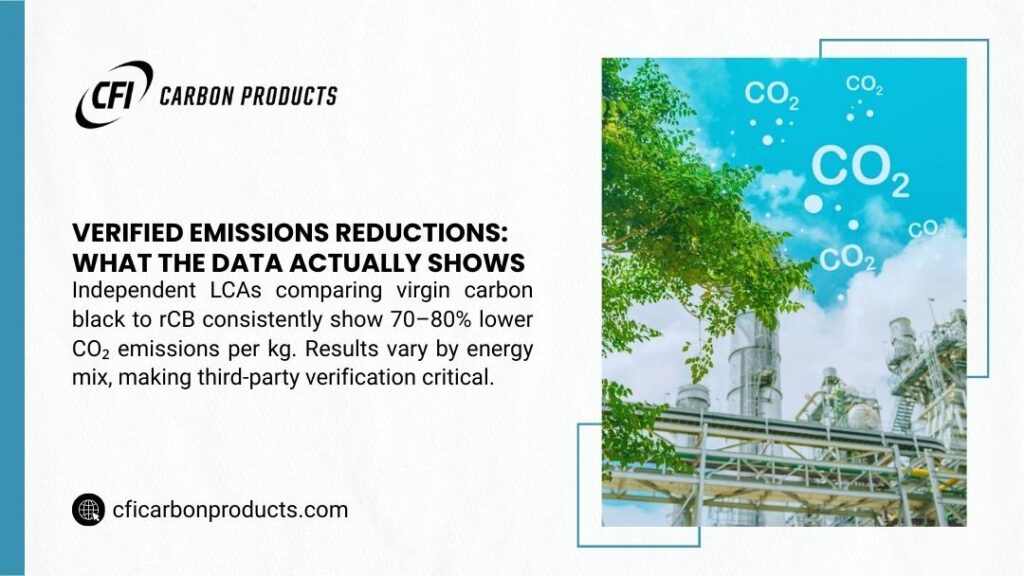
Recovered Carbon Black (rCB): Recovered and circular carbon materials represent one of the fastest-growing categories. Derived from end-of-life tires or industrial waste streams, these fillers lower the carbon footprint while maintaining partial reinforcement. Studies confirm that recovered carbon materials can reduce lifecycle emissions by up to 79-80% compared to virgin carbon black, depending on process energy inputs.
Bio-based carbon (biochar): Bio-based fillers such as biochar rely on renewable feedstocks, including agricultural waste. Their performance depends heavily on ash content and surface structure. When engineered correctly, bio-based fillers contribute stiffness and abrasion resistance, particularly in industrial rubber products where extreme dynamic performance matters less.
Silica and bio-derived silica systems: Silica remains a key reinforcing filler in applications where rolling resistance and wet traction dominate performance requirements. While silica itself is mineral-based rather than bio-based, certain sustainable pathways exist through improved processing efficiency or recovered silica streams.
Rice husk ash (RHA) can serve as a silica source, but its performance depends on purification and surface modification. In tire tread compounds, silica continues to function as the benchmark filler for low rolling resistance “green tire” designs when paired with appropriate coupling agents.
Lignin-based filler systems: Lignin is a renewable aromatic polymer obtained from pulping processes and offers consistent availability at an industrial scale. Its polar chemical structure limits direct reinforcement in non-polar rubber matrices unless compatibilization strategies are applied. When formulated correctly, lignin can function as a sustainable extender or partial filler replacement in seals, gaskets, and molded rubber components, though moisture sensitivity and tensile losses remain considerations.
Mineral and recycled mineral fillers: Recycled silica and calcium-based fillers still play a role in sustainable rubber formulations where density reduction, dimensional stability, or cost control outweigh reinforcement requirements. These fillers are typically non-reinforcing but contribute processing benefits and material circularity when sourced from recycled streams.
Functional comparison of major sustainable rubber filler families
| Filler family | Primary benefit | Key limitation | Typical applications |
| Recovered carbon black (rCB) | Lower carbon footprint, partial reinforcement | Batch variability, ash content | Tires, molded rubber goods |
| Bio-based carbon (biochar) | Renewable feedstock, density reduction | Lower tensile strength ceiling | Industrial rubber products |
| Silica (including recovered/bio-derived sources) | Abrasion control, low rolling resistance | Higher processing energy, coupling required | Tire treads, footwear |
| Lignin-based systems | Renewable raw materials, cost stability | Moisture sensitivity, polarity mismatch | Seals, gaskets, molded parts |
| Recycled mineral fillers | Cost stabilization, circular sourcing | Limited reinforcement | Roofing membranes, mats |
Benefits of Sustainable Fillers
In 2026, the transition to sustainable rubber fillers is driven by more than just environmental ethics; it is a strategic shift to mitigate the rising costs of carbon taxes and the volatility of the petrochemical market.
By integrating recycled carbon black (rCB) and bio-based silica, manufacturers are significantly reducing the Life Cycle Assessment (LCA) values of their final products.
The following table summarizes the primary advantages of switching to sustainable filler systems in modern rubber compounding.
| Benefit Category | Mechanism | 2026 Industry Impact |
| Carbon Neutrality | Incorporation of renewable or circular carbon sources | Supports Scope 3 emissions reduction strategies |
| Weight Reduction | Lower specific gravity relative to conventional mineral fillers | Enables lighter rubber components |
| Price Stability | Feedstocks sourced from waste or renewable streams | Reduces exposure to petrochemical price volatility |
| Performance Gain | Improved filler dispersion and controlled filler interaction | Supports low rolling resistance compound designs |
| Regulatory Compliance | Alignment with recycled and bio-content requirements | Facilitates access to regulated markets |
Challenges and Solutions: Making it Work in Production
Despite the benefits, switching to sustainable fillers introduces technical hurdles.
| Challenge | The Solution |
| Batch Variability | Digital Twinning & AI: Real-time analysis of rCB batches allows for automated formulation adjustments during mixing. |
| Lower Tensile Strength | Hybrid Loading: Replacing only 15-30% of virgin filler with sustainable alternatives to maintain mechanical integrity. |
| Processing Energy | Low-Temperature Mixing: Using specialized dispersants to reduce the viscosity of bio-filled compounds. |
| Moisture Absorption | Surface Coating: Applying hydrophobic treatments to lignin and cellulose to prevent porosity during vulcanization. |
Performance benchmarks that matter in rubber compounds
Tensile strength remains the first metric engineers check. Sustainable rubber fillers often preserve tensile strength when used as partial replacements rather than one-to-one substitutes.
Mechanical properties extend beyond static strength. Dynamic behavior, such as hysteresis, influences rolling resistance and heat build-up. This explains why carbon black and silica still dominate tire tread compounds. Sustainable rubber fillers perform best when their role is clearly defined, either as reinforcement support or as volume-efficient extenders.
A technical comparison of carbon black grades and structure helps clarify why performance varies so widely across fillers.
How to choose sustainable rubber fillers without sacrificing high-performing results
Selection starts with function rather than ideology. If abrasion resistance drives the design, reinforcing fillers take priority. If density reduction or cost stabilization leads, sustainable rubber fillers that extend volume may fit better.
Most production teams adopt hybrid strategies. Partial substitution reduces carbon footprint while maintaining process stability. Validation typically includes dispersion analysis, cure curve comparison, and fatigue testing. Procurement teams also demand consistency, making supplier transparency essential.
Carbon footprint reality check: How sustainability claims hold up
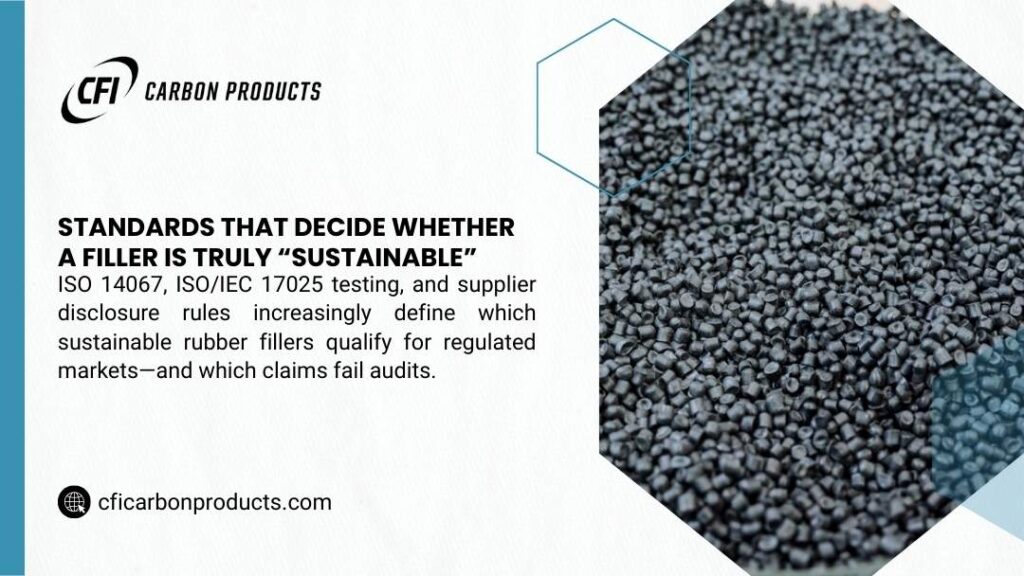
Not all green claims carry equal weight. Carbon footprint calculations vary depending on boundaries, energy sources, and transportation assumptions. According to ISO 14067 guidelines, credible product carbon footprint reporting must disclose system boundaries and allocation methods.
Sustainable rubber fillers backed by third-party verification reduce risk for manufacturers supplying regulated markets. Independent life-cycle assessments published by industry groups consistently show meaningful reductions when recycled or bio-based fillers replace a portion of conventional carbon black and silica.
Application-specific fit for sustainable rubber fillers
Tires present the toughest challenge due to safety and performance demands. Sustainable rubber fillers often appear first in non-critical tread layers or sidewalls, where they reduce emissions without compromising grip. Industrial rubber goods such as hoses, belts, and vibration mounts allow greater flexibility and faster adoption.
Roofing membranes and construction elastomers benefit from sustainable rubber fillers that improve weather resistance while lowering density. A deeper look at how filler choice affects rubber roofing material performance.
The table below maps application types to filler strategies commonly used in practice.
| Application | Preferred filler approach | Sustainability impact |
| Tire tread | Hybrid reinforcing systems | Moderate |
| Industrial rubber | Bio-based or recovered fillers | High |
| Roofing membranes | Low-density sustainable fillers | High |
| Molded goods | Partial carbon replacement | Moderate |
Cost, sourcing, and scale considerations
Cost rarely moves in isolation. Sustainable rubber fillers may lower raw material expense yet increase mixing time or quality control costs. Conversely, stable supply chains often offset price fluctuations tied to fossil-derived materials. Market data indicate that recycled carbon solutions show lower long-term price volatility than virgin grades as regulatory pressure increases.
Manufacturers evaluating scale should qualify multiple sources and document performance ranges. That discipline protects production schedules and customer commitments.
Standards, testing, and documentation expectations
Customers increasingly request documentation that extends beyond certificates of analysis. Incoming QC data, dispersion images, and carbon footprint disclosures now influence purchasing decisions. Labs accredited under ISO/IEC 17025 provide defensible testing for fillers for rubber composite applications, reinforcing confidence across the supply chain.
Where sustainable rubber fillers head next
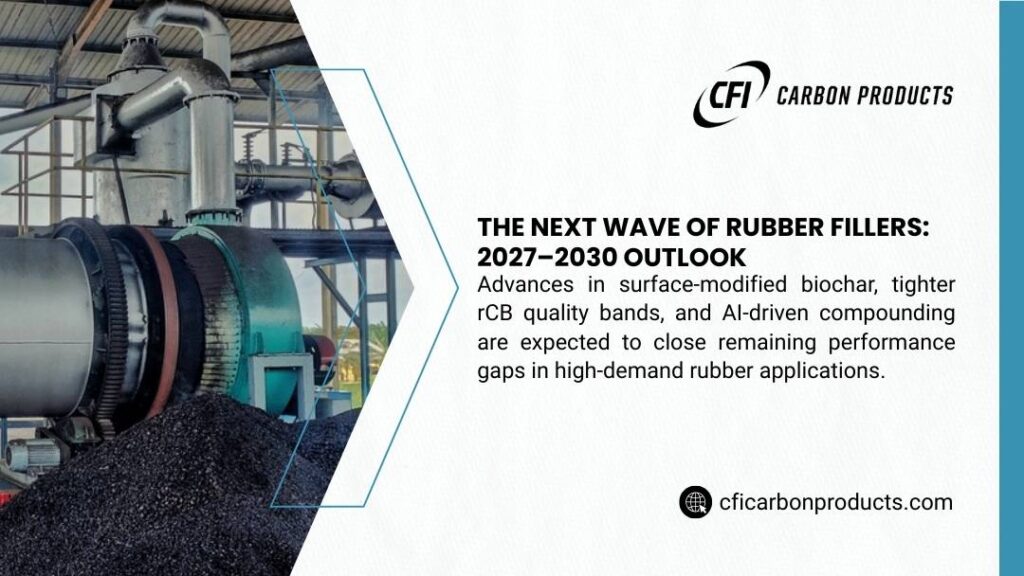
The trajectory points toward normalization. Circular carbon and bio-based systems continue to close the performance gap through surface modification and improved process control. OEMs move from aspirational targets to measurable thresholds, rewarding suppliers who offer proof rather than promises.
Sustainable rubber fillers no longer represent a compromise. When selected with intent and validated properly, they align mechanical properties, cost efficiency, and environmental responsibility.
Ready to move forward? If your formulations still rely on legacy filler systems, now is the time to evaluate sustainable rubber fillers with data rather than assumptions. Explore credible alternatives, validate them under real processing conditions, and position your rubber products for both performance and long-term compliance.