
Cost-effective rubber reinforcement is not about picking the cheapest filler on the shelf. It is about developing a rubber compound that holds up in service, performs well in production, and delivers better value per finished part. In practical terms, that means looking beyond price per pound. Density, dispersion, cure behavior, air retention, scrap rate, sustainability, and long-term durability all have a say.
Rubber manufacturers already know the pressure. Raw material costs move. Customers want better performance. Sustainability reports ask harder questions. Production teams do not want a “cheap” filler that slows mixing, traps air, or causes defects after the compound reaches the press. The goal is not to use the lowest-cost ingredient. The goal is to reduce the cost of a finished rubber part without giving up the properties that keep it in service.
This guide explains how carbon black, silica reinforcement, fabric-reinforced rubber, mineral fillers, and low-specific-gravity organic fillers compare in real rubber applications. It also looks at where Austin Black 325 organic filler fits into a cost-effective rubber reinforcement strategy for manufacturers that want lower compound cost, smoother processing, and more practical sustainability options.
Cost-Effective Rubber Reinforcement
Cost-effective rubber reinforcement starts with a simple problem: rubber needs support. Unfilled rubber can stretch, recover, and seal well, but it often lacks the tear strength, abrasion resistance, dimensional stability, and service life required for tires, belts, hoses, roofing, seals, gaskets, and molded industrial parts. Reinforcement gives rubber more usable strength.
But here’s the catch. Reinforcement can also raise compound density, increase heat build-up, slow production, affect cure, or make sourcing less predictable. That is why cost-effective rubber reinforcement cannot be judged by filler price alone. A material that costs less per pound may cost more in the finished part if it adds weight, reduces throughput, or creates more scrap.
Manufacturers usually compare several routes: carbon black for proven reinforcement, silica reinforcement for dynamic tire performance, fabric reinforcement for load-bearing sheet and belt applications, mineral fillers for cost control, and lower-density organic fillers where volume efficiency and process support matter. Each route can work. None works everywhere.
ACE Products & Consulting researchers wrote that their evaluation of Austin Black 325 explored “potential economic, air permeability, compression set, and odor neutralization advantages” in elastomer applications. That matters because real plant decisions are rarely based on one property. A filler must earn its place through a mix of cost, handling, processing, and end-use performance.
The ACE Laboratories/Rubber World paper also reported Austin Black 325 at a specific gravity of 1.30, compared with carbon black at 1.80 and platy mineral fillers around 2.50, which helps explain why density can change the cost equation in rubber compounding.
Reinforced Rubber Starts With the Polymer Chain
Rubber performance begins at the polymer chain level. Under stress, rubber chains stretch, move, and recover. That movement gives rubber its elastic character, but it also creates limits. Without the right reinforcement, rubber chains can tear more easily, deform under load, or lose performance faster in demanding service conditions.
Fillers help control that movement. Carbon black, silica, mineral fillers, and organic carbonaceous fillers interact with the rubber matrix in different ways. They can restrict chain motion, improve tensile strength, help resist abrasion, affect air permeability, and change the way a compound behaves during mixing and curing. In rubber composites, those interactions determine whether the finished part feels tough, flexible, stable, or overfilled.
Fabric reinforcement works differently. Instead of only supporting the rubber at the particle level, fabric adds a load-bearing structure. That is why reinforced rubber sheet, conveyor belting, expansion joints, and some roofing materials often rely on fabric layers. The filler supports compound behavior; the fabric carries tensile load and improves dimensional control.
For manufacturers, the key question is not “Which material is strongest?” It is “Which reinforcement system gives the required performance at the lowest finished-part cost?” That question keeps the article grounded in cost-effective rubber reinforcement rather than generic material theory.
Carbon Black Still Sets the Benchmark for Reinforced Rubber
Carbon black remains the traditional benchmark for reinforced rubber. It is widely used in tires, hoses, belts, seals, vibration-control parts, and industrial rubber goods because it can improve tensile strength, abrasion resistance, tear resistance, and durability. For many demanding compounds, especially those exposed to repeated flex, wear, and stress, carbon black is still hard to beat.
Its performance comes from particle size, surface area, structure, and interaction with the elastomer matrix. Research published in Rubber Chemistry and Technology notes that adding carbon black particles to elastomeric polymers is essential to the industrial use of rubber in many applications, and that reinforcement depends on how particles interact with each other and with the polymer matrix.
Still, carbon black is not always the most economical answer by itself. High reinforcement can come with trade-offs. Depending on the grade and loading, it may increase compound density, affect heat build-up, demand careful dispersion, or add cost pressure when carbon black markets tighten. Carbon black remains powerful, but it is not always the most cost-effective rubber reinforcement choice when weight, processing speed, or partial replacement is part of the calculation.
That is where many manufacturers begin to ask better questions. Can part of the reinforcement package be adjusted? Can density be reduced? Can processing improve? Can the compound still pass performance tests with a more balanced filler system? Those questions open the door to practical alternatives, not reckless substitutions.
Silica Reinforcement and Sustainable Tires
Silica reinforcement has gained strong attention in tire compounds, especially where rolling resistance, wet traction, and fuel efficiency matter. In the right tire tread system, silica can help reduce energy loss while supporting grip. That is why silica-filled compounds are often discussed in the context of sustainable tires and lower rolling resistance.
The trade-off is that silica is not a drop-in answer for every rubber formulation. It usually needs careful coupling chemistry, strong dispersion control, and a processing window that the plant can manage. If dispersion is poor, the compound may fail to deliver the expected benefit. If processing becomes too complex, the cost advantage can shrink.
A review on silica reinforcement for low-rolling-resistance tires notes that high-dispersion silica has become a preferred alternative to carbon black in some tire tread compounds, but it also points out that combining natural rubber with silica and coupling agents remains a challenge.
That is why “better” depends on the application. Silica may be the right fit for a premium tire tread, but a molded seal, industrial mat, hose cover, roofing membrane, or general-purpose rubber part may need a different cost-performance balance. Cost-effective rubber reinforcement depends on matching the reinforcement system to the job.
Fabric Reinforced Rubber Sheet and Load-Bearing Applications
Some applications need more than particulate reinforcement. Fabric reinforced rubber is used when the product must resist stretch, carry load, maintain shape, or survive repeated mechanical stress. Conveyor belts, hose structures, expansion joints, industrial sheet goods, roofing membranes, and gasketing materials often rely on fabric layers for stability.
A fabric-reinforced rubber sheet can combine the sealing, flexibility, and weathering benefits of rubber with the tensile strength of textile reinforcement. Nylon reinforced rubber sheet is common where toughness, flex resistance, and dimensional stability matter. Reinforced rubber strip can serve in sealing, impact, lining, or protective applications where plain rubber would stretch or deform too much.
This is not the same problem that carbon black or silica solves. Fabric carries load across the part. Fillers tune the compound. In many industrial designs, both matter. A reinforced rubber sheet may need fabric for structure and a balanced filler package for processing, surface finish, hardness, aging, and cost.
The practical takeaway is simple: use fabric when the part needs structural reinforcement; use fillers when the compound itself needs better strength, density control, processing, or durability. Mixing up those roles can raise cost without solving the real problem.
PVC vs Rubber in Cost-Sensitive Industrial Parts
The PVC vs rubber question often appears in cost-sensitive product design. PVC may look attractive where rigidity, low material cost, or simple profiles matter. It can work well in semi-flexible parts, covers, trim, and certain non-dynamic uses. But PVC is not rubber, and the cost comparison can mislead buyers if the part needs elastic recovery.
Rubber often makes more sense where the product must seal under pressure, absorb vibration, flex repeatedly, resist abrasion, or return to shape after compression. A rubber gasket, hose, belt, seal, or vibration pad has to perform in ways that rigid or semi-flexible plastics cannot always match.
That does not make rubber automatically better. It makes the application the judge. If the part needs elastic performance, the smarter cost question is not “PVC or rubber?” It is “How do we make the rubber compound more economical without losing the reason we chose rubber in the first place?” That brings the conversation back to cost-effective rubber reinforcement.
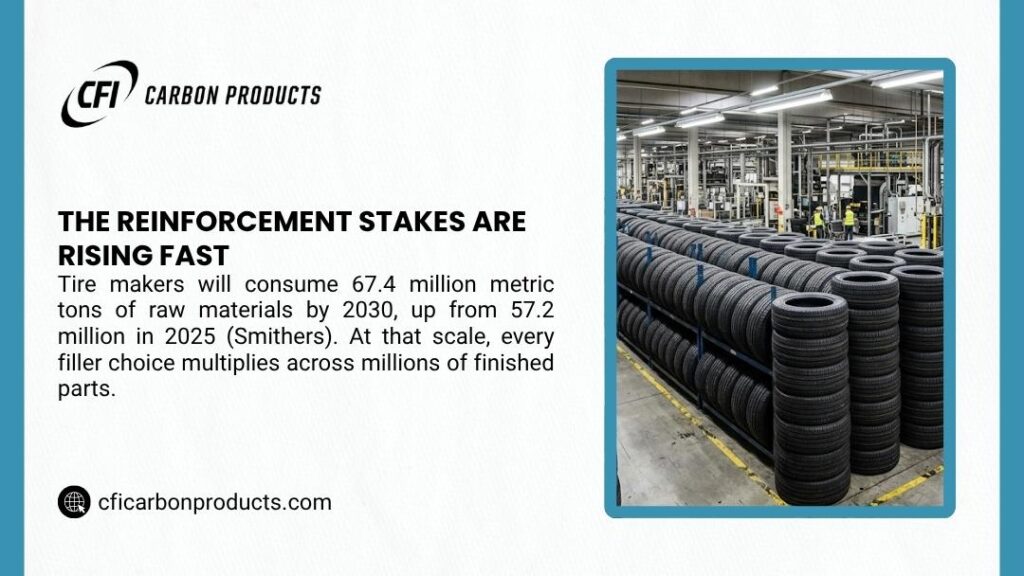
Why Low Specific Gravity Changes the Cost Equation
This is where many compound-cost discussions get more interesting. Price per pound is easy to compare, but it can hide the real economics of a rubber part. Rubber products are often sold or designed by dimensions, volume, or function, not just by weight. So the filler’s specific gravity can change the cost picture.
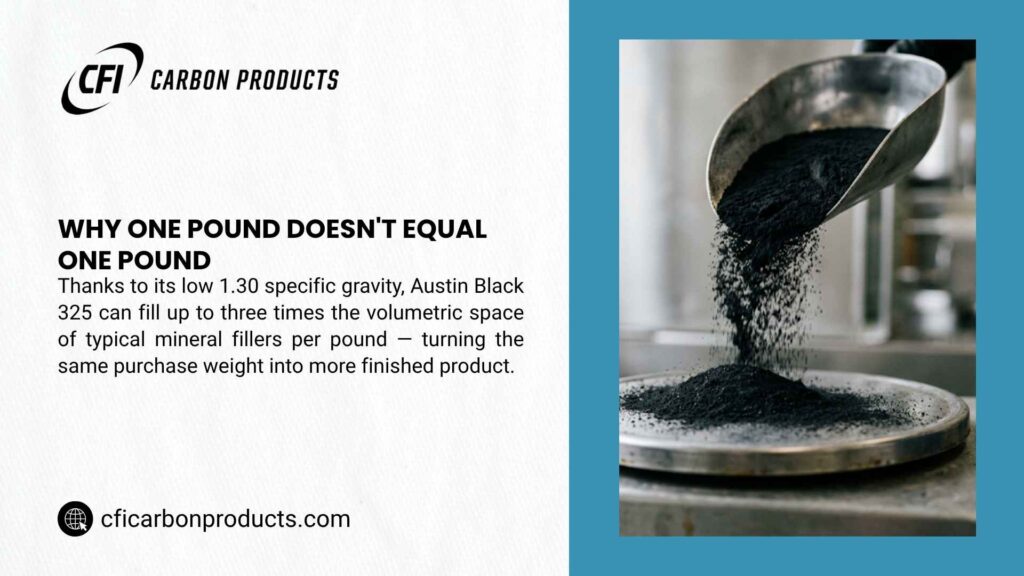
A lower-specific-gravity filler occupies more volume per pound than a higher-density filler. In the right formulation, that can help reduce finished-part weight and improve cost per unit volume. We break down how low density fillers reduce compound weight while protecting performance in a dedicated guide.Price per pound can mislead buyers. In rubber compounding, cost per finished volume often tells the truer story.
Austin Black 325 is relevant here because CFI describes it as a dry, finely divided powder made from high-quality, low-volatile bituminous coal with low specific gravity. CFI also states that it can reduce end-product weight and increase profit margins in suitable applications.
It is a practical way to compare how each reinforcement route can affect cost, density, processing, and end-use performance.
| Material | Typical Role | Specific Gravity Pattern | Cost Impact | Best-Fit Rubber Uses |
| Carbon black | High reinforcement and durability | Higher than Austin Black 325 | Strong performance, possible density and cost trade-offs | Tires, belts, hoses, seals, vibration parts |
| Silica | Dynamic reinforcement | Medium, system-dependent | Can support tire performance, but needs processing control | Sustainable tires, premium tread compounds, select technical rubber |
| Clay, talc, GCC | Cost control and extension | Generally higher-density fillers | Cheap per pound, sometimes less efficient by volume | Non-critical molded goods, sheet, general rubber parts |
| Austin Black 325 | Low-density organic carbonaceous filler | Lower specific gravity | Potential cost-per-volume advantage and process support | Rubber compounds, air retention support, molded and extruded goods |
Low specific gravity is not magic. It still has to be tested against mechanical properties, cure behavior, dispersion, compression set, and customer specifications. But it gives compounders one more lever. And in cost-sensitive rubber production, one good lever can make a measurable difference.
Austin Black 325 as a Practical Carbon Black Alternative
Austin Black 325 should not be framed as a universal one-for-one replacement for carbon black. That would be too broad. Carbon black still has a critical role in many high-performance rubber applications. The stronger and more credible position is this: Austin Black 325 should be evaluated as a formulation tool, not a blanket replacement. In the right compound, it can help reduce weight, support processing, and improve cost control.
CFI positions Austin Black 325 for rubber, plastics, silicone, and coatings, with benefits tied to low specific gravity, processability, and lower emissions compared with traditional carbon black. For rubber applications, that makes it useful for compounders looking at partial replacement, cost reduction, air release, odor control, or improved handling in specific formulas. Manufacturers can review CFI’s rubber industry formulation support for application context.
Third-party product information also supports its processing role. SpecialChem describes Austin Black 325 as readily dispersible in natural rubber, synthetic rubbers, and plastics, and notes that its volatile matter contains inherent oils that can act as an internal plasticizer and dispersing aid.
This is a useful angle for manufacturers because processing is money. A filler that disperses well can help reduce mixing issues, improve consistency, and lower the risk of defects. Again, the point is not hype. It is testable economics.
How Rubber Compounders Should Compare Reinforcement Options
A smart comparison does not start with the cheapest filler. It starts with the part. What does the product have to do? Seal air? Resist abrasion? Hold shape? Flex for years? Survive outdoor exposure? Reduce odor? Meet a customer sustainability target? Once the job is clear, the reinforcement package can be judged properly.
For cost-effective rubber reinforcement, compounders should compare materials through finished-part economics. That includes raw material cost, density, processing time, scrap rate, test performance, packaging efficiency, and supply reliability. A filler that saves money in purchasing but causes production headaches may not save money at all.
| Decision Factor | What to Check | Why It Matters |
| Tensile strength | Lab test against a control formula | Confirms whether the compound still meets strength targets |
| Abrasion resistance | Wear testing under relevant conditions | Predicts service life in tires, belts, mats, and covers |
| Specific gravity | Cost per finished volume | Reveals savings that price per pound may hide |
| Dispersion | Mixing time, surface quality, and batch consistency | Reduces defects, rework, and scrap |
| Compression set | Long-term sealing performance | Matters in gaskets, O-rings, seals, and molded parts |
| Air permeability | Barrier performance in liners and tubes | May reduce costly polymer demand in some systems |
| Sustainability data | Emissions profile and sourcing support | Helps manufacturers answer customer reporting demands |
This kind of table helps R&D, purchasing, and production teams speak the same language. R&D protects performance. Purchasing sees cost. Production sees whether the compound can actually run. When those three views come together, the result is usually better than a price-only decision.
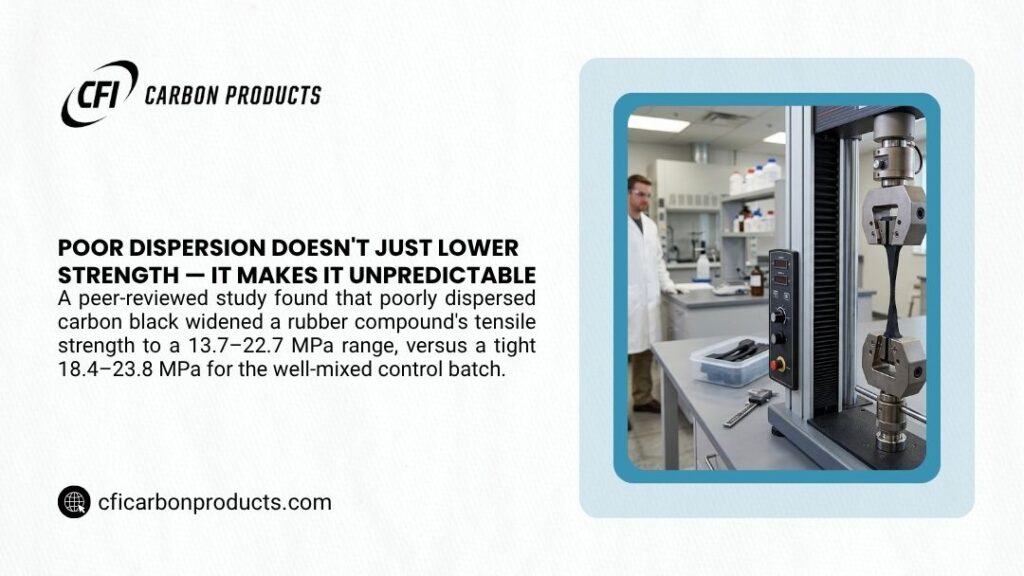
Processing Matters as Much as Filler Price
A rubber compound that looks good on paper can still fail on the production floor. Poor dispersion, trapped air, agglomeration, bubbles, blisters, cure variation, and surface defects all add cost. Some of that cost is obvious, such as scrap. Some is quieter, such as longer mixing cycles, extra inspection, slower throughput, or customer complaints months later.
A filler that looks cheaper on paper can become expensive on the production floor if it increases scrap, slows mixing, or creates surface defects. That is why processability belongs in any cost-effective rubber reinforcement discussion.
CFI’s service model supports this point. The company offers formula testing and lab samples, along with packaging options and toll grinding. That helps manufacturers test a material before they commit to a larger formulation change. In rubber compounding, that step is not optional; it is risk control.
A good pilot test should compare the new formulation against the current control. It should look at mixing behavior, cure response, hardness, tensile strength, elongation, tear, compression set, specific gravity, air permeability where relevant, and surface appearance. The plant should also note whether the compound runs cleaner, faster, or with fewer handling problems.
Where Cost-Effective Rubber Reinforcement Delivers the Biggest ROI
Cost savings matter most where materials are used at scale or where failure is expensive. Tires, tire inner liners, hoses, belts, seals, gaskets, O-rings, roofing membranes, conveyor belts, industrial mats, and molded rubber goods all have different cost drivers.
Tire inner liners care about air retention. Hoses and belts care about durability, flex, and downtime risk. Seals and gaskets care about compression set and long-term sealing. Roofing membranes care about weathering and dimensional stability. Molded goods often care about throughput, scrap control, and consistent finished weight.
| Application | Main Reinforcement Goal | Cost Risk | Practical Filler Strategy |
| Tire inner liners | Air retention and barrier support | High use of costly polymers | Evaluate low-density fillers with barrier-support potential |
| Hoses and belts | Durability, flex life, and abrasion resistance | Downtime and field failure | Balance carbon black with process-friendly filler options |
| Seals and gaskets | Compression set and sealing life | Leaks, returns, and warranty claims | Use balanced filler loading and verify compression set |
| Roofing membranes | Weathering, stability, and service life | Installation failure and replacement cost | Combine fabric reinforcement with compound-level filler support |
| Molded rubber goods | Throughput, weight, and scrap control | Defects, rework, and inconsistent batches | Use easy-dispersing filler systems and test specific gravity |
This is also where CFI’s broader internal content can support the buyer journey. A reader focused on tire compounds can explore tire rubber filler options. A manufacturer focused on cost can review CFI’s guidance on how to reduce rubber compound cost. For broader material comparisons, carbon black alternatives for rubber help inform the next step.
Sustainability Is Now Part of the Cost Calculation
Sustainability used to sit outside the cost conversation. Not anymore. Many manufacturers now have to consider carbon footprint, emissions reporting, shipping weight, product life, waste, and customer sustainability requirements. A filler that lowers finished-part weight or supports a lower-emission material strategy can help beyond the purchasing spreadsheet.
CFI states that Austin Black 325 is a low-emission filler and that SCS Global Services conducted a product carbon footprint and life cycle assessment for the product. The company also presents Austin Black 325 as emitting less CO2 than virgin and recycled carbon blacks, based on its cited source. Manufacturers can review CFI’s low-emission filler strategy for more detail.
This claim should be used carefully, not as green decoration. The stronger argument is that sustainability and cost control now overlap. Lower density, efficient processing, reduced scrap, and lower-emission inputs can all support a more competitive rubber formulation, making sustainable rubber fillers relevant to engineering, procurement, and sales teams alike. CFI’s work on sustainable rubber fillers expands on this perspective.
Common Mistakes That Raise Rubber Reinforcement Cost
One common mistake is overloading carbon black because it is familiar. Familiar does not always mean economical. If the compound is overbuilt for the application, the manufacturer may pay for performance the customer does not need.
Another mistake is treating price per pound as the only metric. This is where high-density fillers can look attractive until the finished part cost is calculated. If a filler increases weight or requires more material to fill the same volume, the savings may shrink.
Skipping pilot trials is another costly shortcut. A filler change can affect cure, dispersion, viscosity, compression set, odor, air release, surface finish, and mechanical properties. Without testing, the risk moves from the lab to the production floor. That is an expensive place to discover a formulation problem.
There is also the mistake of using fabric reinforcement where compound-level reinforcement would do, or relying only on particulate fillers when the part actually needs a structural layer. Fabric-reinforced rubber sheet has a clear place, but it should not be used as a cure-all. Reinforcement needs to match the failure mode.
Finally, some teams ignore processing data. If a compound needs more time to mix, creates dust issues, traps air, or leads to more rejected parts, that cost should be counted. Rubber reinforcement is not only a lab result. It is also a production result.
What to Ask Before Changing a Rubber Reinforcement Formula
Before changing a formula, the team should ask what the part must prove in service. The answer should include target hardness, tensile strength, elongation, tear, abrasion resistance, compression set, air permeability, weathering, and any customer-specific standard. If the product is a seal, compression set may matter more than abrasion. If it is a belt, flex and wear may carry more weight.
The team should also look at the current compound density, current filler loading, scrap rate, mixing time, cure behavior, defect history, and material cost per finished part. That last point matters. A new filler should be judged against finished-part economics, not just purchase price.
Sustainability requirements should be part of the same conversation. If the customer asks for lower-emission materials or better reporting support, the supplier should be able to provide documentation. If the plant needs specific bags, bulk packaging, or low-melt options, packaging should be discussed before scale-up.
The supplier question is just as important. Can the supplier provide samples? Can it support lab testing? Can it help compare a control formula against a trial formula? Can it deliver consistently? For a serious manufacturer, those answers matter as much as the filler itself.
Better Reinforcement Starts With Better Testing
Cost-effective rubber reinforcement is safest when it moves through a clear test path. Start with a control formula. Decide which properties cannot move. Set the cost target. Then test the alternative filler system in a way that reflects the actual application.
A lab batch can show early signs. A pilot batch can reveal processing behavior. Production trials confirm whether the compound runs well at real scale. Each step reduces risk. It also gives purchasing, R&D, and production a shared set of facts.
CFI’s technical support fits naturally here because the company offers formula testing, lab samples, customized packaging, toll grinding, and global collaboration. Manufacturers do not have to guess whether Austin Black 325 belongs in a formula. They can test it against their current compound and decide based on data.
That is also the right way to treat any reinforcement change. Carbon black, silica, fabric, mineral fillers, and Austin Black 325 all have proper uses. The question is not which material sounds best in an article. The question is which one helps the finished rubber product meet its performance target at a better total cost.
A Smarter Path to Lower Rubber Compound Cost
Cost-effective rubber reinforcement is a formulation strategy, not a shortcut. The best results come from matching filler structure, density, dispersion, processing behavior, sustainability profile, and end-use demands. A cheaper ingredient can become expensive if it causes scrap. A higher-performing filler can be wasteful if the application does not need that level of reinforcement. The right answer usually sits between those extremes.
Carbon black still has a major role in reinforced rubber. Silica reinforcement matters in sustainable tires and select dynamic applications. Fabric-reinforced rubber sheet is essential when the product needs structural strength. Low-specific-gravity organic fillers such as Austin Black 325 can help manufacturers think differently about compound cost, weight, processability, and material efficiency.
For manufacturers under cost pressure, the next move should be practical. Compare Austin Black 325 in your current formula, request a sample, or talk with CFI about lab-supported ways to reduce rubber compound cost. A good test will show whether the material fits your application. And if it does, cost-effective rubber reinforcement can become more than an article topic. It can become a measurable production advantage.