
Choosing an electrically insulating filler for rubber starts with the finished part’s electrical specification. Polymer, filler type and grade, loading, dispersion, cure, moisture, and test conditions all affect the result.
Article Summary
Related readingInsulating Rubber Filler: Types, Uses & How to ChooseRead the guide →| Topic | Short answer |
|---|---|
| What the term covers | Particulates used in rubber compounds to meet formulation goals; electrical behavior depends on material grade and the cured compound |
| Four properties that decide the answer | Volume resistivity, dielectric strength, dielectric constant, dissipation factor |
| Largest formulation risk | Conductive filler can reduce resistivity when its grade, loading, and dispersion create connected paths; the threshold is compound-specific |
| Risks most often missed | Absorbed moisture, ionic contamination carried by mineral fillers, agglomerates left by weak dispersion |
| How claims get proven | Use the test methods required by the product specification and report specimen and conditioning details |
| Angle of this piece | Loading level, dispersion, moisture, and ionic purity are treated as the practical levers that move dielectric numbers |
Is Rubber Electrically Insulating by Default?
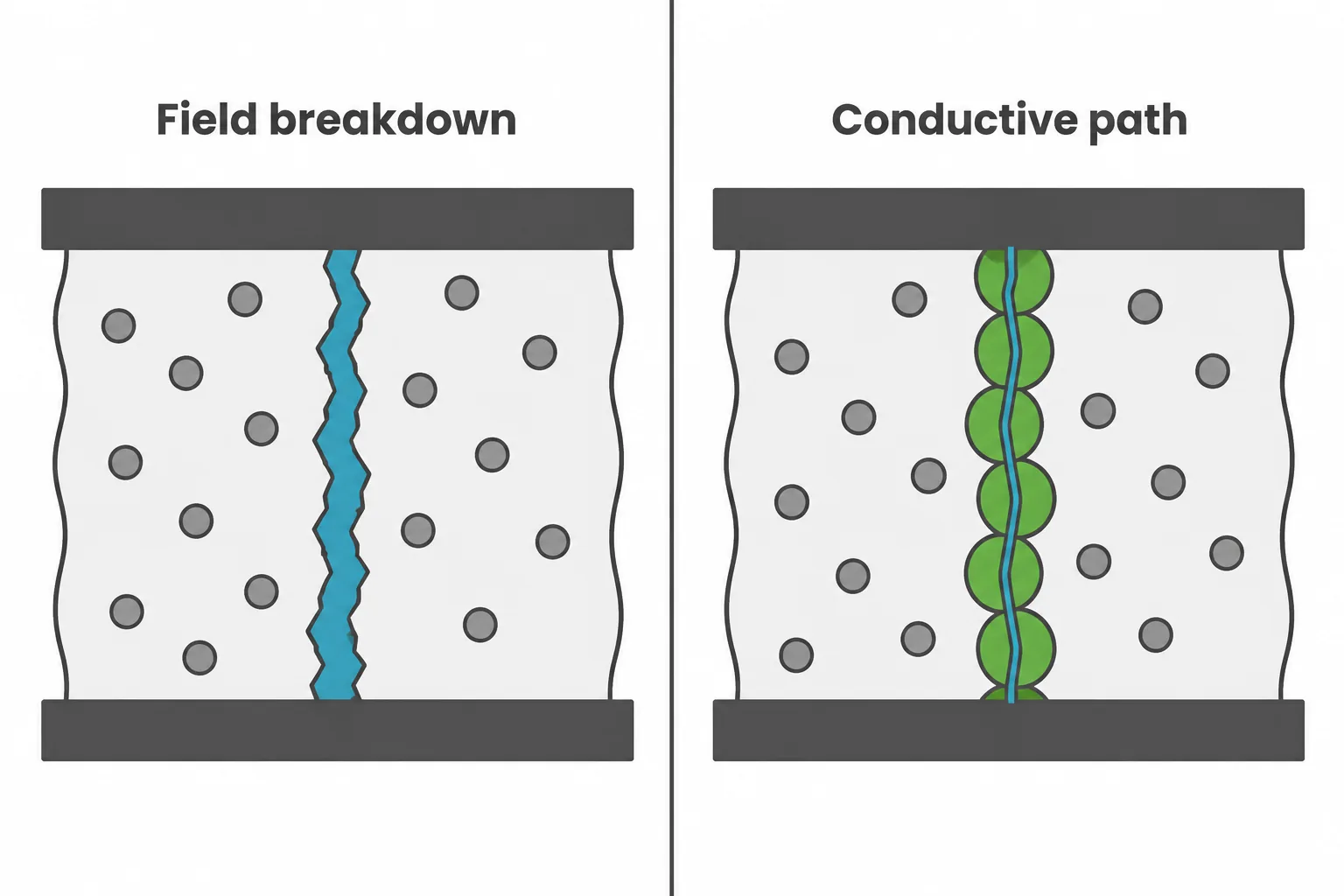
Unfilled elastomers generally resist electrical current, but a rubber part’s insulation performance depends on the full compound and the conditions used to test it.
Compounding changes the material. Fillers, plasticizers, process oils, curatives, cure residues, and absorbed moisture can all affect charge transport. Two compounds based on the same polymer can therefore produce different electrical test results.
Current may flow if the applied electric field causes breakdown or if conductive particles form a connected path through the compound. These are different failure mechanisms. CFI’s explainer on carbon conductivity provides background, but a finished-compound test is needed to assess a formulation.
Electrical Properties That Define an Insulating Rubber Compound
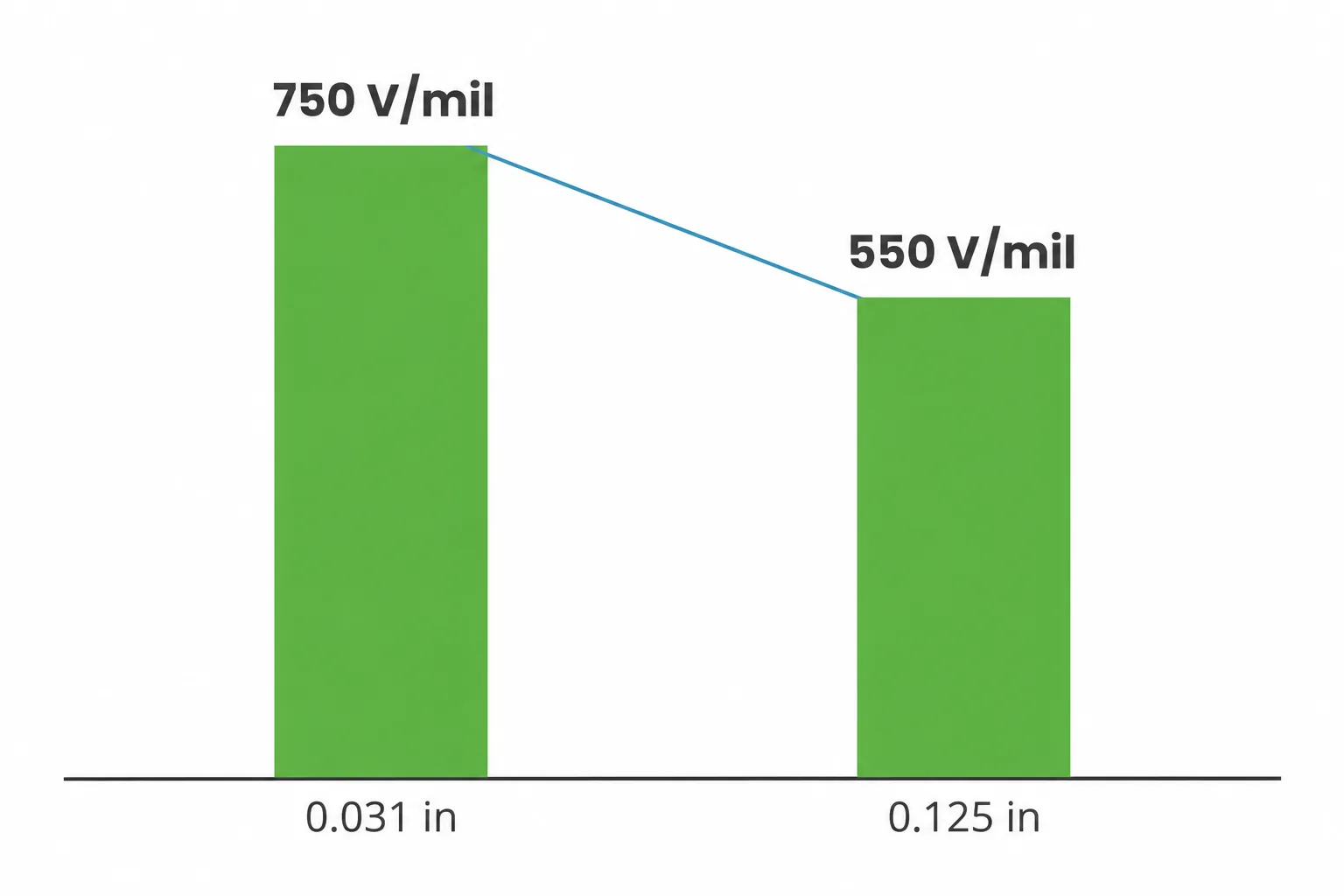
A rubber insulation specification may include several electrical properties. Each answers a different question, so passing one test does not establish that the compound meets every requirement.
| Property | Typical unit | What it tells the formulator | Common method |
|---|---|---|---|
| Volume resistivity | ohm-cm | Resistance to current through the bulk of the material | ASTM D257 |
| Surface resistivity | ohm per square | Resistance along the surface, which governs behavior under pollution and humidity | ASTM D257 |
| Dielectric strength | kV/mm | Field the material withstands before breakdown; falls as specimen thickness rises | ASTM D149 |
| Dielectric constant (relative permittivity) | dimensionless | Charge the material stores; matters for cable capacitance and high-frequency parts | ASTM D150 |
| Dissipation factor (tan delta) | dimensionless | Energy lost as heat under AC; a rising value signals moisture or polar contamination | ASTM D150 |
| Tracking and erosion resistance | Rating or time to failure | Survival of a surface under wet, contaminated, energized conditions | IEC 60587 |
| Arc resistance | seconds | Surface resistance to a dry arc across the part | ASTM D495 |
For outdoor parts, consider bulk and surface behavior separately. Moisture and contamination can affect surface performance, so use the test conditions and requirements specified for the application.
Test Methods for Electrical Properties
Test results are comparable only when you understand the method and specimen conditions. Electrode setup, humidity conditioning, specimen thickness, and test duration can affect the reported value. ASTM lists methods for resistance, dielectric strength, and AC loss and permittivity; select the method required by the product specification. Review ASTM’s electrical-insulating-material standards.
| Standard | Scope | Practical note |
|---|---|---|
| ASTM D257 | DC resistance or conductance of insulating materials | Report electrode type and electrification time with the value |
| ASTM D149 | Dielectric breakdown voltage and dielectric strength at commercial power frequencies | Thickness-dependent; thin plaques flatter the compound |
| ASTM D150 | AC loss characteristics and permittivity | Run across the frequency range the part will see |
| IEC 60587 | Tracking and erosion under severe ambient conditions, inclined-plane arrangement | The relevant screen for high-voltage housings |
| ASTM D495 | High-voltage, low-current dry arc resistance | Useful as a secondary screen, not a service prediction |
Condition specimens consistently and record humidity, temperature, thickness, cure, and test duration. If the part will face moisture or heat, include relevant conditioning in the qualification plan.
What to Request Before a Filler Trial
Request the filler grade and specification, available lot-consistency, moisture, and soluble-ion data, plus handling recommendations. For a formulation trial, record the base compound, loading, cure, conditioning, and test method. Compare the candidate with a control for electrical, mechanical, and processing results.
How Filler Choice Affects Electrical Insulation in Rubber
Several formulation variables can shift the electrical results of a filled compound. Their effects depend on the filler grade and the rest of the formulation.
| Mechanism | Effect on the compound | Control lever |
|---|---|---|
| Percolation of conductive particles | At some loadings, conductive particles may form connected paths and change resistivity nonlinearly | Test a loading range against the product specification |
| Filler structure and surface area | Structure and surface area can affect how conductive particles interact; the result is grade- and compound-specific | Grade selection. |
| Particle shape and aspect ratio | Particle shape and aspect ratio may affect particle interactions and dispersion | Evaluate filler morphology in the target formulation |
| Surface polarity and water affinity | Moisture absorption may affect resistivity and dissipation factor | Review filler treatment, storage, and drying requirements for the formulation |
| Ionic content | Soluble ionic residues may affect electrical behavior | Request relevant supplier data and evaluate the finished compound |
| Dispersion quality | Poor dispersion may affect local electric-field distribution and measured properties | Review mixing, filler treatment, and order of addition |
Conductive-particle networks can produce nonlinear changes in resistivity. Test a loading range when the formulation depends on maintaining electrical resistance; one data point may not show the available margin.
Filler Families to Evaluate for Electrical Insulation
A compound may combine fillers for reinforcement, volume, flame retardance, or other requirements. Treat the table as a starting point: performance varies by grade, loading, polymer, cure, and processing.
| Filler family | Typical role | Effect on insulation | Watch-outs |
|---|---|---|---|
| Precipitated and fumed silica | Reinforcement in silicone and light-colored compounds | Can be considered where electrical resistance and reinforcement are required; confirm performance in the compound | Silanol surfaces can interact with moisture; assess grade and conditioning |
| Calcium carbonate | Low-cost extender | Electrical performance depends on grade, purity, moisture, and formulation | Assess supplier data and finished-compound results |
| Kaolin and calcined clay | Semi-reinforcing extender, used in some wire and cable compounds | Calcined kaolin is used in some EPR and EPDM cable insulation applications; compound results remain formulation-specific | Confirm grade and application requirements. |
| Talc and mica | Platy fillers | May affect barrier and electrical behavior, depending on grade and formulation | High aspect ratio can affect viscosity and orientation during flow |
| ATH and MDH | Flame retardance | May be considered where flame or tracking requirements apply; verify against the relevant specification | Loading can affect processing and other compound properties |
| Barium sulfate, wollastonite | Density, chemical resistance, or reinforcement | Evaluate electrical effects in the target formulation | Cost, density, and processing trade-offs |
| Carbon black | Reinforcement, UV protection, black color | Some grades and loadings can reduce resistivity; behavior varies by grade and compound | See CFI’s carbon black structure information |
| Organic coal-derived filler | Filler that may be considered for volume and weight objectives | Do not assume electrical performance from material origin or color; test the finished compound | Verify with the relevant electrical and mechanical tests |
Carbon-Based Fillers When a Black Compound Is Required
Some parts need black color for appearance or other formulation goals. A formulator may compare different black grades, adjust loading, or evaluate a compatible extender. Each option can affect conductivity, mechanical properties, processing, and cure, so test candidate compounds against the application specification.
Grade and loading both matter. Birla Carbon describes high-resistivity rubber formulations that use selected carbon black grades, but its examples are specific to its products and formulations. Review Carbon’s high-resistivity rubber-compound discussion as one supplier perspective, then test the candidate grade in your own compound.
How the Polymer Base Affects Insulation
Polymer choice and filler selection work together. Select a polymer for the service environment, then qualify the complete compound against the electrical and mechanical requirements.
| Polymer | Insulation behavior | Other application considerations |
|---|---|---|
| Silicone | Used in some electrical-insulation applications; performance depends on the grade and compound | Wide service-temperature range and weathering properties may be relevant, depending on grade |
| EPDM | Used in some cable and outdoor applications; qualify the finished compound | Weather and moisture exposure may matter to the application |
| Butyl | May be considered where low permeability is also required; verify electrical performance | Confirm suitability for the service-temperature range |
| Natural rubber | May be formulated for electrical applications; confirm compound performance | Assess weathering and ozone exposure for the application |
| NBR | Oil resistance may guide selection; polarity can influence electrical properties | Check electrical results alongside oil-resistance requirements |
| CR (chloroprene) | Flame and weather requirements may inform selection; verify dielectric properties | Assess electrical performance in the target formulation |
Silicone is used in some electrical insulation applications, but filler additions can change compound behavior. Review CFI’s silicone-industry information and qualify each formulation for its intended conditions.
What Can Change Insulation Performance After Cure
Electrical performance can change during processing, conditioning, or service. Include relevant environmental exposure in the qualification plan.
| Driver | Mechanism | Countermeasure |
|---|---|---|
| Absorbed moisture | Moisture can affect charge transport and measured electrical properties | Review storage, drying, conditioning, and testing requirements |
| Ionic contamination | Soluble residues may affect electrical behavior | Request relevant supplier data and assess incoming-lot consistency |
| Agglomerates | Poor dispersion may affect local field distribution and measured properties | Review mixing conditions and dispersion |
| Voids and porosity | Voids may affect electrical performance in some applications | Review molding, venting, and cure conditions |
| Surface fouling | Moisture and contamination may affect surface performance | Include service exposure in the test and material-selection plan |
| Thermal aging | Aging may change mechanical and electrical properties | Include relevant aging conditions where required by the specification |
| Plasticizer migration | Plasticizer movement or loss may change compound properties over time | Evaluate formulation stability under relevant service conditions |
A Practical Selection Workflow for Formulators
Start with the electrical requirement and product specification. Select a suitable polymer, define the acceptable formulation range, and compare candidate fillers against processing, mechanical, and cost goals. Use the test methods required by the application and evaluate more than one loading where appropriate.
These are illustrative starting points, not universal formulation recommendations. Confirm filler choices and test methods against the application specification.
| Application | Primary target | Filler direction | Verification |
|---|---|---|---|
| Low-voltage cable jacket | Volume resistivity, flexibility | Calcined clay or calcium carbonate, minimal black for UV | ASTM D257 after humidity conditioning |
| High-voltage insulator housing | Tracking and erosion resistance | ATH in silicone at high loading | IEC 60587 inclined plane |
| Gaskets and seals near live parts | Dielectric strength, compression set | Treated silica plus blocky mineral extender | ASTM D149 at part thickness |
| Encapsulation and potting | Low dissipation factor, void-free cure | Low-moisture, low-ion mineral filler | ASTM D150 across service frequency |
| Weather-exposed sheet and roofing | Surface behavior, UV stability | Minimum effective black plus mineral or organic extender | D257 surface and volume, plus aging |
Compare density and cost on the basis relevant to the finished part. CFI’s rubber-industry information discusses the role of specific gravity in compound economics. Any change in filler loading can also affect electrical and mechanical properties, so include those measures in the trial.
Where Austin Black 325 May Fit in Insulating Compounds
CFI supplies filler materials to rubber, plastics, silicone, and coatings manufacturers. The company describes Austin Black 325 as a dry, finely divided powder produced from low-volatile bituminous coal. Its suitability for an insulating compound should be established through formulation-specific testing.
| Attribute | Detail | Relevance to an insulating compound |
|---|---|---|
| Base material | Low-volatile bituminous coal, finely ground | Organic filler chemistry distinct from furnace carbon blacks |
| Specific gravity | CFI lists a specific gravity of 1.30 | May affect compound density and weight; evaluate the finished formulation |
| Processing | CFI reports processability benefits in some formulations | Verify mixing, flow, cure, and finished-part performance in a trial |
| Production | CFI describes Austin Black 325 as a low-emission filler | Review the supporting product documentation for the application and claim |
| Support | CFI lists formula testing, lab samples, toll grinding, and packaging options | Ask CFI which evaluation services are available for your target application |
Do not specify a filler based on a supplier claim alone. Evaluate a sample in the target formulation and compare the cured compound with the application specification. CFI’s Austin Black 325 product information includes product data and sample resources. CFI also publishes a silicone formulation example reporting insulating-property results; treat it as an example, not a guarantee for another formula.
Key Takeaways
| Takeaway | Why it matters |
|---|---|
| Insulation is a compound property, not a polymer property | The same polymer delivers very different dielectric numbers depending on its filler package |
| Conductive filler loading can be an important variable | Connected particle networks may change resistivity nonlinearly; test the target formulation |
| Moisture and ionic content can affect results | Assess the filler grade and condition specimens consistently |
| Dispersion quality can affect test results | Review mixing and dispersion when interpreting compound data |
| Test conditions must match service conditions | Thickness, humidity, and frequency all change the reported number |
| Finished-compound testing supports qualification | Use methods and conditions that match the application specification |
Frequently asked questions
Is rubber electrically insulating?
Which Rubber Is Used for Electrical Insulation?
Can Silicone Rubber Be Used as an Electrical Insulator?
Can Rubber Conduct Electricity?
Can a Black Rubber Compound Still Be Electrically Insulating?
Which Formulation Factors Can Reduce Rubber Resistivity?
What Should I Request When Evaluating a Rubber Filler for Insulation?
Talk Through Your Insulating Compound With CFI
Share your electrical specification, target cost, and formulation goals with CFI to discuss whether a sample or formulation evaluation is appropriate. CFI’s technical services list its support for manufacturers. Confirm the available test scope with CFI, then qualify the finished compound against the requirements for your application.
For product specifications and sample information, use the Austin Black 325 product page linked above or contact CFI.