
Pressure loss in a sound rubber part rarely starts at a hole. It starts at the molecular scale, where gas dissolves into the rubber surface, threads between polymer chains, and leaves on the low-pressure side. That slow, invisible process decides whether a tire, an air spring, or an inflatable seal still holds specification pressure three months after it left the plant.
Article Summary at a Glance
The question of how to improve air retention in rubber has five practical answers, and they stack. Each one below is a decision a compounder or process engineer can act on this quarter, ordered by return against disruption.
| Lever | What it controls | Direction of effect | First action to take |
|---|---|---|---|
| Polymer backbone | Free volume and chain mobility | Largest single drop in permeability | Base the barrier layer on butyl or halobutyl |
| Filler shape | Length of the gas diffusion path | High aspect ratio adds tortuosity | Favor platy particles over blocky ones |
| Filler load and dispersion | Uniformity of the barrier network | Gains flatten, then reverse | Prove dispersion quality before raising phr |
| Liner gauge and coverage | Wall thickness the gas must cross | Loss falls as gauge rises | Correct thin spots, splices, and bead coverage |
| Cure state | Crosslink density and free volume | Full cure lowers diffusivity | Confirm cure with rheometer data |
Two numbers settle any argument about results. Inflation Pressure Loss Rate (IPLR) reports how much pressure a mounted, inflated tire gives up per month, where a lower value means better retention.
The permeability coefficient, measured on cured test sheets, isolates the compound itself from the way the product was built. Neither belongs in a formulation review as an estimate.
What Air Retention Means in a Rubber Compound
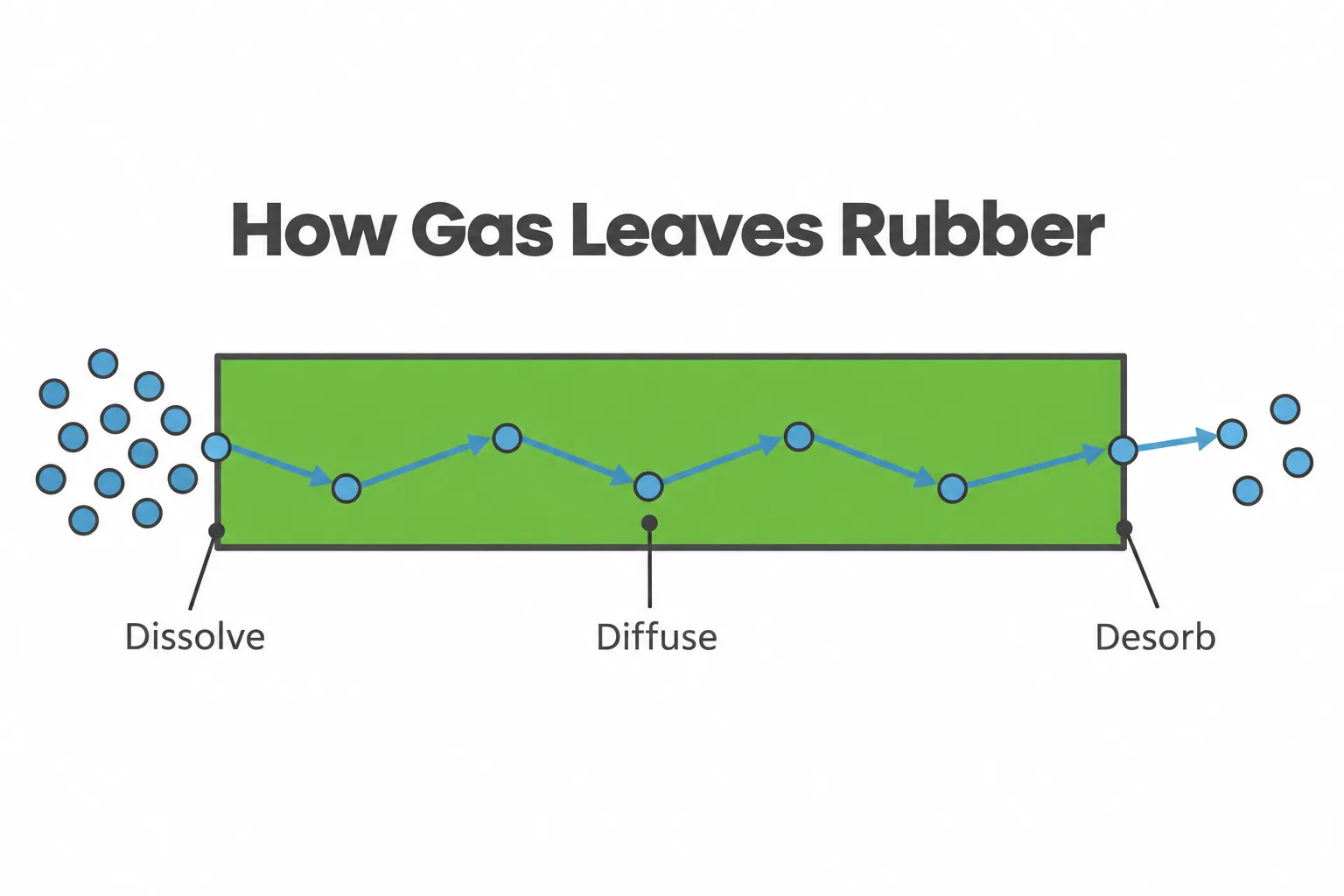
Air retention is the ability of a cured rubber article to hold internal pressure over weeks and months of service. The governing model is solution-diffusion. Gas molecules dissolve into the rubber at the high-pressure face, migrate through the matrix by random thermal motion, and desorb into the atmosphere on the other side.
Permeability is the product of solubility and diffusivity, so a compound can fail on either term. A polymer that dissolves a lot of gas and a polymer that lets gas move quickly both leak, for different reasons.
The commercial scope is wide: passenger and truck tire inner liners, inner tubes, curing bladders, air spring bellows, pneumatic seals, hoses, and inflatable industrial goods.
CFI Carbon Products supports formulators across these applications through its work in the rubber industry, where barrier performance and compound weight are usually argued over at the same meeting.
Before any reformulation starts, separate the two failure modes. They look identical on a pressure gauge and need opposite fixes.
| Failure mode | Where it happens | Typical evidence | Correct fix |
|---|---|---|---|
| Mechanical leak | Valve core, bead seat, splice, tool mark, trapped air blister | Localized, soap-test positive, fast loss | Repair the defect or correct the build process |
| Permeation | Through the bulk of the liner wall | Diffuse, steady, temperature-dependent | Change polymer, filler system, gauge, or cure |
Why Rubber Loses Air Even Without a Puncture
Polymer chains never pack perfectly. The gaps left between them, known as free volume, form a shifting network of transient pathways. Gas molecules hop from one gap to the next whenever thermal motion opens a route. A pressure gradient biases those hops outward, so flux continues for as long as pressure inside exceeds pressure outside.
Temperature makes both terms worse. Warmer rubber has more chain motion, more free volume, and a higher diffusion coefficient, which is why a trailer parked in summer sun loses pressure faster than the same trailer in a cool yard.
Gas composition shifts as well, since oxygen moves through most elastomers faster than nitrogen. Over months, the residual air inside a tire becomes nitrogen-richer while total pressure falls.
The cost of that slow loss is not limited to a low gauge reading. Underinflation raises rolling resistance and fuel burn, concentrates wear on the shoulders, and drives heat build-up in the casing. Heat accelerates thermo-oxidative aging, which depletes antidegradants and rearranges the crosslink network.
That is the honest answer to whether rubber gets weaker over time: it does, and poor air retention speeds the process up.
How to Improve Air Retention in Rubber: Start With Butyl and Halobutyl
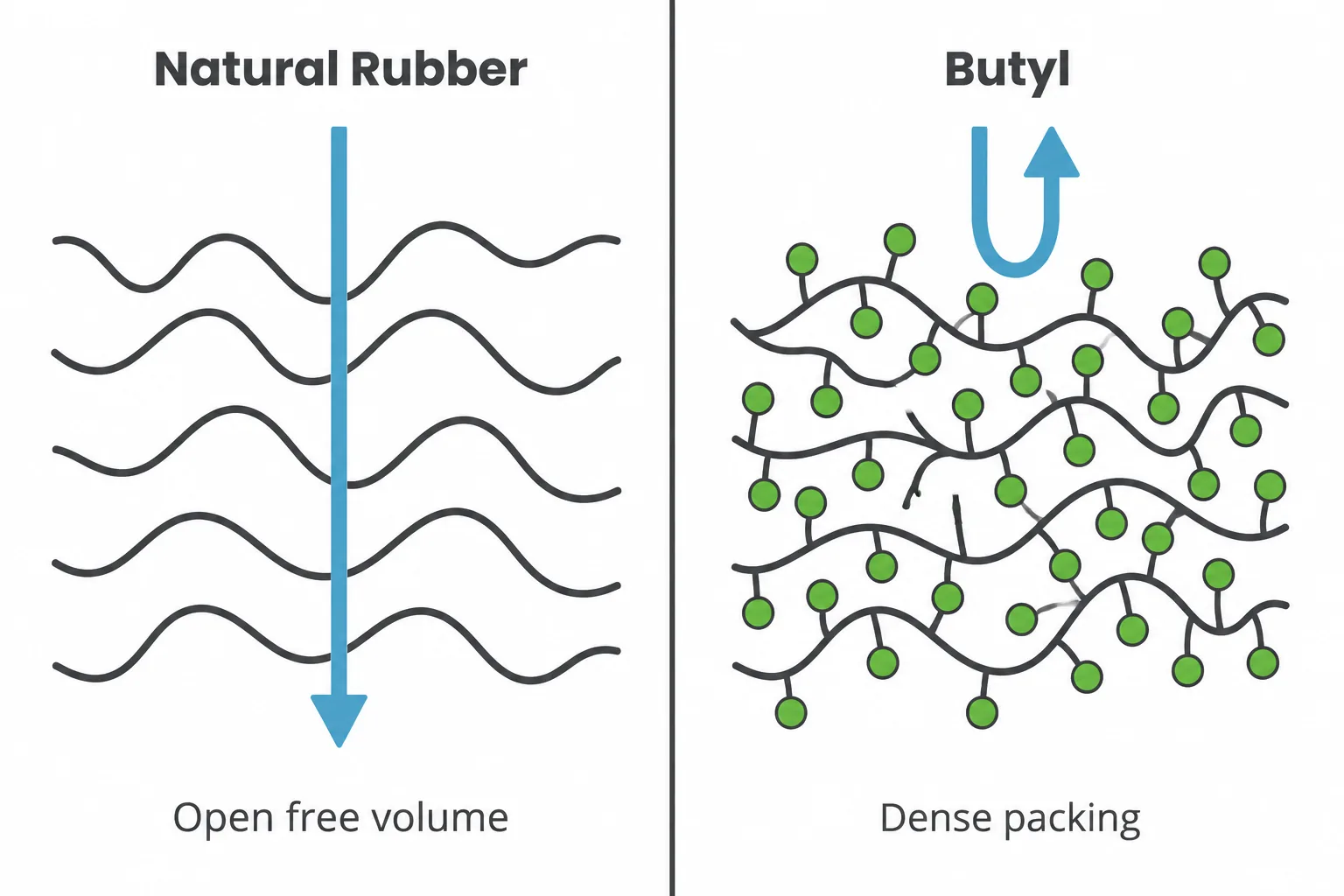
Butyl rubber (IIR) is a copolymer of isobutylene with a small amount of isoprene. The pendant methyl groups along the backbone pack densely and restrict chain rotation, which lowers free volume and gives butyl a far lower gas permeability than general-purpose elastomers such as natural rubber or SBR.
That single property is why butyl and its halogenated versions carry the barrier duty in nearly every pneumatic product.
Halobutyl grades, chlorobutyl and bromobutyl, keep the barrier backbone and add reactive halogen sites. Those sites allow co-vulcanization with the adjacent natural rubber or SBR carcass, so the liner bonds to the tire instead of delaminating from it.
Pure butyl has the barrier property but poor cure compatibility with diene rubbers, which limits it to inner tubes and bladders.
| Elastomer | Relative gas permeability | Typical barrier role |
|---|---|---|
| Butyl (IIR) | Lowest of the common general-purpose elastomers | Inner tubes, curing bladders, closures |
| Halobutyl (BIIR, CIIR) | Close to butyl, with cure compatibility | Tire inner liners, air spring bellows |
| Nitrile (NBR), high acrylonitrile | Low | Fuel and gas hose liners |
| EPDM | Moderate | Roofing membrane, weather seals |
| SBR | Higher | Tread and sidewall blends |
| Natural rubber (NR) | Higher | Carcass stock, tubes in non-butyl markets |
| Polybutadiene (BR) | Highest of this group | Abrasion blends, not a barrier polymer |
Halobutyl content in a liner is a cost decision as much as a technical one. Many plants run blends with natural rubber to hold down price and improve building tack, and every point of dilution costs barrier performance.
Compounds built around natural rubber or around alternative rubber materials face the same arithmetic, which shifts the barrier workload onto the filler system.
Filler Choice: Shape Does More Than Volume
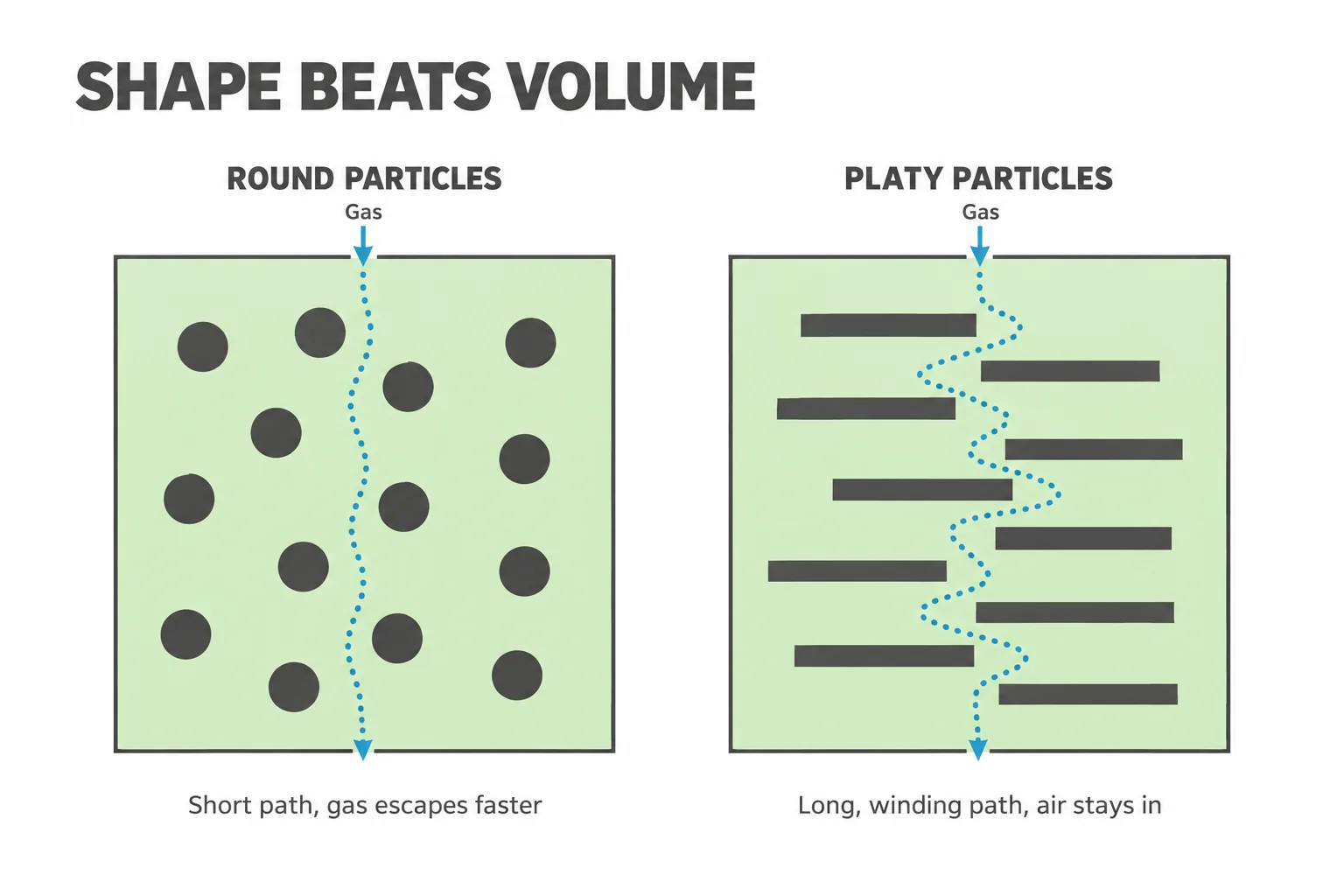
Gas cannot cross a solid filler particle. Every impermeable particle in the matrix forces a gas molecule to detour around it, and the sum of those detours is the tortuous path. Aspect ratio is the dominant variable.
A flat plate with its face perpendicular to the flux direction blocks far more effective area than a sphere of the same volume, so plate-like particles outperform blocky ones at equal loading.
In natural rubber compounds, carbon black sits among the more effective fillers for cutting air loss, while bentonite and calcium carbonate reduce permeation to a smaller degree. The reinforcing role of carbon black in rubber is well documented, and its barrier contribution comes from the same aggregate structure that delivers modulus.
Related readingImprove Filler Dispersion in Rubber: Practical GuideRead the guide →| Filler family | Particle shape | Effect on permeability | Processing notes |
|---|---|---|---|
| Carbon black | Fused aggregates of near-spherical primaries | Strong reduction at reinforcing loads | Raises viscosity and mixing heat history |
| Platy organic filler from bituminous coal | Plate-like, low specific gravity | Reduction through orientation and tortuosity | Disperses readily, lowers compound weight |
| Bentonite and treated clays | High-aspect-ratio platelets | Marked reduction when well exfoliated | Hydrophilic, usually needs surface treatment |
| Calcium carbonate | Blocky to rhombic | Modest, mostly volume displacement | Low cost, little reinforcement |
| Precipitated silica | Hydrophilic aggregates | Neutral to negative without coupling | Requires silane and high mixing energy |
| Talc | Platy | Useful reduction | Can suppress tack and interply adhesion |
Silica deserves a caution. On its own it is not a barrier filler, and a poorly coupled silica compound can hold air worse than the unfilled control because filler-polymer gaps open new pathways. The industrial additives around the filler matter too.
A 2005 study in Polymer from Wuhan University and Beijing University of Chemical Technology compared layered clay with carbon black in SBR, and the clay held gas back better. The authors explain why:
> “Experimental results reveal that gas permeability in rectorite/SBR nanocomposite is mainly influenced by fractional free volume and tortuous diffusional path effects attributed to the clay plateletlike morphology.”
The study used clay, not coal-based filler, but the geometry argument applies to any plate-shaped particle.
Tackifiers, processing aids, and polymer processing additives change flow and orientation during calendring, and specialty adhesive additives affect how well the liner stays married to the carcass. None of them substitutes for the barrier system, but any of them can undo it.
How to Improve Air Retention in Rubber With Platy Organic Fillers
Austin Black 325 is a finely divided powder produced from high-quality, low-volatile bituminous coal. Its particles are platy rather than spherical, and that geometry is what makes it relevant to barrier work.
During calendering and extrusion, shear aligns the platelets roughly parallel to the sheet surface, so they stack across the direction a gas molecule needs to travel and stretch the diffusion path well beyond the nominal gauge.
Low specific gravity is the second advantage. At equal volume loading, a coal-based organic filler adds less mass than mineral fillers, which keeps liner weight down. For a tire, lower liner mass feeds back into rolling resistance, so the barrier gain does not have to be paid for in fuel economy.
ACE Laboratories evaluated the material at 40 phr in a butyl inner liner compound, and the results appear in CFI’s air retention study on Austin Black 325.
| Property affected by platy filler loading | Direction of change |
|---|---|
| Permeability | Falls while dispersion and orientation hold |
| Compound specific gravity | Falls relative to mineral fillers at equal volume |
| Extrusion and calender smoothness | Improves in many liner compounds |
| Elongation and building tack | Falls once loading is pushed past the optimum |
| Cost position | Depends on specific gravity, so compare by volume rather than by weight |
Filler Load, Dispersion, and Orientation
More filler lowers permeability up to a point. Past that point, elongation, fatigue life, and building tack all deteriorate, and the compound starts to crack or delaminate in service, which is a far worse outcome than a slightly high IPLR. The optimum is a curve, not a ceiling, and it should be mapped with a loading ladder rather than assumed.
An agglomerate is a defect, not a barrier: it concentrates stress, creates voids at the polymer interface, and can raise permeability.
Dispersion decides whether the load does any work at all.
Mixing energy, fill factor, rotor speed, and drop temperature control the outcome, and the relationship between aggregate morphology and mixing behavior is covered in this explanation of carbon black structure.
| Dispersion problem | Likely cause | Corrective action |
|---|---|---|
| Visible agglomerates on a cut surface | Low fill factor or short mix cycle | Raise fill factor, extend the dispersive stage |
| High and variable Mooney viscosity | Inconsistent drop temperature | Tighten temperature control and batch timing |
| Barrier gain below prediction | Platelet orientation lost after milling | Reduce re-milling, control sheet relaxation |
| Poor liner-to-carcass adhesion | Excess processing aid or filler at the interface | Rebalance the aid package, check tie gum |
Inner Liner Design: Gauge, Coverage, and Splices
Permeation rate scales inversely with wall thickness, so a thicker liner holds air better. It also adds weight, cost, and cure time, which is why gauge alone is a blunt tool.
Uniformity matters more than the average: total loss is dominated by the thinnest regions, and a liner that meets specification on average while running thin over the shoulder will underperform a thinner but even one.
Splice overlap is the other frequent offender. Insufficient overlap, contamination, or low tack at the splice creates a path that no filler package can close. Bead area coverage and the tie gum layer between a halobutyl liner and a diene carcass complete the picture, since adhesion failure eventually becomes a leak path.
These construction choices interact with the rest of the recipe, including the tire rubber filler system chosen for the liner and adjacent stocks.
| Design variable | Effect on air retention | Trade-off incurred |
|---|---|---|
| Higher liner gauge | Loss falls roughly in proportion | Added weight, material cost, cure time |
| Tighter gauge uniformity | Removes the dominant thin-spot loss | Demands calender and tooling discipline |
| Longer splice overlap | Closes a common leak path | Slight local mass and stiffness increase |
| Full bead area coverage | Protects a high-stress leak zone | Build complexity |
| Tie gum layer | Preserves adhesion over life | Extra component and cost |
Cure System and Crosslink Density
Vulcanization converts a tangle of independent chains into a network joined by permanent chemical bonds. Those bonds restrict segmental motion and reduce free volume, which lowers the diffusion coefficient and therefore permeability. Cure state is a barrier variable, not only a mechanical one.
Undercure is the common fault in thick liner sections. It leaves higher permeability, weak adhesion, and poor aging resistance. Overcure creates its own problems, since reversion and excessive crosslinking embrittle the compound and raise crack risk, and a cracked liner leaks regardless of its permeability coefficient.
Halobutyl liners are typically cured with zinc-oxide-based systems, sometimes with resin cure where heat resistance is critical. Press time is not proof of cure state; rheometer data on the actual compound is.
| Cure state | Air retention | Modulus | Fatigue and aging outcome |
|---|---|---|---|
| Undercured | Poor, diffusivity stays high | Low | Weak adhesion, rapid property drift |
| Optimum | Best available for the recipe | On target | Stable over service life |
| Overcured or reverted | Good initially, degrades with cracking | High or erratic | Brittle, crack initiation risk |
Measurement: How to Prove the Compound Actually Holds Air
Two levels of testing answer two different questions. IPLR measures the finished product, mounted and inflated, and reports percentage pressure loss per month. It captures the compound, the gauge, the splices, the bead, and the valve all at once, which makes it the acceptance number but a poor diagnostic.
Laboratory gas transmission testing on cured sheets removes the construction from the result and tells you what the recipe alone is worth.
Fair comparison requires control. Sheet thickness, test gas, temperature, sample conditioning, and pressure differential all shift the reported value, so candidate compounds must run under a single protocol. A permeability coefficient quoted without its test conditions carries no information.
| Test method | What it measures | When to use it |
|---|---|---|
| Inflation Pressure Loss Rate | Pressure loss per month on a built, inflated product | Final acceptance and benchmark comparison |
| Gas transmission rate on cured sheets | Compound permeability in isolation | Screening recipes before a production trial |
| Rheometer cure trace | Crosslink development and cure state | Every batch, before conclusions about leaks |
| Dispersion rating on cut samples | Agglomerate count and size | Whenever barrier gains fall short of prediction |
A plant does not need to burn production time to get these answers. CFI offers formula testing, lab sampling, toll grinding, and custom packaging through its technical services, which lets a candidate loading be screened on the bench before anyone schedules a calender run.
Trade-Offs to Weigh Before a Reformulation
Every barrier gain has a price somewhere else in the recipe. Higher filler loading costs elongation and tack. Higher gauge costs weight. More halobutyl costs money. The task is to pick the trade the application can absorb.
Cost comparisons deserve particular care. Rubber compounds are mixed by weight but used by volume, so cost per pound misleads whenever specific gravity differs between candidates.
A lighter filler at the same volume loading yields more finished parts per ton, a point worth working through alongside published carbon black pricing when two options look close on paper.
Lower compound weight also serves sustainability targets, since it cuts material consumed per part and the mass a vehicle carries for the life of the tire.
| Goal | Recommended lever | Side effect to monitor |
|---|---|---|
| Lowest achievable permeability | Raise halobutyl content in the liner | Compound cost, building tack |
| Better retention without added weight | Substitute platy low-density filler | Loading limits on elongation |
| Lower compound cost at equal barrier | Optimize filler volume, not filler weight | Dispersion quality at higher loadings |
| Fewer field leaks | Gauge uniformity and splice control | Process discipline, tooling upkeep |
| Longer service life | Full cure plus adequate antidegradant | Scorch safety and cure time |
Beyond Tires: Other Rubber Goods That Need Barrier Performance
The same three levers apply wherever a rubber wall separates pressurized gas from the atmosphere: a low-permeability polymer, a platy impermeable filler, and enough well-cured wall thickness.
Air spring bellows, inflatable seals, hose liners, diaphragms, gaskets, and membrane systems such as rubber roofing material all trade on barrier behavior, whether the goal is to hold pressure in or keep moisture and gas out.
Formulators in these markets usually evaluate barrier fillers alongside neighboring chemistry, including rubber additives for cure and aging, polyurethane additives in adjacent components, and carbon black alternatives selected for weight or emissions reasons.
The barrier decision should rest on its own evidence rather than get bundled into a general additive review.
| Application | Dominant failure mode | Lever that fixes it |
|---|---|---|
| Air spring bellows | Slow permeation through the wall | Halobutyl base plus platy filler |
| Inflatable and pneumatic seals | Thin sections and set under load | Gauge control and cure state |
| Hose liners | Gas or fuel migration through the tube | Polymer selection, high ACN or halobutyl |
| Membrane roofing | Moisture and gas transmission, weathering | Filler tortuosity plus antidegradant package |
| Diaphragms | Flex fatigue with permeation | Balanced loading, full cure |
Common Questions About Rubber, Air Loss, and Aging
How do you improve air retention in rubber?
Does petroleum jelly soften rubber?
What makes rubber expand?
Does freezing shrink rubber?
Does rubber get weaker over time?
Which filler improves air retention most?
| Question | Short technical answer |
|---|---|
| Petroleum jelly as a fix | Swells and plasticizes rubber, raises permeability |
| Cause of rubber expansion | Heat, absorbed fluids, internal pressure |
| Effect of freezing | Reversible contraction and stiffening, no retention benefit |
| Aging | Real and progressive, accelerated by heat and underinflation |
| Best barrier filler shape | Platy and high aspect ratio, fully dispersed |
Key Takeaways: How to Improve Air Retention in Rubber
Work the levers in order. Polymer choice sets the ceiling, filler choice captures most of what remains, construction protects the result, and process control keeps it repeatable from batch to batch. Technical data sheets, FAQs, and further reading sit in the CFI resources index.
| Lever | Expected direction | First action |
|---|---|---|
| Polymer backbone | Largest reduction in permeability | Base the barrier layer on butyl or halobutyl |
| Filler shape and type | Longer diffusion path, lower loss | Move to platy, impermeable particles |
| Load and dispersion | Gains up to an optimum, then losses | Run a loading ladder with dispersion ratings |
| Liner gauge and splices | Fewer leak paths, lower total loss | Audit gauge uniformity and overlap |
| Cure state | Lower diffusivity, stable aging | Verify with rheometer data, not press time |
| Verification | Confidence in the change | Confirm with IPLR and lab permeability |
Next Step for Your Barrier Compound
If your inner liner, bellows, or seal compound does not hold pressure the way the specification demands, the fastest low-risk test is a platy filler substitution at a controlled loading.
Technical data, particle characteristics, and sampling for Austin Black 325 come directly from CFI Carbon Products, along with formula testing, lab sampling, and toll grinding support for plants that want the bench work done before a production trial. Request a sample or a formulation review for your barrier compound, and bring the IPLR data with you.