
A good rubber compound rarely fails because of one dramatic mistake. More often, the trouble starts quietly: a filler that does not break down well, a mixer that runs a little cold, a batch that gets too much oil too early, or a polymer filler system that looks fine on paper but acts stubborn on the floor. That is why manufacturers that want stronger parts, cleaner extrusion, better air retention, and consistent performance need to improve filler dispersion in rubber before they chase bigger formula changes.
Improve Filler Dispersion in Rubber
To improve filler dispersion in rubber, compounders need to control filler selection, mixing sequence, shear, temperature, fill factor, polymer viscosity, oil addition, and quality testing. The aim is not just to “mix longer.” The real target is achieving uniform filler breakdown and distribution inside the rubber matrix without damaging the polymer, scorching the compound, or wasting energy.
Here’s the thing: filler dispersion plays a direct role in determining material performance. When carbon black, silica, mineral filler, or specialty rubber filler remains as agglomerates, the compound may show weak spots, rough surfaces, poor extrusion, reduced tear strength, and batch-to-batch variation. When dispersion quality is high, the filler can do its job. The rubber matrix becomes more uniform, process controls become easier to manage, and mechanical properties tend to hold steadier from one production run to the next.
For rubber compounders, the practical question is not whether filler dispersion matters. It does. The better question is how to improve filler dispersion in rubber without adding needless cost or slowing production to a crawl.
Uniform Dispersion and Material Performance
Uniform dispersion means the filler is properly distributed through the rubber compound and large agglomerates have been reduced to a size that supports the desired performance. In simple terms, the filler should reinforce, extend, modify, or protect the compound without acting like grit trapped in dough.
Carbon black is the classic example. It is more than a dark pigment. In rubber, carbon black can help improve strength, abrasion resistance, UV resistance, and cost efficiency. But those gains depend heavily on how well the filler enters and spreads through the polymer. Poorly dispersed carbon black may raise viscosity, create weak points, reduce surface quality, and cause unpredictable test results.
A Smithers rubber compounding resource puts the risk plainly: “Residual agglomerates or undispersed pellets introduce structural discontinuities that serve as potential crack initiation sites.” That point matters because it connects dispersion quality to durability, not just lab neatness. In plain shop-floor terms, poor dispersion does not stay hidden inside the compound. Sooner or later, it can show up as weaker parts, rougher processing, inconsistent test results, or premature failure.
They say “mix better,” then stop. In real production, you improve filler dispersion in rubber by managing the whole system: filler morphology, polymer viscosity, mixing time, rotor speed, ram pressure, dump temperature, oil timing, and post-mix handling.
| Dispersion Factor | What It Affects | What to Watch in Production |
| Filler particle size and structure | Reinforcement, viscosity, dispersion difficulty | Finer, high-structure fillers often need more energy |
| Polymer viscosity | Shear transfer and filler wet-out | Too low may reduce shear; too high may limit flow |
| Mixing sequence | Filler incorporation and agglomerate breakdown | Add oil too early, and shear may fall |
| Temperature | Viscosity, wetting, scorch risk | Too cold may under-disperse; too hot may damage the batch |
| Mixing time | Breakdown and distribution | Longer is not always better |
| Equipment condition | Batch consistency | Worn rotors, poor ram pressure, or residue can ruin repeatability |
Carbon Black, Rubber Filler, and Filler Systems
A rubber formula is a compromise. Every filler brings benefits and trade-offs. Carbon black may reinforce and protect. Silica can improve traction and rolling resistance in tire compounds, especially when paired with silane coupling agents. Mineral fillers can lower cost or alter hardness. Organic fillers and carbon black alternatives can help reduce weight, improve processing, or support lower-emission goals. Dispersion behavior is closely tied to particle density, which is why cutting compound weight with low density fillers often improves mixing as well as mass.
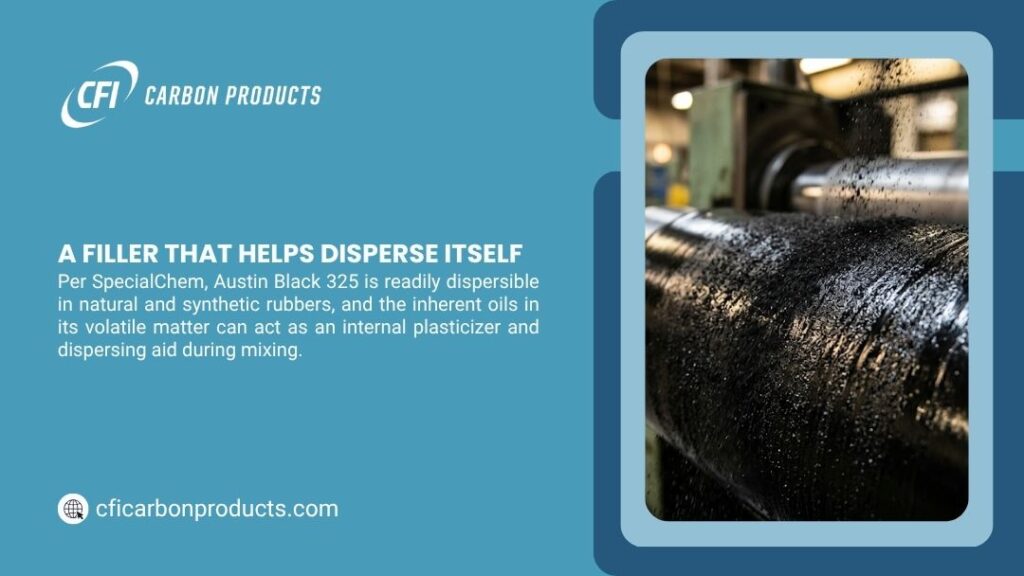
This is also where Austin Black 325 deserves a closer look. CFI Carbon Products positions Austin Black 325 as a finely divided organic filler with low specific gravity, which means compounders can think beyond price per pound and look at cost per filled volume.
That matters in rubber because a filler that contributes more volume at a lower weight can help reduce part weight, support easier processing, and protect margin without forcing a complete formula rebuild.
For rubber compounders that rely heavily on carbon black, clay, talc, calcium carbonate, or other filler systems, Austin Black 325 can be tested as a practical way to balance processability, weight reduction, and profitability.
The point is not that one filler solves every dispersion problem. It does not. The point is that filler choice sets the stage before the mixer even starts. If a filler is difficult to wet, too dense for the cost target, or poorly matched to the rubber matrix, better mixing may only hide the problem for a while. A low-specific-gravity organic filler such as Austin Black 325 gives teams another route to evaluate, especially when the goal is improved processing, consistent performance, and lower compound cost by volume.
For rubber-focused industries, CFI’s rubber industry applications connect Austin Black 325 to practical manufacturing concerns such as processability, air retention, odor reduction, and compound cost. That makes the filler especially relevant for manufacturers that need better production behavior without losing sight of end-use performance.
But no filler is magic dust. To improve filler dispersion in rubber, the filler must suit the polymer, the mixing equipment, the end-use part, and the desired balance of hardness, tensile strength, elongation, abrasion resistance, compression set, and aging behavior.
Process Controls That Enhance Filler Dispersion
Process controls are where good lab ideas either survive or fall apart. The same formula can behave differently in a Banbury mixer, two-roll mill, kneader, microcompounder, or production-scale internal mixer. That is why rubber compounders should document how the filler enters the rubber matrix, not merely which ingredients appear in the recipe.
A common mistake is to treat mixing time as the main control. Mixing time matters, sure, but it is only one part of the job. Rotor speed, fill factor, ram pressure, batch temperature, polymer viscosity, and ingredient sequence all influence the shear forces that break filler agglomerates apart.
To improve filler dispersion in rubber, the masterbatch stage should give the compound enough shear to break down filler clusters and enough temperature to reduce viscosity for wetting. At the same time, the batch should not get so hot that polymer degradation, premature cure risk, or excessive viscosity loss start to work against the compound.
Oil timing deserves special care. Processing oil can help flow, but if too much oil enters too early, the compound may become too lubricated. Lower shear means weaker agglomerate breakdown. This is one of those shop-floor details that sounds small until a compound starts to show poor tensile strength, surface defects, or inconsistent Mooney viscosity.
Common Production Mistakes That Hurt Uniform Dispersion
Most dispersion problems do not come from one obvious failure. They creep in through small habits that become normal on the production floor. A mixer runs slightly underfilled. Oil goes in too early because the batch “looks dry.” Dump temperature gets treated as a suggestion. A worn rotor keeps doing the job, sort of, until the lab results begin to wander.
The first mistake is adding processing oil too soon. Oil can help flow, but early oil addition can reduce shear before filler agglomerates have had a fair chance to break down. The batch may look smoother, yet dispersion quality may suffer.
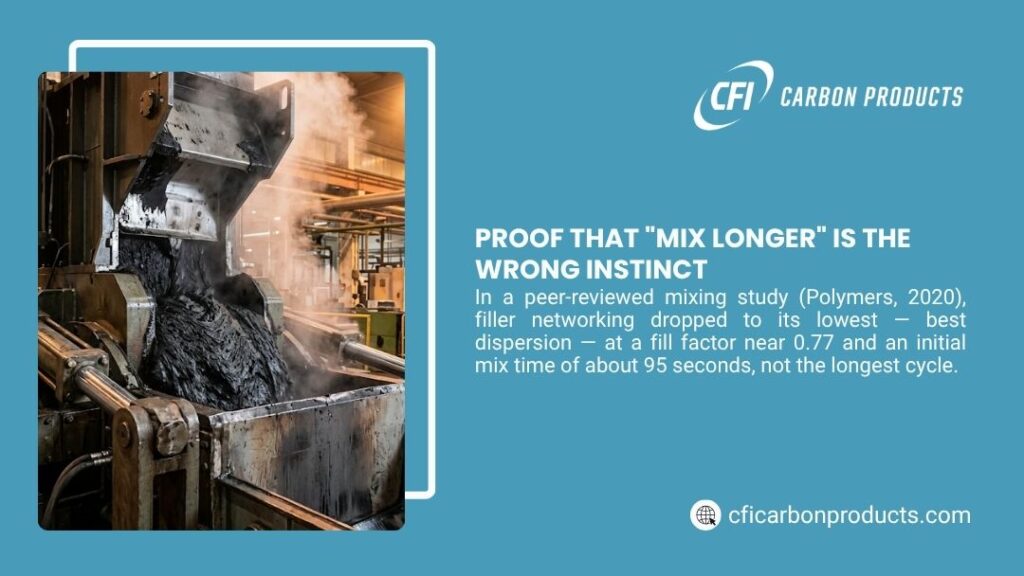
The second mistake is chasing longer mixing time instead of better mixing energy. More time can add heat history without solving filler wet-out.
The third mistake is treating all filler systems the same. Carbon black, silica, mineral fillers, and organic rubber fillers do not enter the rubber matrix in identical ways. Their surface chemistry, structure, particle behavior, and density all change how they respond to shear.
A better approach is to control sequence first, then energy, then time. Add the filler when the polymer can still deliver useful shear. Stage oil so the compound does not become too lubricated too early. Watch temperature as a process signal, not just a safety limit. And when a new filler enters the formula, test it against the current process instead of assuming the old mixing cycle will still be right.
Coupling Agents, Processing Aids, and Improved Processing
Coupling agents and processing aids can improve filler dispersion in rubber when the filler surface and polymer matrix need better compatibility. Silica-filled compounds are the best-known example because silica is polar while many rubbers are nonpolar. Silane coupling agents help bridge that gap, improve filler-polymer interaction, reduce filler-filler interaction, and support better mechanical properties.
Processing aids can also help, but they need careful use. The wrong aid or the wrong dose may reduce viscosity too much, alter cure behavior, or create unwanted migration. The aim is improved processing without a hidden penalty.
Austin Black 325 can support this discussion because CFI presents it not only as a filler, but as a formula-improving material that can aid processability and flowability in the right compound. For a plant that sees persistent dispersion problems, that distinction matters. The answer may not be a heavier filler load or a stronger processing aid. Sometimes the better move is to test a filler that fits the process window more cleanly.
For manufacturers that need custom support rather than guesswork, CFI’s formula testing and lab services show how material suppliers can help evaluate filler performance before a full production change. That matters for any plant that wants to improve filler dispersion in rubber while protecting throughput, quality, and customer specifications.
| Additive or Adjustment | Best Use Case | Possible Risk |
| Silane coupling agent | Silica-filled rubber compounds | Poor control can affect cure and VOCs |
| Dispersing aid | Hard-to-wet fillers or high loading | May soften compound or alter cure |
| Staged oil addition | Carbon black or high-filler formulas | Added too late, it may increase cycle time |
| Higher shear window | Agglomerate breakdown | Too much heat or polymer damage |
| Filler blend | Cost, weight, processing balance | Incompatible filler systems can reduce properties |
Rubber Matrix, Mixing Time, and Dispersion Quality
The rubber matrix itself controls how much shear reaches the filler. A high-viscosity polymer may create more shear but can be harder to process. A low-viscosity polymer may flow more easily but may not transmit enough force to break down agglomerates. So, to improve filler dispersion in rubber, compounders need the right viscosity window, not the highest or lowest value on the sheet.
Mixing time should be judged by dispersion quality and compound health. A longer cycle may improve distribution up to a point. After that, extra time can create heat history, reduce productivity, and sometimes cause re-agglomeration or loss of desirable properties. In other words, the mixer can solve one problem while quietly creating another.
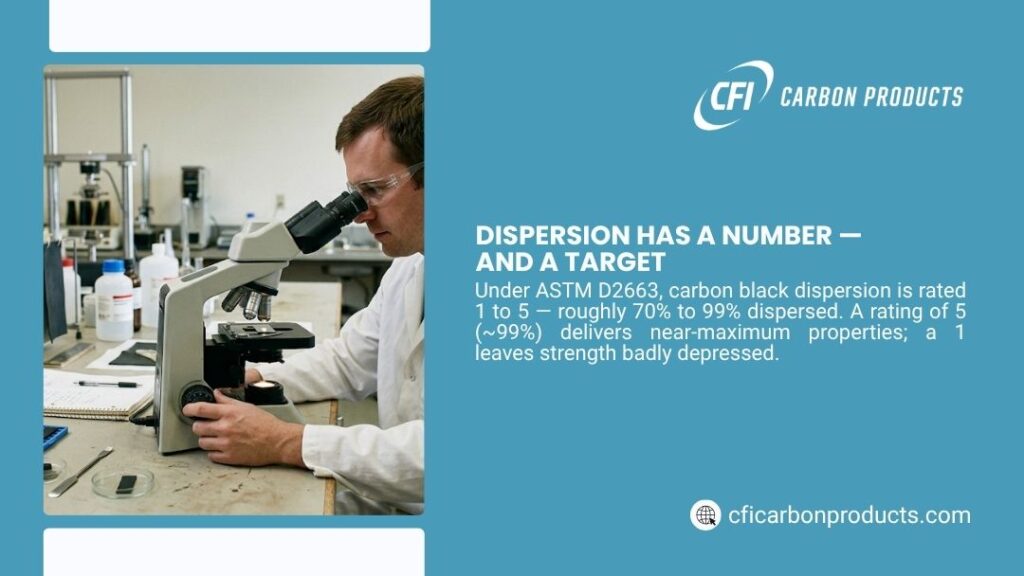
This is why lab and production teams should track dispersion, Mooney viscosity, cure behavior, tensile strength, tear strength, abrasion resistance, compression set, and surface appearance together. One test rarely tells the whole story.
CFI’s value here is not only the material itself. It is the ability to help manufacturers compare how Austin Black 325 behaves in a real formulation, not in a generic product claim. That is important because dispersion quality is tied to the entire compound, including the polymer, filler package, oil system, cure package, and production equipment.
Filler Dispersion Testing and Quality Checks
If you cannot measure dispersion quality, process control turns into folklore. Plants that want to improve filler dispersion in rubber should use a test method that fits the compound and the risk level of the product.
Optical dispersion analysis, microscopy, surface roughness checks, Payne effect testing, dynamic mechanical analysis, electrical resistivity for conductive carbon black systems, and tensile or tear testing can all support decisions. Some methods measure filler distribution directly. Others show the effect of dispersion on performance.
A tire inner liner, roofing membrane, hose, belt, gasket, or molded seal may not need the same test plan. For example, a rubber roofing compound may need special attention to weathering, processing, and cost, where CFI’s guidance on rubber roofing material aligns well. A tire-related compound typically requires greater focus on abrasion, air retention, and durability, making CFI’s tire rubber filler information more relevant.
When to Test an Alternative Rubber Filler
A plant should consider an alternative filler when the current compound keeps showing the same defect even after process controls have been tightened. If dispersion scores remain inconsistent, extrusion stays rough, viscosity is hard to control, or the compound needs too much energy to process, the filler system may be part of the problem.
This is where a controlled comparison can save a lot of guesswork. Instead of changing three or four variables at once, a technical team can run the current filler beside an alternative such as Austin Black 325 and compare dispersion rating, Mooney viscosity, cure behavior, tensile strength, tear resistance, hardness, compression set, part weight, and cost per usable volume. That side-by-side view is often more useful than a spreadsheet price comparison because it shows how the filler behaves in the actual rubber matrix.
CFI’s formula testing, lab samples, packaging options, and toll grinding support can help manufacturers test that question before a full production change. For a rubber compounder, that lowers risk. The team can see whether Austin Black 325 improves processing, supports the target properties, or creates a better cost-performance balance before it reaches the production mixer.
Troubleshooting Poor Filler Dispersion
When filler dispersion fails, the symptoms may show up as rough extrusion, specks, weak tensile results, poor tear resistance, inconsistent hardness, high viscosity, porosity, scorch problems, or customer complaints. The fix depends on the cause.
If agglomerates remain visible, the compound may need more effective shear, better filler wet-out, staged filler addition, or a change in filler grade. If viscosity is too low during early mix, oil timing or polymer choice may need review.
If the batch overheats, rotor speed, fill factor, cooling, or dump temperature may be the issue. If dispersion looks good in the lab but fails at scale, equipment geometry, batch size, ram pressure, and heat transfer may be the culprits.
Here’s what I found: most guide on this topic tells readers to “increase mixing.” That advice is only half right. To improve filler dispersion in rubber, you may need to increase shear, but not always time. You may need a better sequence, not a longer cycle. You may need a different filler, not more processing aid. And sometimes, yes, you need a lab trial before the production mixer gets blamed.
| Problem Seen in Compound | Likely Cause | Practical Fix |
| Visible black specks or filler clusters | Poor agglomerate breakdown | Increase effective shear or revise filler addition |
| High viscosity and poor flow | Excess filler loading or poor wetting | Review filler type, oil timing, and process aid |
| Weak tensile or tear results | Poor filler-polymer contact | Improve mixing window or use compatible aid |
| Batch variation | Equipment or sequence drift | Tighten process controls and QC checks |
| Surface defects after extrusion | Undispersed filler or contamination | Check dispersion test and mixer cleanliness |
| Scorch risk | Excess heat history | Reduce dump temperature or cycle severity |
Cost, Sustainability, and Consistent Performance
To improve filler dispersion in rubber is also to protect margin. Poor dispersion wastes filler value. A high-performance filler cannot perform if it stays locked in clumps. A lower-cost filler can become expensive if it increases scrap, slows mixing, or causes field failure.
This is where CFI’s value proposition becomes stronger than a simple material substitution. Austin Black 325 is promoted as a low-emission organic filler that can fit into existing formulas while helping manufacturers reduce end-product weight and improve profitability. In practical terms, that means a rubber team can review more than lab performance. They can also review batch cost, filled volume, part weight, processing behavior, and carbon-reduction goals in one trial.
That combination matters because sustainability claims do not help much if the compound becomes harder to process or more expensive to produce. CFI’s position is more grounded: use a low-specific-gravity filler that may support better cost-per-volume economics while giving manufacturers a route to reduce reliance on heavier or higher-emission filler systems where the application allows it.
For rubber parts, roofing materials, tire-related compounds, hoses, belts, seals, and molded goods, that kind of practical sustainability is easier to defend than a broad green claim.
For broader support around material selection, internal content like rubber additives, rubber reinforcement additives, reinforcement fillers for elastomers, sustainable rubber fillers, and high-performance rubber fillers helps connect problem diagnosis with appropriate material choices.
How Rubber Compounders Can Improve Filler Dispersion in Rubber
The best route is a controlled trial, not a hunch. Start with the current formula and define the defect: poor physical properties, bad extrusion, high viscosity, surface flaws, long mix cycle, or inconsistent cure. Then isolate the likely factor. Change one variable at a time: filler grade, loading, oil timing, rotor speed, dump temperature, mixing sequence, or processing aid.
A practical trial should compare the current compound against a revised process and, where appropriate, an alternative filler system. The test plan should include dispersion rating, Mooney viscosity, cure curve, tensile strength, tear strength, elongation, hardness, abrasion, compression set, and any application-specific requirement.
This can help you improve filler dispersion in rubber without turning formulation work into guesswork. Better still, it gives purchasing, R&D, production, and quality teams the same evidence base. When the compound works, everyone can see why.
For CFI’s ideal customer, this is the most useful decision point. If the current filler system is heavy, expensive by volume, difficult to process, or tied to a carbon-reduction challenge, Austin Black 325 gives the team something concrete to test. Not a vague promise. A measurable comparison. That is exactly the kind of evidence rubber compounders need before they touch a production formula.
Supplier Support Matters More Than It Looks
Rubber compounders do not just buy filler. They buy consistency, technical support, and supply confidence. CFI has served manufacturing markets since 1987 and operates from facilities in Virginia and West Virginia, close to Appalachian bituminous coal sources. That matters for customers that need dependable raw material control, reliable logistics, and responsive support rather than a distant supplier that only ships material.
The company also supports more than rubber. Its filler materials serve plastics, silicone, and coatings, which gives CFI a broader view of polymer and additive behavior across industrial markets.
For rubber teams, the useful part is the support around Austin Black 325: lab samples, formula testing, custom packaging, toll grinding, and help with application-specific trials. In other words, the company is not asking manufacturers to guess. It gives them a way to test, compare, and decide with evidence.
Better Dispersion Starts Before the Mixer Runs
To improve filler dispersion in rubber, start with the filler system, then control the process around it. Carbon black, silica, mineral fillers, and organic fillers all behave differently in the rubber matrix. Mixing time, shear, temperature, oil timing, coupling agents, and lab testing decide whether those fillers support the compound or weaken it.
The plants that get this right do not simply add more energy and hope for the best. They use process controls, practical testing, and supplier support to build rubber compounds with consistent performance. If your team is reviewing filler options for rubber, silicone, plastics, or coatings, CFI Carbon Products’ Austin Black 325 and technical services are worth a closer look.
If your team needs to improve filler dispersion in rubber, start with the current formula, document the defect, and run a controlled comparison. Test the existing filler system beside Austin Black 325. Measure dispersion, processing behavior, part weight, cure response, and cost per usable volume. Then decide from the data, not from habit.
To move the next trial forward, request an Austin Black 325 sample, compare it against your current rubber filler, or ask CFI Carbon Products about formula testing support for your compound. A small lab-backed test may be enough to show whether better dispersion, easier processing, and stronger cost control are within reach.