
Rubber tensile strength sits at the heart of product durability, flexibility, and long-term performance. Whether the application involves automotive seals, industrial belts, or coatings, the ability to improve the tensile strength of rubber directly affects reliability and cost efficiency. This guide explains how to improve rubber tensile strength, how manufacturers actually approach this problem, from material selection to filler optimization, based on real-world practices rather than textbook theory.
What Is the Best Way to Improve Rubber Tensile Strength?
The most effective way to improve rubber tensile strength is to combine three key factors: selecting the right reinforcing filler, optimizing the vulcanization system, and ensuring proper filler dispersion within the rubber compound. When these elements work together, they create a strong polymer network that resists breaking under stress.
In industrial applications, manufacturers often improve tensile strength by using high-performance reinforcing fillers, adjusting sulfur vulcanization systems, and controlling processing conditions to achieve uniform crosslink density and material consistency.
How to improve rubber tensile strength?
If you’ve ever worked with rubber compounds, you already know there’s no single fix. Some batches come out stronger, others slightly off, even with the same recipe. That’s because tensile strength depends on how well everything inside the compound works together.
At its core, improving tensile strength means helping the rubber resist breaking when stretched. Natural rubber often delivers higher tensile strength out of the gate due to its long-chain structure. On the other hand, synthetic rubber gives more control over properties but needs careful formulation to reach similar strength.
What actually improves tensile strength is not just adding more material, but choosing the right combination of reinforcing agent, curing system, and processing conditions so the entire network holds together under stress.
What Determines the Tensile Strength of Rubber?
Tensile strength develops from structure, not just ingredients. The polymer backbone forms the base, but what really matters is how that backbone connects and interacts with everything else.
Natural rubber tends to crystallize under strain, which explains its higher tensile strength. Synthetic rubber doesn’t do this as easily, so it relies more on fillers and additives to compensate. That’s where the rubber compound design becomes critical.
Crosslink density plays a major role. During sulfur vulcanization, bridges form between polymer chains. Too few crosslinks and the rubber stretches too easily. Too many, and it becomes stiff and prone to cracking. There’s a narrow window where tensile strength and elongation both perform well.
Fillers step in as reinforcement. They distribute stress across the material, but only if they bond properly with the polymer matrix. Poor interaction means the filler behaves like a contaminant rather than a strengthening agent.
Temperature, mixing, and raw material consistency also shape the outcome. Even a well-designed formulation can underperform if processing conditions are off.
Proven Methods to Improve the Tensile Strength of Rubber
Before jumping into specific methods, it’s worth pointing out something manufacturers often learn the hard way: tensile strength doesn’t improve in isolation. Each adjustment, whether in filler type, curing chemistry, or mixing, affects something else. The goal isn’t just higher strength; it’s balanced performance.
Reinforcing Fillers That Actually Make a Difference
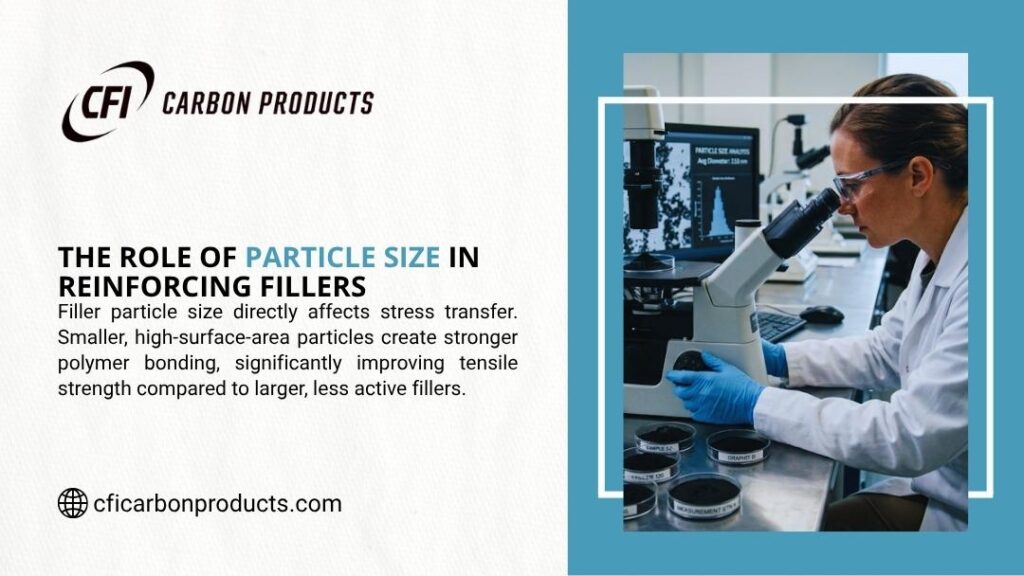
Not every filler strengthens rubber, and that’s where most formulations go wrong. Some materials simply increase volume without contributing to tensile properties. The real difference comes down to surface interaction, particle structure, and how efficiently stress transfers through the rubber compound.
Carbon black has historically been the go-to reinforcing agent because of its ability to bond with polymer chains. However, manufacturers are no longer relying on it alone. The shift toward low-density, high-efficiency fillers is driven by both performance and cost pressure. If the finished part must also resist electrical breakdown, our article on balancing strength with electrical insulation compares the main options for that job. When a compound also has to insulate, our article on testing dielectric strength in filled rubber explains how to qualify a new material before it reaches production. If you are weighing that trade-off, this guide to choosing a low density filler for rubber compounds explains how to cut weight without giving up tensile performance.
For example, engineered materials like those used in high-performance rubber fillers, such as the solution outlined in this material profile, offer a lower specific gravity. That means you can achieve the same or better reinforcement using less weight, which directly improves batch economics and processing efficiency.
Here’s what many overlook: tensile strength doesn’t increase just because a filler is added; it improves when that filler is properly dispersed and actively participates in load transfer across the polymer network.
| Property | Traditional Carbon Black | Low-Density Reinforcing Fillers |
| Density | Higher | Lower |
| Volume Efficiency | Moderate | Significantly improved |
| Dispersion Potential | Moderate | Easier, more uniform |
| Cost per Volume | Higher | More cost-effective |
| Tensile Impact | Strong | Balanced + efficient reinforcement |
In one common industrial scenario, partial replacement of traditional carbon black with a lower-density reinforcing filler allowed manufacturers to maintain tensile strength while reducing compound weight. This resulted in improved processability and lower material cost per batch, without compromising performance.
This kind of adjustment is increasingly common in applications like tire compounds and industrial rubber components, where both strength and efficiency matter.
Fine-Tuning the Vulcanization System
Vulcanization defines how rubber behaves under stress, but in practice, it’s rarely optimized properly. Most production issues tied to tensile failure come back to crosslink imbalance. Either the network is too tight, which limits elongation, or too loose, which reduces strength. The goal is controlled crosslink density, not maximum curing.
Sulfur systems remain dominant because they create flexible bonds that allow movement under stress. But what’s often missed is the role of accelerator systems and cure timing. Even small deviations in cure rate can shift tensile properties significantly.
In high-performance rubber products, manufacturers often fine-tune cure systems based on end-use stress conditions rather than relying on standard formulations.
| Vulcanization Type | Crosslink Nature | Practical Impact |
| Sulfur System | Flexible bonds | Better tensile strength and elongation balance |
| Peroxide System | Rigid bonds | Higher thermal stability but reduced flexibility |
This is where formulation expertise matters, because tensile strength isn’t just created during curing; it’s either preserved or lost depending on how that system is controlled.
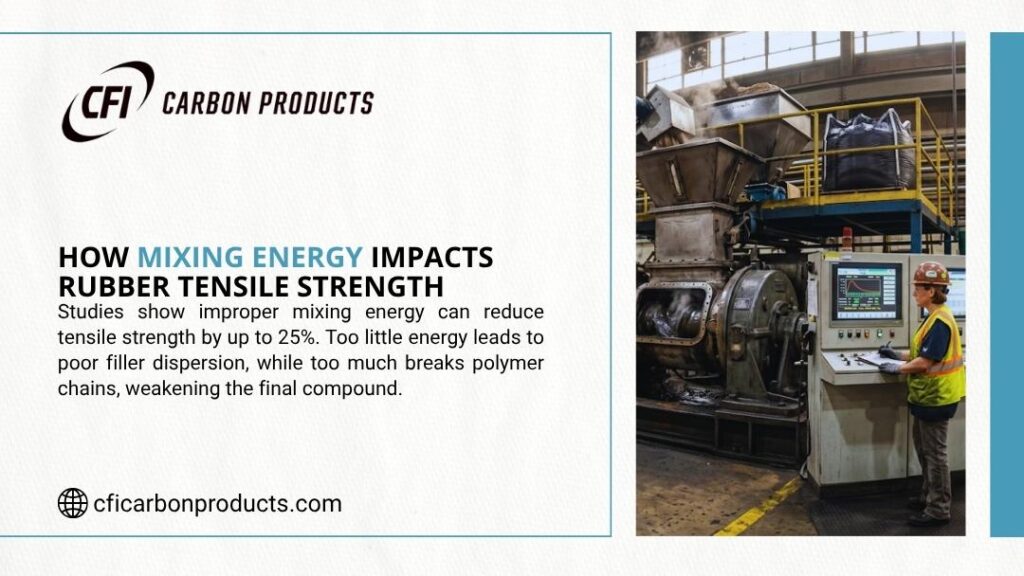
Improve Filler Dispersion in Rubber Compound: The Hidden Factor Most People Overlook
This is one of the most underestimated factors in improving rubber tensile strength, and one of the most common reasons formulations fail in real production.
Even with the right reinforcing agent, poor dispersion creates microscopic weak zones. These zones don’t show up immediately, but under stress, they become the starting point for cracks.
What actually improves tensile strength is not just filler selection, but how evenly that filler distributes across the rubber matrix.
Advanced solutions like reinforcement fillers for elastomers are designed to improve dispersion behavior, not just reinforcement capability.
| Dispersion Level | What Actually Happens |
| Poor | Localized stress → early failure |
| Inconsistent | Unpredictable tensile performance |
| High | Uniform strength across the compound |
In many cases, improving dispersion alone can deliver better tensile results than switching materials entirely. That’s why processing and mixing strategy deserve as much attention as formulation.
Select the Right Rubber Matrix
The base polymer sets the limits of what’s possible. Natural rubber typically delivers higher tensile strength because of strain-induced crystallization. Synthetic rubber offers flexibility in performance but often requires reinforcement to match strength levels.
| Rubber Type | Tensile Strength Potential | Typical Use |
| Natural Rubber | High | Tires, heavy-duty products |
| SBR | Moderate | Cost-sensitive applications |
| EPDM | Lower tensile, high durability | Roofing, seals |
The key is matching the rubber type to the application rather than forcing performance through additives alone.
Use Functional Additives and Processing Aids
Additives are rarely the headline, but they often decide whether tensile strength holds over time. A rubber compound may test well initially, but without stabilization, those properties degrade under heat, oxidation, or environmental exposure.
Antioxidants protect against chain breakdown. Plasticizers adjust flexibility. Coupling agents improve bonding between filler and polymer, and that last one is especially critical for tensile strength.
Well-designed rubber additives do more than support processing; they enhance how effectively reinforcement works within the compound, improving overall performance and consistency.
| Additive Type | Role in Compound | Real Impact |
| Antioxidants | Prevent degradation | Maintain tensile properties over lifecycle |
| Plasticizers | Improve flexibility | Support elongation without failure |
| Coupling Agents | Improve bonding | Enhance filler effectiveness |
Ignoring additives often leads to short-term strength gains but long-term performance loss.
Control Processing Temperature and Mixing Conditions
Temperature control often separates consistent production from unpredictable results. Excess heat can break down polymer chains before curing even begins. Mixing time also matters. Under-mixing leads to poor dispersion, while over-mixing can degrade the compound.
| Parameter | Effect on Rubber |
| High temperature | Polymer degradation |
| Low mixing time | Poor dispersion |
| Controlled mixing | Optimal strength |
Maintaining stable processing conditions ensures that the formulation performs as intended.
Reduce Voids and Improve Density
Voids act like stress concentrators. Under tension, these small gaps become the starting point for cracks. Improving compound density through proper mixing and degassing reduces internal weaknesses.
| Condition | Impact on Tensile Strength |
| Air pockets present | Reduced strength |
| Uniform density | Improved load distribution |
Even minor improvements here can significantly improve final product durability.
Comparison of Reinforcing Fillers for Rubber Strength
Choosing the right filler often comes down to understanding trade-offs. Strength, cost, density, and sustainability all play a role.
| Filler Type | Density | Reinforcement Level | Cost Efficiency | Sustainability |
| Carbon Black | High | Excellent | Moderate | Low |
| Alternative Carbon Fillers | Low | High | High | High |
| Silica | Medium | Moderate | Higher | Medium |
Many manufacturers now evaluate carbon black alternatives to balance performance and environmental goals.
How Sustainable Fillers Improve Tensile Strength and Cost Efficiency
There’s a clear shift happening across the industry, and it’s not just about sustainability claims. Manufacturers are now evaluating fillers based on how they affect both tensile strength and cost per unit output. That’s where lower-density materials are changing the equation.
When a filler has a lower specific gravity, more volume can be added without increasing weight. This improves dispersion, reduces mixing resistance, and often leads to better processability, factors that directly influence tensile performance.
Solutions such as sustainable rubber fillers demonstrate that performance and environmental goals can align. More importantly, materials built around cost-effective carbon solutions allow manufacturers to maintain, or even improve, tensile properties while reducing formulation cost. That combination is what’s driving adoption, not sustainability alone.
Where Tensile Strength Matters Most in Real Applications
Different industries rely on tensile strength for different reasons. In some cases, it’s about load-bearing. In others, it’s about resisting environmental stress.
| Application | Requirement | Why Strength Matters |
| Tires | High tensile + abrasion | Load-bearing under motion |
| Roofing | Flexibility + strength | Weather resistance |
| Seals | Elastic strength | Prevent leakage |
Applications involving tire rubber filler and rubber roofing material depend heavily on maintaining consistent tensile performance over time.
Mistakes That Quietly Reduce Tensile Strength
Most tensile failures don’t come from dramatic formulation errors. They come from small decisions that seem harmless at first. Understanding these mistakes helps prevent costly production issues and performance failures in the field.
| Common Mistake | What Actually Happens |
| Excess filler loading | Reduced flexibility → brittle behavior under stress |
| Poor dispersion | Weak zones → early crack formation |
| Incorrect curing system | Imbalance between strength and elongation |
| Inconsistent raw material | Batch-to-batch performance variation |
These issues are rarely visible during early testing, but they show up quickly under real operating conditions.
What’s Changing in Rubber Reinforcement Today
Rubber reinforcement is no longer just about maximizing strength; it’s about achieving performance with efficiency. The industry is moving toward smarter materials that deliver reinforcement without excessive weight, energy use, or environmental impact.
Recycled carbon materials and advanced filler systems are gaining traction because they offer a more balanced approach. They improve dispersion, reduce density, and maintain tensile properties without the drawbacks of traditional fillers.
Developments in recycled material for rubber and eco-friendly carbon products reflect this shift. What’s driving change isn’t regulation alone; it’s the need to produce stronger, lighter, and more cost-efficient rubber products at scale.
Why the Right Supplier Makes a Difference
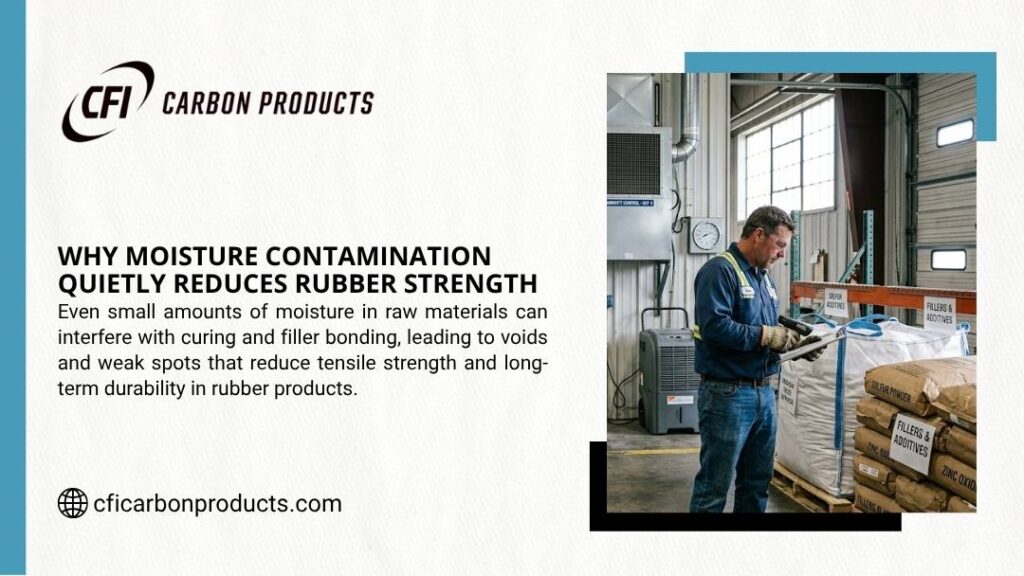
This is where theory meets reality. You can design the perfect formulation on paper, but if raw materials vary, tensile strength becomes unpredictable. Consistency in particle size, structure, and composition plays a major role in final performance.
Working with an experienced industrial carbon supplier ensures that every batch behaves the same way during mixing and curing. That consistency alone can improve tensile reliability without changing the formulation.
Beyond supply, access to technical formulation services allows manufacturers to refine compounds based on real testing rather than trial-and-error. In practice, the right supplier doesn’t just provide material; they reduce risk across production.
Industry Insight: Why Tensile Strength Fails in Real Production
In controlled lab conditions, rubber compounds often perform exactly as expected. But production tells a different story. Variations in mixing temperature, filler dispersion, and raw material consistency can reduce tensile strength by 15–30% in real manufacturing environments.
Research shows that tensile strength in filled elastomers is heavily affected by filler–rubber interactions, especially when reinforcing fillers such as carbon black are well dispersed and strongly bonded to the polymer matrix.
This explains why two formulations with identical ingredients can produce very different results. The difference isn’t just chemistry, it’s execution.
Manufacturers who consistently achieve high tensile strength focus on controlled dispersion, stable curing systems, and consistent filler quality. That combination, not just formulation, is what separates high-performance rubber products from average ones.
How Polymer–Filler Interaction Improves Tensile Properties
The strength of rubber doesn’t come from individual components; it comes from interaction. When reinforcing fillers bond effectively with polymer chains, they restrict chain movement under stress, which increases tensile strength and improves durability.
In natural rubber systems, this interaction is often enhanced by strain-induced crystallization. In synthetic rubber, it depends more heavily on filler structure and dispersion quality.
This is why reinforcing agents such as carbon black or advanced carbon alternatives remain essential in modern rubber compound design. They don’t just fill space; they actively strengthen the material at a molecular level.
FAQs About Rubber Tensile Strength
How to increase the tensile strength of rubber?
To increase the tensile strength of rubber, manufacturers typically use reinforcing fillers such as carbon-based materials, optimize the vulcanization system to control crosslink density, and ensure proper dispersion during mixing. These steps improve load distribution within the rubber compound and prevent early material failure.
What improves tensile strength the most in rubber?
The single most important factor in improving tensile strength is effective filler–polymer interaction. When reinforcing fillers are properly dispersed and bonded within the rubber matrix, they significantly increase strength and durability under stress.
How to improve rubber tensile strength at home?
Small improvements can come from better curing and avoiding overheating, but industrial-grade strength requires proper fillers and controlled vulcanization.
How to make rubber stronger?
Choose the right rubber matrix and reinforce it with suitable fillers and additives.
How do you make rubber more durable?
Control degradation through antioxidants and ensure uniform dispersion of reinforcing agents.
What chemical hardens rubber?
Sulfur is commonly used in vulcanization to create crosslinks that strengthen rubber.
Will WD-40 restore rubber?
No, it may temporarily soften the surface, but it does not restore structural strength.
What are the 4 ways to strengthen a material?
Improve composition, optimize structure, enhance processing, and use reinforcement.
Where Performance Meets Practical Results
Improving tensile strength isn’t just about formulation; it’s about choosing materials that perform consistently under real production conditions.
Manufacturers working to improve rubber tensile strength often see the biggest gains when they combine advanced reinforcing fillers, optimized curing systems, and controlled processing conditions.If you’re evaluating ways to improve both performance and cost efficiency, exploring specialized materials from experienced manufacturers like CFI Carbon Products can provide a measurable advantage, especially when consistency, scalability, and sustainability all matter.