
Easy-dispersing fillers for rubber wet out, break down to their working particle size, and spread evenly at normal mixer energy, without extra passes or a scorched batch. A filler earns that behavior through its physical shape and its surface chemistry.
The mixer then either protects that head start or wastes it. This guide ranks the common rubber fillers by how readily they disperse, then covers the process controls, the test methods, and the cost effects that follow from dispersion quality.
Article Summary
| Question | Short answer |
|---|---|
| What is an easy-dispersing filler for rubber? | A filler that wets out and breaks down to its primary aggregate size at normal mixer energy, a safe dump temperature, and a short cycle time. |
| What controls dispersion ease? | Particle size, surface area, structure (void volume), agglomerate strength, pellet or powder friability, moisture content, and how closely the filler surface matches the polarity of the elastomer. Loading level alone does not decide it. |
| Which rubber fillers disperse most easily? | Coarse mineral fillers and low-density coal-derived organic filler sit at the easy end, low-to-medium structure carbon black sits in the middle, and precipitated silica sits at the hard end unless a silane coupling agent is used. |
| Which process controls matter most? | Fill factor, addition order, the point at which oil enters the batch, rotor speed, and a dump temperature target in place of a fixed mix time. |
| How is dispersion measured? | Torn-surface reflected light rating, an optical dispersion index, thin-section microscopy, a DMA strain sweep, and viscosity consistency between batches. |
| What does better dispersion return? | Shorter cycles, fewer passes, lower energy per batch, less scrap and rework, and tighter physical property spread. |
What Makes a Rubber Filler Easy to Disperse
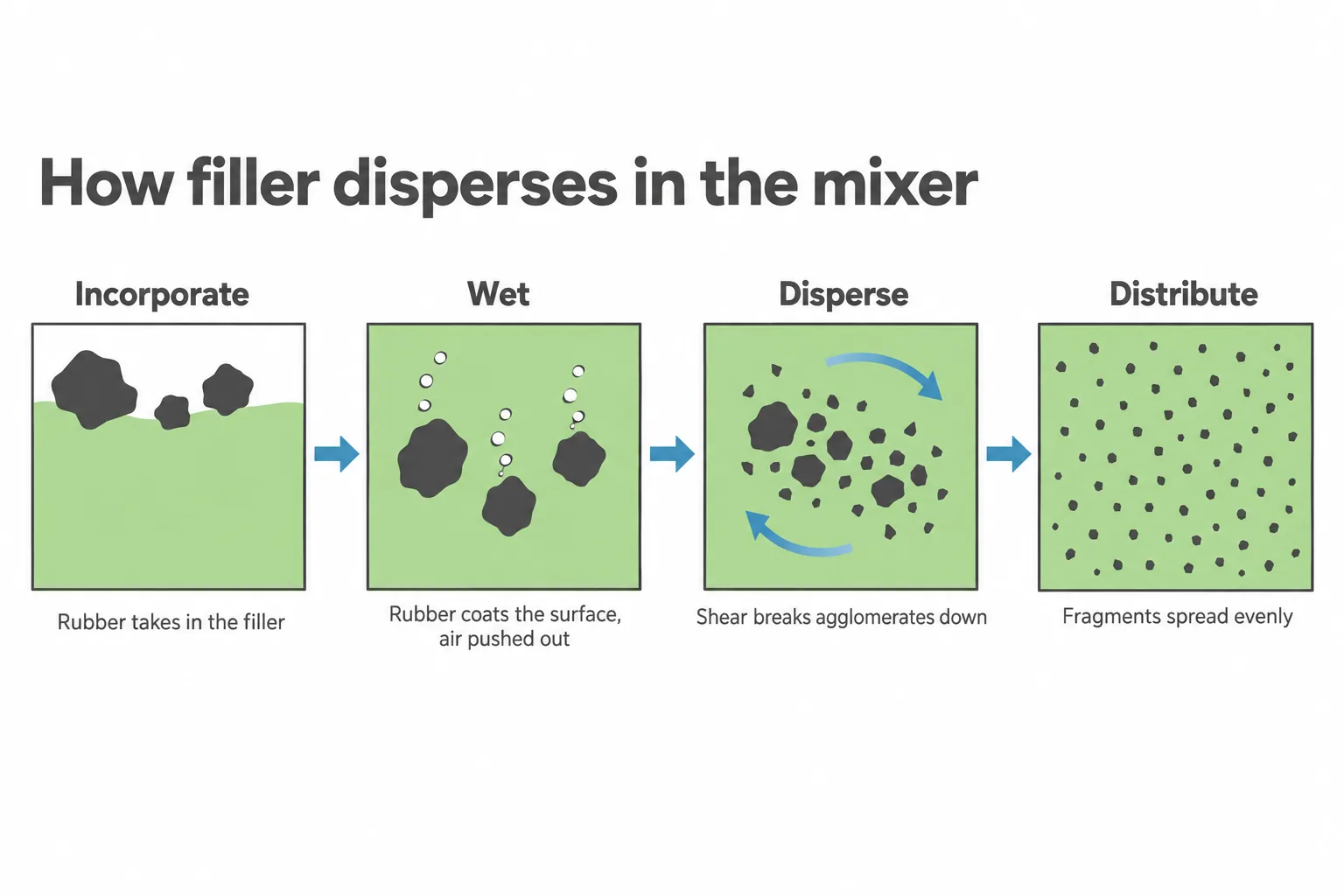
Inside an internal mixer, filler goes through four mechanical stages. First the rubber engulfs the powder or pellet, which is incorporation, and the time that takes is the incorporation time. Then polymer wets the filler surface and displaces trapped air.
Shear next ruptures the agglomerates down toward aggregate size. Finally the aggregates spread through the matrix. Filler dispersibility is the sum of those four stages. A filler that stalls at any one of them is a hard-dispersing filler, whatever the loading level says.
Compounders report two different things and often confuse them. Micro-dispersion is the breakdown of agglomerates into their primary aggregates. Macro-distribution is the uniform spread of those aggregates across the batch.
A stock can be well distributed and still carry hard undispersed lumps, and a stock with excellent micro-dispersion can still show streaks if the last pass ran too cold. Fixing the wrong one wastes a shift.
Related readingHigh-Performance Rubber Fillers: Types, Benefits & Sustainable AlternativesRead the guide →| Trait | Easy-dispersing end | Hard-dispersing end |
|---|---|---|
| Primary particle size | Coarser particles, lower surface energy per unit mass | Very fine particles with high specific surface energy |
| Surface area | Moderate | High, so more polymer must wet more surface in the same cycle |
| Structure and void volume | Lower, less occluded rubber, less viscosity rise | High structure, more occluded rubber, higher batch viscosity |
| Agglomerate strength | Friable, breaks under modest shear | Strongly bonded, often hydrogen bonded, resists rupture |
| Surface polarity | Close to the polymer, wets fast | Far from the polymer, self-associates instead of wetting |
| Moisture pickup | Low | High, which stiffens agglomerates and causes voids |
Particle Size, Surface Area, and Structure
Two numbers on a filler data sheet predict most of the mixing behavior. Surface area, reported as BET area, CTAB area, or iodine number, tells you how much filler surface the rubber has to coat.
Structure, reported as DBP oil absorption, tells you how open and branched the aggregates are. Higher values on either one mean more reinforcement potential and more mixing energy demand at the same time.
| Filler property | Effect on dispersion ease | Effect on reinforcement |
|---|---|---|
| Smaller primary particle size | Harder, needs more shear and longer wetting | Higher tensile and abrasion resistance |
| Higher surface area | Harder, viscosity climbs early in the cycle | More polymer contact, higher modulus |
| Higher structure (DBP) | Harder, occluded rubber raises viscosity and slows breakdown | Higher modulus and better green strength |
| Coarse, low-structure grade | Easier, incorporates and spreads quickly | Semi-reinforcing at best, used as an extender |
| Low specific gravity | Easier, more volume per pound at a given weight loading | Depends on particle geometry, not density alone |
High-structure grades carry rubber inside the aggregate voids, so effective polymer volume drops and compound viscosity rises well before the filler is fully broken down. That viscosity rise is why a high-structure batch runs hot and still shows lumps.
Grade choice is the first and cheapest dispersion decision, and the trade-offs across the common carbon black grades map closely onto mixing difficulty.
Surface Chemistry and Polymer Compatibility
Non-polar carbon surfaces wet readily in hydrocarbon elastomers such as natural rubber, SBR, and EPDM. Polar surfaces behave differently: silanol-rich silica prefers its own kind, so particles stay attached to each other rather than to the polymer.
That is why precipitated silica in a hydrocarbon rubber is normally paired with a silane coupling agent and a controlled temperature hold, and why silica-filled stocks need more process discipline than carbon-filled ones.
The balance between filler-filler interaction and filler-polymer interaction also decides what happens after the mixer. A compound can leave the mill looking clean and then flocculate during storage or in the early stage of cure, because the particles find each other again.
Bound rubber, the polymer fraction that stays attached to filler after solvent extraction, is the practical marker that filler-polymer contact won and the network will hold.
Moisture deserves its own line item. Damp mineral filler and damp silica form stiffer agglomerates, release water as steam at mixing temperature, and leave voids, blisters, and porosity behind. Dry storage and covered hoppers cost almost nothing and remove a whole category of dispersion complaints.
Easy-Dispersing Fillers for Rubber: Which Fillers Are Used and How They Rank
Carbon black is the most widely used filler for making rubber, followed by precipitated silica, calcium carbonate, kaolin and other aluminosilicate clays, talc, zinc oxide, and organic fillers such as finely ground bituminous coal.
Reinforcing fillers raise strength and abrasion resistance, semi-reinforcing fillers give part of that benefit at lower cost and easier mixing, and extenders mainly add volume and control cost.
| Filler | Typical role | Dispersion ease | Notes |
|---|---|---|---|
| Carbon black, tread grades (fine, high structure) | Reinforcing | Hard | Highest reinforcement, highest mixing energy, most sensitive to dump temperature |
| Carbon black, carcass and general purpose grades | Reinforcing to semi-reinforcing | Moderate | The everyday reference point for carbon black in rubber compounds |
| Carbon black, thermal and coarse grades | Semi-reinforcing | Easy | High loadings tolerated, low viscosity rise |
| Precipitated silica | Reinforcing | Hard without silane | Needs coupling chemistry and a silanization hold; prone to flocculation |
| Calcium carbonate | Extending | Easy | Cheap volume, little strength gain, keep it dry |
| Kaolin and aluminosilicate clay | Semi-reinforcing to extending | Easy to moderate | Calcined and surface-treated versions mix cleaner |
| Talc | Extending, barrier | Easy | Platy shape helps permeation resistance |
| Zinc oxide | Cure activator, minor filler | Moderate | Low loading, but poor dispersion shows up as uneven cure |
| Coal-derived organic filler | Semi-reinforcing, processing aid | Easy | Low specific gravity, acts as a mixing aid and helps air release |
| Recycled and bio-based fillers | Extending | Variable | Particle size spread and moisture drive the result |
Interest in carbon black alternatives and in eco friendly rubber keeps growing, and it changes the dispersion conversation. 7
Recovered carbon, ground reclaim, and plant-derived powders vary more batch to batch than a controlled furnace grade, so a formula that leaned on tight filler consistency needs new process limits before rubber alternatives can be qualified. Plan the sustainability move and the mixing schedule in the same review.
Why Dispersion Quality Decides Compound Performance
According to a conference paper on dispersive mixing of agglomerates, archived by MINES ParisTech:
> “It is well established that the degree of filler dispersion has a major influence on the physical properties of rubber compounds. Typical fillers, e.g. carbon black and silica, are difficult to disperse, particularly if they are fine and low structured. As a result, the quantity of undispersed fillers generally amounts for 1% to 10% of the compound and higher in some other cases.”
Undispersed filler, usually in the form of hard agglomerates, is a stress concentrator sitting inside a part that flexes millions of times. Tensile strength, tear resistance, flex fatigue life, and cut growth resistance fall first, usually before anything looks wrong on a durometer check.
| Dispersion defect | Property lost first | Field symptom |
|---|---|---|
| Hard agglomerates left in the matrix | Tear strength, fatigue life | Early cracking at flex points |
| Trapped air and moisture voids | Tensile strength, sealing | Blisters, porosity, leaks |
| Filler-rich and filler-lean streaks | Modulus consistency | Dimensional drift, uneven cure state |
| Over-mixed, over-heated batch | Cure safety, elongation | Scorch, rough extrudate, short scorch time |
| Surface agglomerates on calendered sheet | Appearance, weathering | Rough surface, early chalking or crack initiation |
As filler content rises, particles begin to touch and form continuous paths through the rubber. Past that percolation threshold, stiffness jumps and electrical behavior changes. Does carbon conduct electricity inside a compound?
Carbon black itself conducts, but a filled rubber only conducts once dispersion and loading combine to build a continuous network, and too much shear at the wrong stage breaks that same network.
The conductive behavior of carbon fillers is a dispersion outcome as much as a material property. Color follows the same logic, since carbon-based fillers read deep black and serve as the pigment in black stocks, so poor dispersion shows as gray streaking.
Dynamic behavior tells the same story. Poorly dispersed stocks show a stronger Payne effect, the drop in storage modulus as strain amplitude rises.
Modeling work on filled rubbers ties that softening to partially reversible breakdown and re-aggregation of filler-filler bonds, so the size of the drop reads as a report on the filler network. Higher hysteresis means more heat build-up, and heat build-up shortens the life of a mount, a hose, or a belt cover.
Mix Process Controls That Improve Filler Dispersion
Work the controls in order of leverage, since process sets how much of a filler’s dispersibility you actually get.
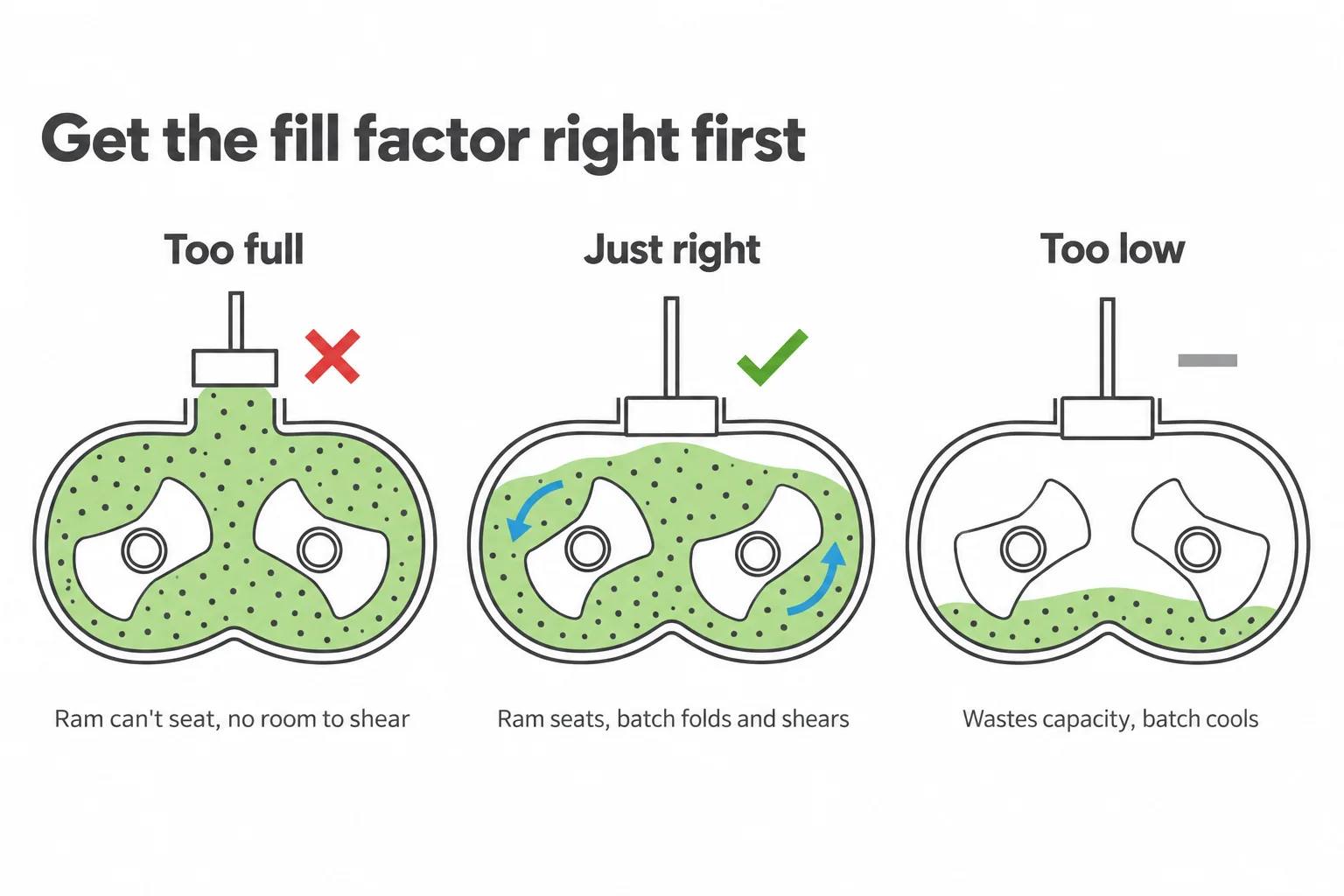
Fill factor and addition order come first, because no amount of extra mixing time fixes a chamber too full to shear. Practical detail on process sequence and common corrections sits in this guide to better filler dispersion in rubber.
| Control variable | Usual direction of change | Risk if overdone |
|---|---|---|
| Fill factor | Reduce until the ram seats and the batch folds | Too low wastes capacity and cools the batch |
| Ram pressure | Raise for high-loading stocks | Excess power draw, motor trips |
| Rotor speed | Raise early for breakdown, drop late for control | Runaway temperature, scorch |
| Addition order | Feed polymer, then filler in stages | Long cycles if staged too finely |
| Upside-down mix | Filler and oil charged first, polymer last | Poor incorporation with soft polymers |
| Oil addition timing | Delay until the filler is incorporated | Late oil leaves the batch hot and stiff |
| Number of passes | Two passes for high surface area systems | Extra passes cost energy and heat history |
| Dump temperature | Set a target and hold it | Too high scorches sulfur-cured stock |
| Cooling and rest between passes | Allow full cool to a set temperature | Long queues tie up floor space |
| Two-roll mill finish | Use for homogenization, not for breakdown | Mill work alone will not rupture hard agglomerates |
Oil added too early is the most common self-inflicted error. Oil lubricates the polymer, shear collapses, and agglomerates get locked in place inside a soft batch that feels finished. The temperature window is the second. Enough heat to soften the polymer helps wetting, and too much heat costs cure safety.
Shops running small mixers or high-surface-area fillers often get further with a two-pass schedule or a pre-dispersed masterbatch than with a longer single pass. A dispersing aid such as a zinc soap or fatty acid ester can also speed wetting.
Common Production Mistakes That Wreck Uniform Dispersion
| Mistake | What the operator sees | Corrective action |
|---|---|---|
| Overfilled chamber | Ram rides high, low power draw, lumpy dump | Cut batch weight, recheck fill factor against rotor wear |
| Worn rotor tips, enlarged clearances | Longer cycles for the same dispersion rating | Measure clearance, schedule rebuild |
| Inconsistent bale temperature | Batch-to-batch viscosity swing | Condition bales in a set temperature room |
| Feed hopper carryover | Off-color streaks, stray agglomerates | Clean between compounds, dedicate hoppers |
| Moisture in mineral filler bags | Porosity, blisters, steam at dump | Dry storage, sealed pallets, first-in first-out |
| Weighing drift | Slow property trend across a week | Calibrate scales, log every batch |
| Hot batch straight to the mill | Sticky sheet, scorch, poor sheet quality | Cool to a set temperature before milling |
| Heavy reclaim or recycled rubber addition | High viscosity that masks dispersion faults | Qualify reclaim separately, retest dispersion index |
One quality habit beats the rest: a fixed dump temperature target is a better instruction than a fixed mixing time, because it adapts to bale temperature, ambient conditions, and rotor wear on its own.
Coupling Agents, Process Aids, and Other Rubber Additives
Beyond fillers, a rubber compound normally carries process oils or plasticizers, a cure system with accelerators, antidegradants, coupling agents, process aids, pigments, and sometimes blowing agents. Each class has a dispersion side effect worth knowing.
| Additive class | Function | Effect on dispersion |
|---|---|---|
| Fillers | Reinforcement, volume, cost control | Set the ceiling for what mixing can achieve |
| Process oils and plasticizers | Soften, lower viscosity, aid flow | Help late, hurt early if added too soon |
| Cure system, sulfur or peroxide | Crosslink the network | Poor dispersion of curatives gives uneven cure |
| Accelerators | Control cure rate and scorch safety | Heat from long mixing eats scorch time |
| Antidegradants | Ozone, heat, and flex protection | Low loading, blooms if badly dispersed |
| Silane coupling agents | Bond silica to hydrocarbon rubber | Require a temperature hold to react properly |
| Process aids, zinc soaps, fatty acid esters | Lower viscosity, speed wetting | Improve flow, can hurt cure if overdosed |
| Blowing agents | Cellular structure | Need uniform dispersion or cells go irregular |
| Pigments | Color | Agglomerates show as visible specks |
Compounders who buy rubber additives usually buy from the same shelves as the coatings and plastics side of the plant, so the language overlaps: industrial additives, specialty additives, polymer processing additives, polyurethane additives for cast parts, and adhesive additives for bonded assemblies.
The dispersion logic carries across those families, since a powder that resists wetting in rubber tends to resist wetting in a resin or a paint system too.
How to Measure Dispersion, Not Guess It
Most dispersion arguments end the moment someone produces a number. Carbon black dispersion in rubber has a published test standard, the ASTM D2663 test methods for carbon black dispersion, and that designation is enough for any rubber lab to quote the work.
For silica and mineral fillers, ASTM D7723 measures macro-dispersion from the surface roughness of a freshly cut sample and reports a dispersion index.
| Method | What it detects | Lab time | When to use it |
|---|---|---|---|
| Torn-surface reflected light rating | Macro-dispersion, visible agglomerates | Minutes | Shop floor check every shift |
| Optical surface topography dispersion index (ASTM D7723) | Numeric macro-dispersion score | Under an hour | Formula and process qualification |
| Thin-section transmission microscopy | Micro-dispersion, aggregate scale | Hours to days | Root cause work on failures |
| DMA strain sweep for the Payne effect | Filler network state, hysteresis | Hours | Dynamic parts, heat build-up problems |
| Mooney viscosity and rheometer consistency | Batch-to-batch process drift | Minutes | Routine release testing |
| Extrudate or calendered surface rating | Surface defects that reach the customer | Minutes | Sheet and profile lines |
| Electrical resistivity check | Continuity of the conductive network | Minutes | Conductive and antistatic stocks |
For conductive compounds, resistivity doubles as an indirect dispersion probe, since network continuity is sensitive to how far agglomerate breakdown has gone.
Background on the resistivity of carbon fillers helps set realistic pass limits before a line starts. A workable routine is one in-process check per shift and one lab dispersion rating per formula or process change.
A Low-Density Organic Filler That Mixes Faster
CFI Carbon Products, founded in 1987, manufactures Austin Black 325 at facilities in West Virginia and Virginia. It is a finely divided powder made from high-quality, low-volatile bituminous coal, and its low specific gravity is the property that matters most to a mixing room.
In rubber compounds it works as a mixing aid and helps air release during mixing, which cuts bubble and blister problems, as described on CFI’s page for the rubber industry.
| Buyer concern | How a low-density organic filler addresses it |
|---|---|
| Mix cycle time | Acts as a mixing aid, so incorporation and air release happen faster |
| Part weight | Low specific gravity reduces end-product weight at equal volume |
| Surface finish | Fewer trapped-air defects means cleaner sheet and profile surfaces |
| Cost per volume | More filler volume per pound than denser fillers |
| Emissions profile | Production runs with low CO2 emissions, useful for sustainability reporting |
Those are processability and weight benefits, not a substitute for a reinforcing grade in a high-abrasion tread. The practical use is as one of the easy-dispersing fillers for rubber inside a filler system, where it carries volume and mixing behavior while a reinforcing filler carries strength.
Easy-Dispersing Fillers for Rubber by Application
| Application | Dominant filler system | Why dispersion matters most here |
|---|---|---|
| EPDM single-ply roofing membrane | Carbon black plus mineral extenders and organic filler | Calendered sheet must be defect free across a wide web, and surface agglomerates become weather-exposed crack starters |
| Tire tread and sidewall | Fine carbon black, silica with silane | Rolling resistance, wear, and heat build-up all track the filler network state |
| Automotive seals, hoses, and mounts | General purpose carbon black, mineral fillers, low-density organic filler | Fatigue life and weight reduction, the two reasons easy-dispersing fillers show up in car part formulas |
| Conveyor belt covers | Carbon black at moderate structure | Cut and gouge resistance fails fast around undispersed lumps |
| Molded industrial goods | Extenders plus semi-reinforcing filler | Flow, cure uniformity, and cost per part |
Roofing is the clearest case. Wide sheet, long exposure, and visible surface quality mean a single agglomerate population can fail an entire run, which is why easy-dispersing fillers for rubber roof stocks are specified on dispersion behavior as much as on reinforcement. Formulation notes for rubber roofing material cover that balance in more detail.
What Better Dispersion Returns on Cost
| Cost lever | Mechanism | Where the plant sees it |
|---|---|---|
| Shorter mix cycles | Faster incorporation and breakdown, shorter mix cycle time | Throughput per mixer per shift |
| Fewer passes | One well-controlled pass instead of two | Energy and labor per batch |
| Lower scrap and rework | Fewer surface and porosity rejects | Scrap rate, first-pass yield |
| Stable properties | Tighter spread on tensile and modulus | Fewer hold lots, less retesting |
| Volume-based filler buying | Low-density filler covers more volume per pound | Raw material spend |
| Longer part life | Fewer stress concentrators in service | Warranty and returns |
Filler pricing moves with energy and feedstock markets, so a formula costed only on price per pound can mislead. What a compound consumes is volume, which is why cost per unit volume is the fair comparison, especially for easy-dispersing fillers for rubber that are also low in density.
If a dispersion or weight target is already on your plate, CFI’s technical services cover formula testing, lab sampling, toll grinding, and custom packaging, so a candidate filler can be trialed against your own mix cycle before anything changes on the production floor.
Key Takeaways
| Statement | Practical action |
|---|---|
| Filler choice sets the dispersion ceiling | Check surface area, structure, and density before blaming the mixer |
| Process decides how close you get to that ceiling | Fix fill factor and addition order first, cycle time last |
| Oil timing is the most common error | Hold oil until filler is incorporated |
| Temperature control beats time control | Mix to a dump temperature target, not a clock |
| Polar fillers need coupling chemistry | Budget a silanization hold for silica systems |
| Measurement is the cheapest fix available | One shop-floor rating per shift, one lab index per change |
| Low-density fillers change the cost math | Compare cost per volume, not cost per pound |
Frequently asked questions
What is rubber compounding?
What is the chemical compound for rubber?
Which filler disperses easiest in rubber?
Can a filler be too easy to disperse?
Do easy-dispersing fillers for rubber lower mixing cost?
How do you measure filler dispersion in rubber?
Do easy-dispersing fillers work in eco friendly rubber formulations?
Talk Through Your Compound With CFI
Send your formula and target properties, and CFI’s technical team will look at where dispersion, weight, or cycle time can move. Request a lab sample of Austin Black 325 to run against your own mixer schedule. Technical data sheets, FAQs, and further reading sit in the resources index.